
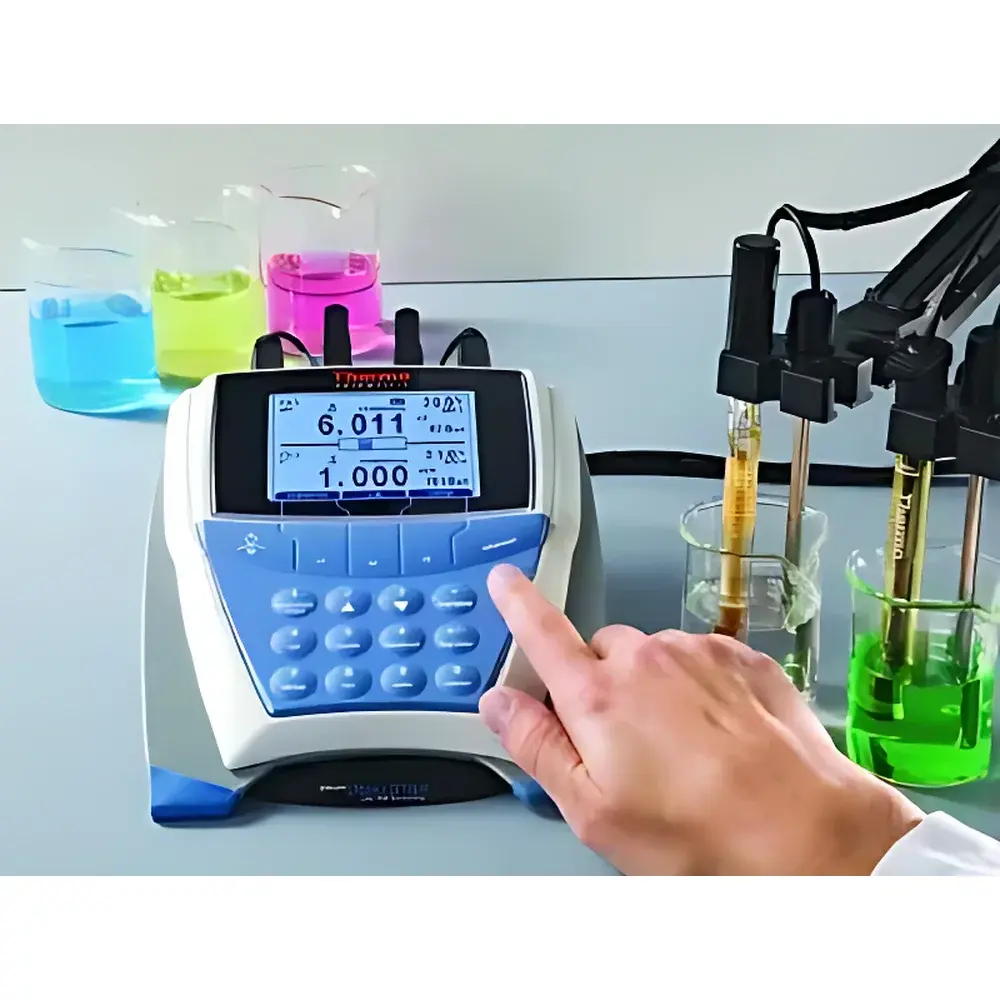
Thermo Fisher Scientific Orion Dual Star D10P-70 Residual Chlorine and Chlorine Dioxide Analyzer
| Brand | Thermo Fisher Scientific |
|---|---|
| Origin | USA |
| Manufacturer Type | Original Equipment Manufacturer (OEM) |
| Product Category | Imported Instrument |
| Model | D10P-70 |
| Pricing | Available Upon Request |
| Electrode | 9770BNWP Free Chlorine Sensor |
| Measurement Range (Cl₂) | 0.01–20 ppm |
| Detection Limit | 3 × 10⁻⁷ M |
| pH Range | 0–14 |
| Temperature Range (Continuous) | 0–50 °C |
| Temperature Range (Intermittent) | 50–100 °C |
| Repeatability | ±2% |
| Electrode Slope | 28 ± 2 mV/decade |
| Electrode Dimensions | 110 mm length, 12 mm body diameter, 16 mm cap diameter |
| Cable Length | 1 m |
| Dual Channel Capability | pH + ISE (e.g., Cl₂, NH₄⁺, F⁻, Na⁺, K⁺, Br⁻, NO₃⁻) |
| Ion Concentration Range | 0–19999 (units: ppm, mg/L, M, %, or unitless) |
| Resolution | 1–3 significant digits |
| Accuracy (Ion) | ±0.1 mV or ±0.05% (whichever is greater) |
| pH Range | −2.000 to 19.999 |
| pH Resolution | 0.001 |
| pH Accuracy | ±0.001 |
| ORP Range | ±1999.9 mV |
| ORP Resolution | 0.1 mV |
| Temperature Range | −5 to 105 °C |
| Temp Accuracy | ±0.1 °C |
| Display | Dual-channel LCD |
| Interfaces | Dual BNC, Dual Reference, Dual MiniDIN (for ATC probes) |
| Methods Stored | 20 |
| Data Storage | 1000 entries with timestamp |
| GLP Compliance | Yes (audit trail, user password, method-level security) |
| Connectivity | RS232 (bidirectional), optional USB cable |
| Enclosure Rating | IP54 |
| Certifications | CE, CSA, UL, TÜV, FCC Class A |
| Power | 4×AA batteries or universal AC adapter |
| Dimensions | 9.4 × 17.0 × 22.4 cm (H × W × L) |
Overview
The Thermo Fisher Scientific Orion Dual Star D10P-70 Residual Chlorine and Chlorine Dioxide Analyzer is a dual-channel benchtop electrochemical measurement system engineered for precise, trace-level quantification of free chlorine (as Cl₂) in drinking water, wastewater, cooling towers, swimming pools, and disinfection process streams. It operates on the amperometric principle using the 9770BNWP membrane-covered chlorine-selective electrode, which generates a current proportional to the concentration of dissolved hypochlorous acid (HOCl) — the dominant active species in chlorinated aqueous systems at typical pH values. The instrument simultaneously measures pH and temperature to enable real-time compensation of the HOCl/OCl⁻ equilibrium, ensuring accuracy across variable sample matrices. Unlike colorimetric methods requiring reagents and optical path calibration, this potentiometric–amperometric hybrid platform delivers stable, interference-resistant measurements without routine photometric recalibration or complex digestion steps.
Key Features
- Dual-channel architecture supports concurrent measurement of residual chlorine and pH (or second ion such as NH₄⁺, F⁻, or NO₃⁻) — eliminating sequential analysis delays and enabling dynamic process correlation.
- Integrated automatic temperature compensation (ATC) via 927007MD thermistor probe ensures accurate activity-based concentration reporting across 0–50 °C continuous operation (intermittent up to 100 °C).
- GLP-compliant data management includes time-stamped storage of 1000 readings, user-defined method passwords, audit-trail-enabled calibration logs, and electronic signature support per FDA 21 CFR Part 11 requirements.
- Advanced calibration routines include single/dual standard addition/subtraction, automatic blank correction, and graphical calibration curve visualization — critical for low-concentration samples with matrix effects.
- Rugged IP54-rated enclosure meets industrial laboratory and field-deployable environmental monitoring needs; certified to CE, UL, CSA, TÜV, and FCC Class A electromagnetic compatibility standards.
- Expandable method library (20 stored protocols) accommodates multi-analyte workflows, including simultaneous Cl₂/pH titration control or sequential disinfectant residual profiling.
Sample Compatibility & Compliance
The D10P-70 is validated for use with potable water, secondary effluent, seawater-impacted brackish sources, and high-TDS industrial recirculating systems. Its 9770BNWP electrode exhibits minimal interference from common anions (Cl⁻, SO₄²⁻, NO₃⁻) and oxidants (e.g., ozone, H₂O₂) when operated within specified pH (0–14) and temperature ranges. The system complies with ASTM D1253 (Standard Test Method for Determining Residual Chlorine in Water), ISO 7393-2 (Electrochemical determination of free chlorine), and US EPA Method 334.0 (Amperometric Titration for Total Residual Chlorine). All firmware and calibration procedures are designed to satisfy GLP and GMP documentation requirements, including full traceability of electrode lot numbers, standard batch certifications (e.g., 977007 iodate reference standard), and user-action timestamps.
Software & Data Management
Data acquisition and reporting are managed through the built-in dual-channel interface with bidirectional RS232 communication. Optional USB connectivity enables firmware updates and direct export of CSV-formatted datasets to LIMS or Excel-compatible platforms. Each stored reading includes sample ID, date/time stamp, measured mV, compensated concentration (ppm Cl₂), pH, temperature, electrode slope (%), and calibration status flag. The instrument supports configurable data output formats and auto-export triggers upon completion of defined method sequences. All calibration events — including buffer recognition (NIST, DIN, US), slope verification, and drift assessment — are logged with operator ID and timestamp, fulfilling regulatory expectations for analytical instrument qualification under ISO/IEC 17025 and FDA 21 CFR Part 11.
Applications
- Drinking water treatment plants: Real-time monitoring of chlorine residual at entry points, distribution nodes, and endpoint taps to verify CT compliance per WHO and US EPA guidelines.
- Wastewater disinfection validation: Quantitative assessment of post-secondary effluent chlorine decay kinetics and breakpoint chlorination optimization.
- Pharmaceutical water systems: USP and EP 2.2.27-compliant residual oxidant verification in purified water and water-for-injection loops.
- Food & beverage processing: Sanitizer concentration control in CIP rinse cycles and surface contact water testing.
- Swimming pool & spa management: Regulatory compliance reporting for state health departments requiring daily residual logbooks with GLP-grade metadata.
- Research laboratories: Kinetic studies of chlorine demand, chloramine formation pathways, and disinfectant byproduct precursor interactions.
FAQ
What is the detection limit for free chlorine using the 9770BNWP electrode?
The lower detection limit is 0.01 ppm (3 × 10⁻⁷ M) under optimized conditions with proper electrode conditioning and zero-current amperometric mode.
Can the D10P-70 measure combined chlorine (chloramines)?
No — the 9770BNWP electrode is selective for free chlorine (HOCl/OCl⁻); combined chlorine requires separate analysis via DPD colorimetry or differential amperometry with chemical reduction.
Is temperature compensation mandatory for accurate Cl₂ readings?
Yes — because the HOCl ⇌ OCl⁻ equilibrium is highly pH- and temperature-dependent, ATC via the 927007MD probe is required for trace-level accuracy across variable sample conditions.
How often should the 9770BNWP electrode be recalibrated?
Calibration frequency depends on usage intensity and regulatory requirements; daily calibration is recommended for routine QC, with slope verification before each analytical batch per ISO 7393-2 Annex B.
Does the instrument support automated sampling integration?
Yes — the D10P-70’s RS232 interface and programmable method triggers allow seamless integration with third-party autosamplers (e.g., Gilson XYZ series) via ASCII command protocol.
Are replacement membranes and electrolyte solutions available separately?
Yes — Thermo Fisher part numbers 977001 (membrane kit), 977002 (electrolyte refill solution), and 977003 (electrode polishing kit) are stocked globally through authorized distributors.
Related Products







