
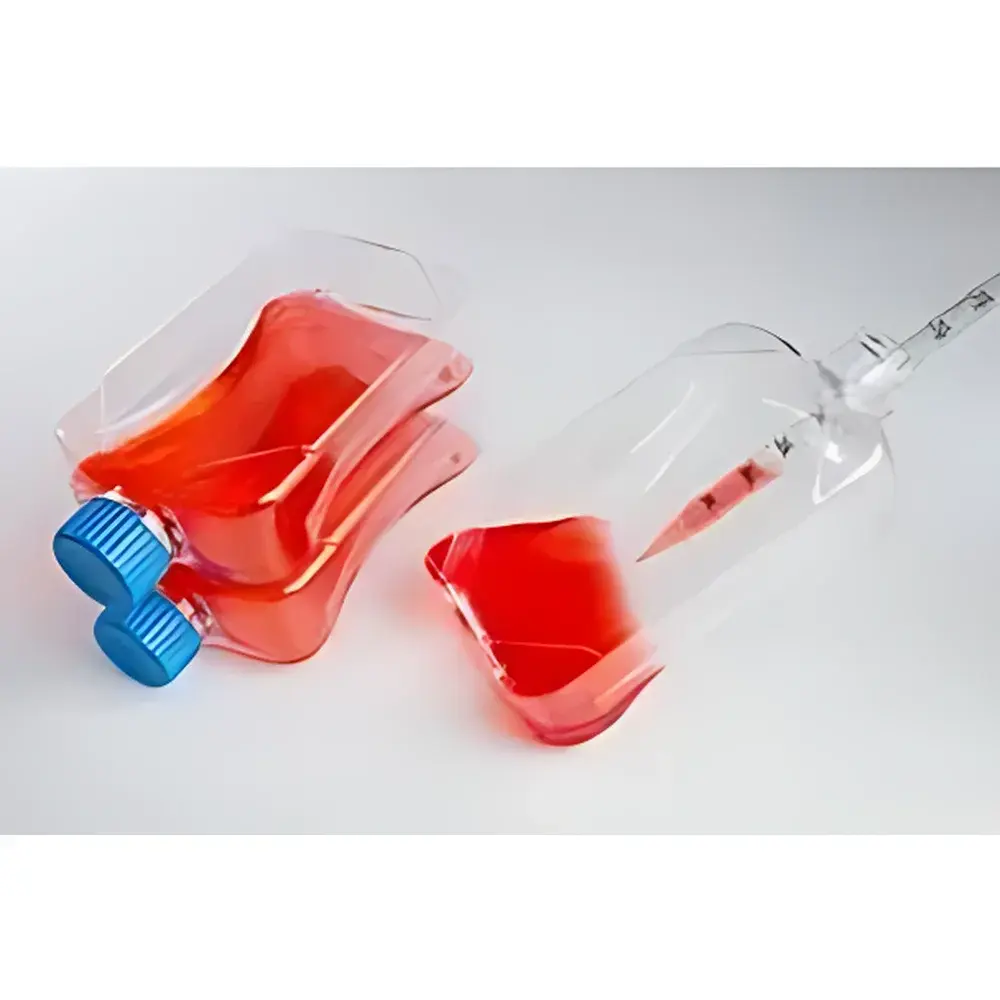
Nunc 300 cm² Cell Culture Flask
| Brand | Thermo Fisher Scientific |
|---|---|
| Origin | USA |
| Manufacturer | Thermo Fisher Scientific |
| Product Type | Imported |
| Model | Nunc™ 300 cm² |
| Sterilization | Gamma-irradiated, Non-pyrogenic |
| Surface Treatment | Tissue Culture-Treated (TC-treated) |
| Total Capacity / Working Volume | 1900 mL / 400 mL |
| Cap Options | Vent Cap (透气盖), Plug Seal Cap (密闭盖), Filter Cap (0.2 µm PES membrane) |
| Packaging | 1 flask per pack, 12 packs per case |
| Stackable Design | Yes |
| Ergonomic Grip | Molded finger groove for secure handling |
| Surface Area | 300 cm² |
Overview
The Nunc™ 300 cm² Cell Culture Flask is a high-capacity, tissue culture-treated polystyrene vessel engineered for scalable adherent cell expansion in controlled incubator environments. Designed to meet the rigorous demands of primary cell isolation, bioproduction seed train development, and large-scale transfection workflows, this flask leverages optimized surface chemistry—corona discharge or plasma treatment—to ensure consistent, high-efficiency cell attachment and monolayer formation. Its geometry supports uniform gas exchange and nutrient distribution under standard CO₂ incubation (5% CO₂, 37°C, humidified), while the low-profile base minimizes shear stress during medium aspiration and reduces residual volume retention. As part of Thermo Fisher Scientific’s Nunc portfolio, the 300 cm² flask complies with ISO 5–8 cleanroom manufacturing standards and undergoes full batch traceability per ISO 13485 quality management systems.
Key Features
- Tissue Culture-Treated Surface: Hydrophilic modification ensures reproducible attachment and proliferation of sensitive cell lines—including human mesenchymal stem cells (hMSCs), HEK293, and primary neurons—without requiring additional coating steps.
- Gamma-Irradiated & Certified Non-pyrogenic: Sterilized at ≥25 kGy dose; endotoxin levels ≤0.03 EU/mL (LAL assay), validated per USP and EP 2.6.14.
- Optimized Ventilation Architecture: The vent cap integrates a hydrophobic 0.2 µm polyethersulfone (PES) membrane enabling continuous CO₂/O₂ exchange while preventing microbial ingress—critical for long-term cultures exceeding 72 hours.
- Ergonomic Handling System: Molded finger grooves and tapered sidewalls facilitate secure grip and stable stacking up to 10 flasks—even when wearing nitrile gloves—reducing workflow disruption in biosafety cabinets.
- Precision Volume Calibration: Internal graduated markings (50–400 mL) allow rapid, visual estimation of working volume without reliance on external measuring devices—supporting GLP-aligned documentation practices.
- Chemical Resistance & Clarity: Medical-grade polystyrene offers compatibility with common disinfectants (70% ethanol, 0.5% sodium hypochlorite) and provides optical clarity for phase-contrast microscopy monitoring.
Sample Compatibility & Compliance
The Nunc 300 cm² flask supports adherence-dependent mammalian, insect, and certain avian cell types. It is routinely validated for use in applications governed by FDA 21 CFR Part 11-compliant workflows when integrated with electronic lab notebook (ELN) systems. All lots are supplied with Certificate of Analysis (CoA) listing bioburden, endotoxin, cytotoxicity (ISO 10993-5), and extractables data. The flask meets ASTM F2774–19 for plastic containers used in cell therapy manufacturing and is compatible with automated liquid handlers (e.g., Tecan Freedom EVO) via standardized footprint alignment.
Software & Data Management
While the flask itself is a passive consumable, its integration into digital lab ecosystems is enabled through Thermo Fisher’s SampleManager LIMS and Biosafety Cabinet Log modules. Batch-specific lot numbers link directly to raw material traceability databases, supporting audit readiness for ISO 9001, ISO 13485, and GMP Annex 1 inspections. QR-coded labels (optional upon request) permit scan-to-record functionality in electronic batch records (EBRs), satisfying ALCOA+ data integrity principles.
Applications
- Seed train expansion for monoclonal antibody production in CHO-K1 and CHOK1SV cell lines.
- Preclinical scale-up of induced pluripotent stem cells (iPSCs) prior to cryopreservation or differentiation protocols.
- High-yield viral vector amplification (e.g., AAV, lentivirus) under serum-free or chemically defined media conditions.
- Toxicity screening assays requiring ≥1 × 10⁷ confluent cells per replicate (e.g., OECD TG 442D).
- 3D co-culture models where surface area enables stratified layer formation before scaffold transfer.
FAQ
Is the Nunc 300 cm² flask suitable for suspension cell culture?
No—it is specifically designed for adherent cell growth; suspension cultures require alternative vessels such as shaker flasks or bioreactor-compatible bags.
Can the flask be reused after autoclaving?
No—gamma irradiation is a single-use sterilization method; autoclaving compromises polystyrene integrity and surface treatment efficacy.
What is the maximum recommended centrifugation speed for this flask?
Not applicable—this is a static culture vessel; centrifugation requires transfer to conical tubes rated for respective RCF values.
Does the filter cap retain humidity during extended incubation?
Yes—the hydrophobic PES membrane maintains internal humidity >95% RH over 120-hour periods under standard incubator conditions, as verified by gravimetric moisture loss testing.
Are custom labeling or bulk packaging options available?
Yes—Thermo Fisher offers OEM labeling, barcoded lot tracking, and case configurations ranging from 12 to 96 units per shipping carton, subject to minimum order quantities.




