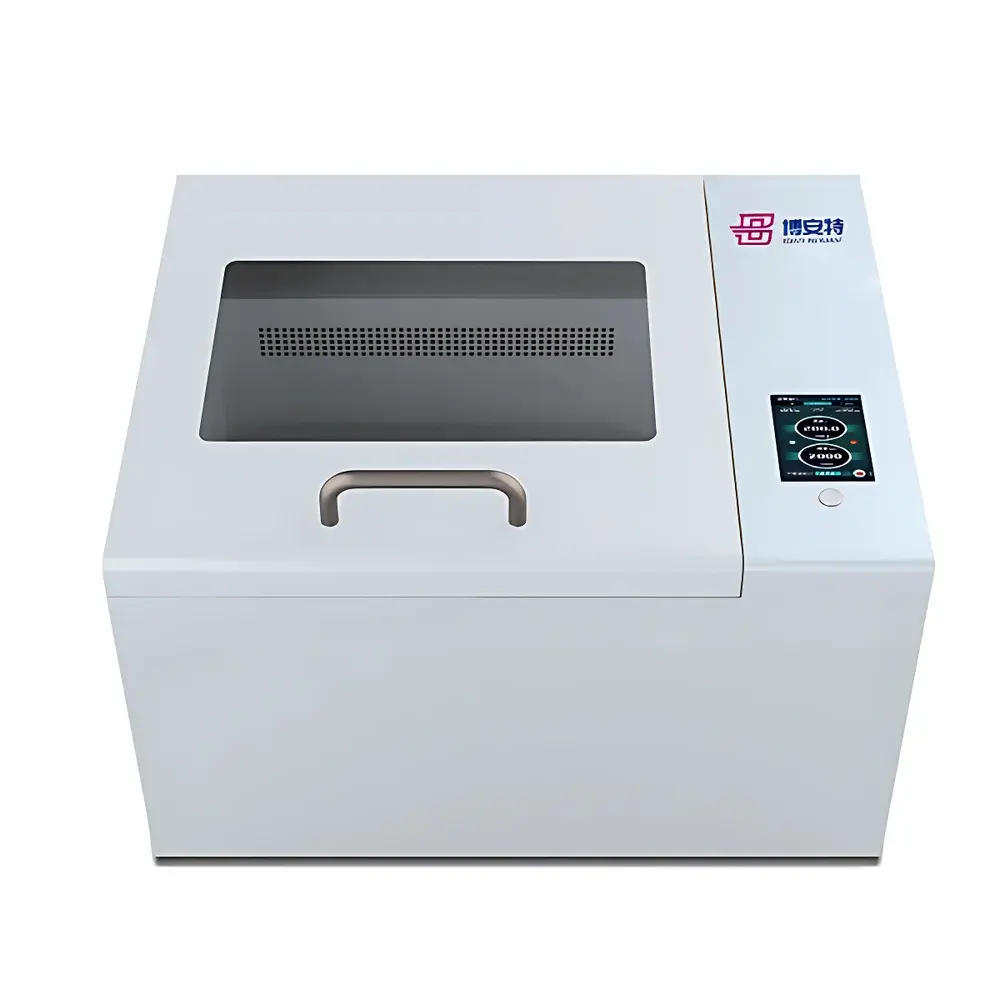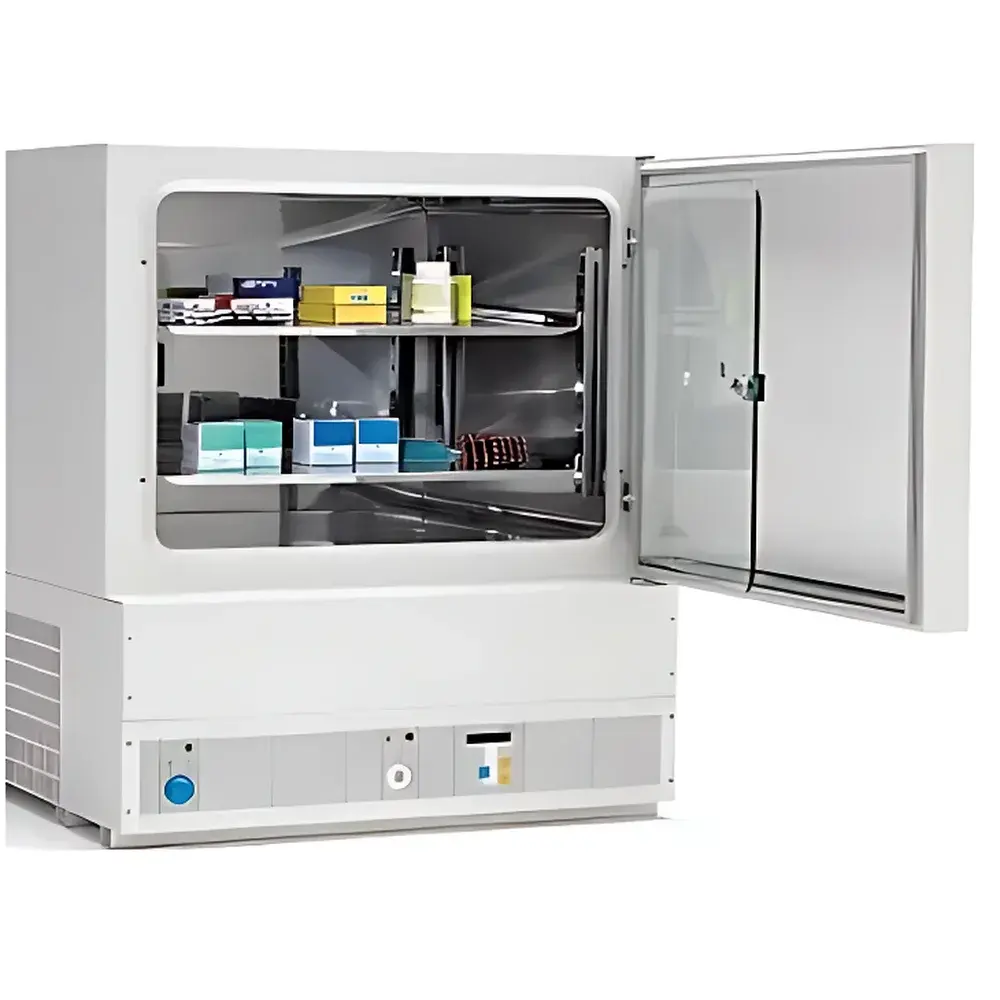
Thermo Scientific Heraeus BK6160 Low-Temperature Biochemical Incubator
| Brand | Thermo Fisher Scientific |
|---|---|
| Origin | USA |
| Manufacturer | Thermo Fisher Scientific |
| Product Type | Imported |
| Model | Heraeus BK6160 Low-Temperature |
| Internal Volume | 166 L |
| Temperature Range | 0–50 °C |
| Temperature Uniformity | ±0.8 °C |
| Temperature Stability | ±0.1 °C |
| Air Circulation Rate (with optional fan) | 150 L/h |
| Relative Humidity | >75% at 5 °C, >90% at 37 °C |
| Shelving | 2 standard / up to 7 |
| External Dimensions (W×D×H) | 744 × 920 × 725 mm |
| Internal Dimensions (W×D×H) | 607 × 470 × 585 mm |
| Refrigerant | R134a, 220 g |
| Illumination | 4000 lux (4 lamps, 70 W total) |
| Power Supply | 230 V, 50/60 Hz |
| Weight (with lighting / without) | 120 kg / 100 kg |
| Controller Options | Kelvitron K / KP / KL microprocessor-based units |
Overview
The Thermo Scientific Heraeus BK6160 Low-Temperature Biochemical Incubator is an engineered platform for precise, stable, and reproducible environmental control in life science laboratories. Designed around a robust refrigeration architecture using R134a refrigerant and a high-efficiency insulated chamber with multi-layer thermal barrier construction, the BK6160 maintains tight temperature regulation across its full operational range of 0–50 °C. Its core function is to support long-term cell culture, microbial growth, enzyme kinetics, and biochemical assay development under controlled low-temperature conditions—where even minor thermal fluctuations can compromise experimental integrity. Unlike general-purpose incubators, the BK6160 integrates advanced microprocessor-based control logic (Kelvitron series), active humidity retention via integrated water reservoirs, and optimized airflow management to ensure spatial uniformity (±0.8 °C) and temporal stability (±0.1 °C) — critical parameters for GLP-compliant workflows and ISO 17025-accredited testing environments.
Key Features
- Triple-controller flexibility: Choose between Kelvitron K (basic setpoint control), KP (10-step programmable ramping, including time-dependent temperature profiles), or KL (advanced diurnal cycle simulation with dual-zone light/temperature scheduling)
- High-fidelity thermal uniformity: Achieved through double-wall vacuum-insulated construction, rear-mounted forced-air convection (optional internal fan, 150 L/h), and precision PID-driven compressor modulation
- Humidity preservation system: Stainless-steel water reservoir maintains ≥90% RH at 37 °C and ≥75% RH at 5 °C—minimizing sample desiccation during extended incubations
- Hygienic interior design: Seamless 304 stainless-steel chamber with radius-rounded corners, non-porous surfaces, and removable shelves (2 standard, expandable to 7) for autoclave-compatible cleaning
- Integrated illumination: Four 4000-lux cold-white LED lamps (70 W total) provide uniform, non-thermal photostimulation; compatible with circadian rhythm studies and photobiological assays
- Compliance-ready connectivity: Optional RS232 port enables integration with LIMS or SCADA systems; supports third-party data logging software compliant with FDA 21 CFR Part 11 audit trail requirements
Sample Compatibility & Compliance
The BK6160 accommodates standard tissue culture flasks (T25–T225), Petri dishes, multiwell plates (6–96-well), and microbiological tubes—compatible with both aerobic and microaerophilic protocols. Its temperature profile fidelity meets ASTM E145-22 (Standard Specification for Gravity-Convection and Forced-Ventilation Ovens) and ISO 2859-1 sampling plans for environmental validation. The unit is designed and validated per IEC 61010-1 for laboratory equipment safety and conforms to UL 61010-1 and EN 61010-1. For regulated environments, optional controller firmware supports electronic signature capture, user-level access control, and immutable event logging—facilitating alignment with GMP Annex 11 and EU GMP Chapter 4 documentation standards.
Software & Data Management
When equipped with the Kelvitron KP or KL controller and optional RS232 interface, the BK6160 supports bidirectional communication with Thermo Fisher’s proprietary incubator management software or validated third-party platforms (e.g., LabArchives, DeltaTrak Validator). Data streams include real-time temperature, humidity, setpoint history, alarm status, and door-open events—with timestamped records stored locally or transmitted to centralized servers. All logged data retains cryptographic integrity and supports automated report generation (PDF/CSV) meeting ALCOA+ principles (Attributable, Legible, Contemporaneous, Original, Accurate, Complete, Consistent, Enduring, Available).
Applications
- Low-temperature microbial cultivation (e.g., psychrophilic bacteria, lactic acid fermentation studies)
- Long-term stability testing of biologics and diagnostic reagents per ICH Q5C guidelines
- Enzyme activity profiling across sub-physiological temperature gradients
- Circadian rhythm modeling in primary neuronal cultures using KL controller’s light-temperature coupling
- Quality control of probiotic formulations under refrigerated storage simulation
- Environmental stress response assays in plant callus or algal cultures
FAQ
What is the minimum operating temperature of the BK6160?
The unit achieves and maintains stable operation down to 0 °C, verified per internal calibration protocol against NIST-traceable reference thermometers.
Can the BK6160 be used for CO₂-independent cell culture?
Yes—its sealed, humidity-retentive chamber and stable thermal environment are suitable for CO₂-independent media (e.g., HEPES-buffered systems), though it does not regulate CO₂ concentration.
Is the Kelvitron KL controller required for light-dark cycling?
Yes—the KL variant uniquely synchronizes lamp activation/deactivation with temperature ramps to emulate natural diurnal cycles; the K and KP controllers lack this coordinated photoperiod functionality.
Does the incubator comply with FDA 21 CFR Part 11 for electronic records?
When configured with validated software, audit-trail-enabled firmware, and role-based user authentication, the system supports Part 11 compliance—subject to site-specific risk assessment and validation protocol execution.
What maintenance is recommended for long-term reliability?
Annual verification of temperature uniformity and stability using calibrated thermocouple arrays; biannual inspection of condensate drain path and refrigerant charge integrity; quarterly cleaning of air intake filters and water reservoir.