
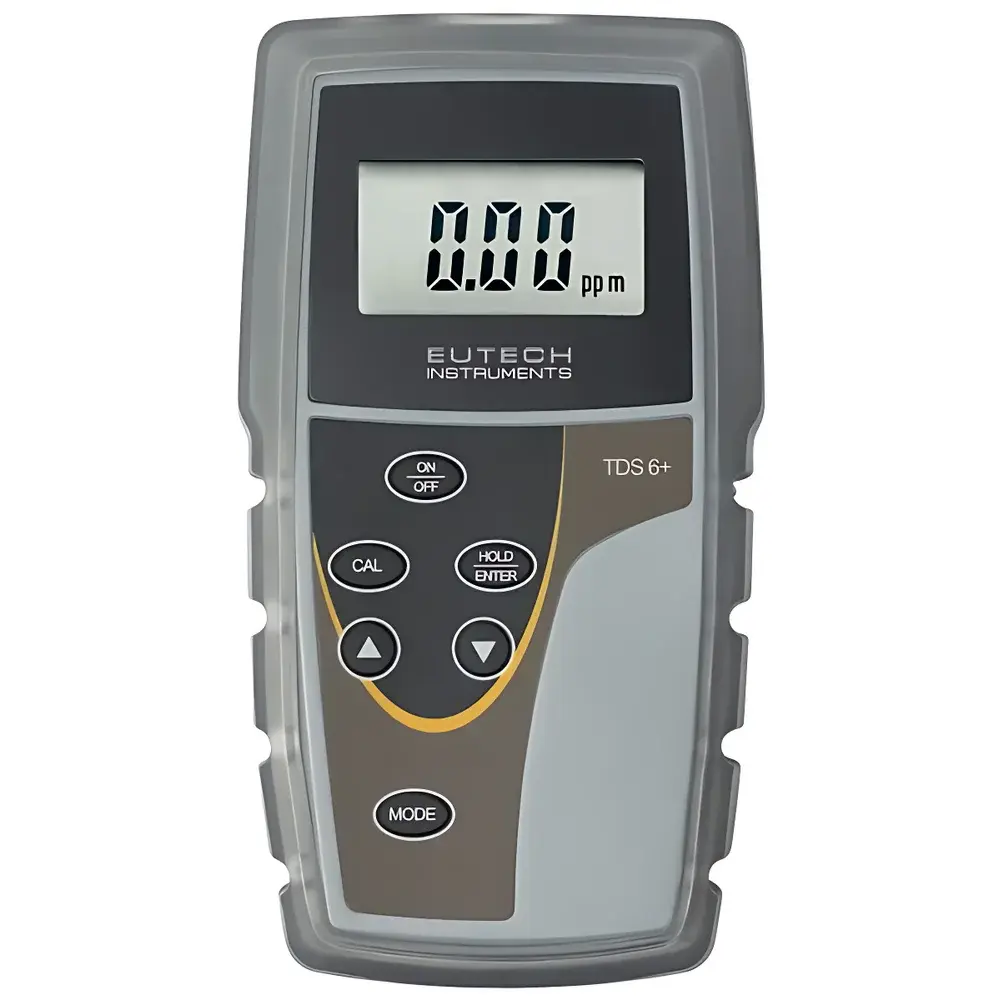
Eutech TDS 6+ Portable Total Dissolved Solids Meter
| Brand | Thermo Fisher Scientific |
|---|---|
| Origin | Singapore |
| Manufacturer | Eutech Instruments (a Thermo Fisher brand) |
| Type | Portable Conductivity-Based TDS Meter |
| Model | TDS 6+ |
| IP Rating | IP54 |
| TDS Range | 0–99.9 ppm / 100–999 ppm / 1.00–99.9 ppt (dependent on selectable TDS factor) |
| TDS Resolution | 0.05% of full scale |
| TDS Accuracy | ±1% FS + 1 LSD |
| Adjustable TDS Factor | 0.40–1.00 |
| Temperature Range | 0–100.0 °C |
| Temp. Resolution | 0.1 °C |
| Temp. Accuracy | ±0.5 °C |
| Temp. Compensation | Automatic or manual (0–80 °C) |
| Reference Temp. | 20.0 °C or 25.0 °C |
| Temp. Coefficient | 0.0–3.0%/°C |
| Cell Constants Supported | 0.1, 1.0, 10.0 cm⁻¹ |
| Display | Single-line LCD (4.5 × 2.3 cm) |
| Power | 4 × 1.5 V AAA alkaline batteries |
| Battery Life | >100 hours |
| Auto-off | 20 min inactivity |
| Dimensions (instrument) | 15.7 × 8.5 × 4.2 cm |
| Weight (instrument) | 255 g |
| Input | BNC + 2.5 mm phono sockets |
Overview
The Eutech TDS 6+ Portable Total Dissolved Solids Meter is a field-deployable, conductivity-based analytical instrument engineered for rapid, reliable quantification of total dissolved solids (TDS) in aqueous samples. It operates on the fundamental principle that electrical conductivity correlates with ionic concentration; the meter converts measured conductance—using a calibrated cell constant and user-selectable TDS conversion factor—into mass-based TDS values (ppm or ppt). Designed for routine water quality assessment in environmental monitoring, aquaculture, hydroponics, drinking water verification, and industrial process control, the TDS 6+ delivers laboratory-grade repeatability in a rugged, handheld form factor. Its IP54-rated enclosure ensures resistance to dust ingress and incidental water splashes, supporting dependable operation in outdoor, mobile, or non-laboratory environments where portability and operational simplicity are critical.
Key Features
- Conductivity-derived TDS measurement with selectable TDS factor (0.40–1.00), enabling accurate conversion across diverse sample matrices including freshwater, brackish water, and low-conductivity effluents.
- Integrated dual-parameter capability: simultaneous real-time display of TDS and temperature, with automatic temperature compensation (ATC) across 0–80 °C using a built-in NTC thermistor.
- Multi-point calibration support (up to 5 points) with automatic buffer recognition, reducing operator error and ensuring traceable accuracy per ISO/IEC 17025-aligned calibration practices.
- High-resolution single-line LCD (4.5 × 2.3 cm) optimized for legibility under variable ambient lighting conditions; intuitive button interface minimizes training requirements.
- Energy-efficient design featuring auto-power-off after 20 minutes of inactivity and >100 hours of continuous operation on standard AAA alkaline cells.
- Built-in diagnostic self-test routine with error code reporting (e.g., electrode fault, open circuit, out-of-range signal), facilitating rapid troubleshooting without external software.
- Modular electrode compatibility via standard BNC and 2.5 mm phono inputs, supporting interchangeable conductivity cells with cell constants of 0.1, 1.0, and 10.0 cm⁻¹ for optimal range matching.
Sample Compatibility & Compliance
The TDS 6+ is validated for use with low-to-moderate ionic strength aqueous solutions, including potable water, surface water, groundwater, aquarium systems, cooling tower make-up, and reverse osmosis permeate. It is not intended for highly viscous, suspended-solid-laden, or non-aqueous media. While the instrument itself does not carry formal regulatory certification, its measurement methodology aligns with established standards including ASTM D1125 (Standard Test Methods for Electrical Conductivity and Resistivity of Water) and ISO 7888 (Water quality — Determination of electrical conductivity). When used within defined operating parameters (0–50 °C ambient, 0–100 °C sample), it supports GLP-compliant field data collection when paired with documented calibration records and electrode maintenance logs.
Software & Data Management
The TDS 6+ operates as a standalone, embedded-system device with no onboard data logging or USB/Bluetooth connectivity. All measurements are displayed in real time and must be manually recorded. This architecture eliminates firmware update dependencies and ensures deterministic response latency—critical for time-sensitive field assessments. For laboratories requiring electronic data capture, integration is achieved externally via standardized protocols: users may employ third-party digital loggers connected to the analog output (if equipped with optional accessories) or transcribe readings into LIMS-compatible spreadsheets. The absence of internal memory enhances data integrity by preventing accidental overwrites or untraceable edits—a design consideration aligned with FDA 21 CFR Part 11 principles for manual entry workflows.
Applications
- Environmental field surveys: rapid screening of river, lake, and well water for baseline TDS profiling and salinity trend analysis.
- Aquaculture and aquarium management: monitoring osmotic stress indicators in recirculating systems to maintain species-specific ionic balance.
- Hydroponic nutrient solution control: verifying dilution consistency and detecting fertilizer accumulation prior to crop stress onset.
- Drinking water safety checks: validating point-of-use filter performance and post-treatment stability in municipal or rural distribution networks.
- Industrial pretreatment verification: confirming desalination or softening system output meets intake specifications for boiler feed or rinse water.
- Educational laboratories: introducing foundational concepts of ionic solutes, conductivity theory, and calibration traceability in undergraduate chemistry and environmental science curricula.
FAQ
How is TDS calculated from conductivity on the TDS 6+?
The instrument measures conductance (in µS/cm), applies the selected cell constant (0.1, 1.0, or 10.0 cm⁻¹) to derive conductivity, then multiplies by the user-defined TDS factor (0.40–1.00) to yield ppm or ppt values—consistent with the linear approximation method described in Standard Methods 2510B.
Can the TDS 6+ measure seawater?
It is not recommended for full-strength seawater (~35,000 ppm TDS) due to range limitations; however, diluted samples (e.g., 1:10) can be measured with appropriate factor adjustment and subsequent mathematical correction.
What calibration standards are required?
NIST-traceable KCl solutions are preferred: 84 µS/cm (for low-range), 1413 µS/cm (mid-range), and 12.88 mS/cm (high-range)—each selected to bracket expected sample conductivity.
Does the meter comply with ISO/IEC 17025?
As a field instrument, it supports compliance when used within its specified uncertainty budget (±1% FS + 1 LSD), with documented calibration, environmental controls, and operator competency—per Clause 6.4 and Annex A of ISO/IEC 17025:2017.
Is the electrode replaceable and serviceable?
Yes—the included conductivity/TDS probe features a replaceable platinum black sensor element and detachable cable; routine cleaning with mild detergent and periodic storage in KCl solution maintains long-term stability.





