
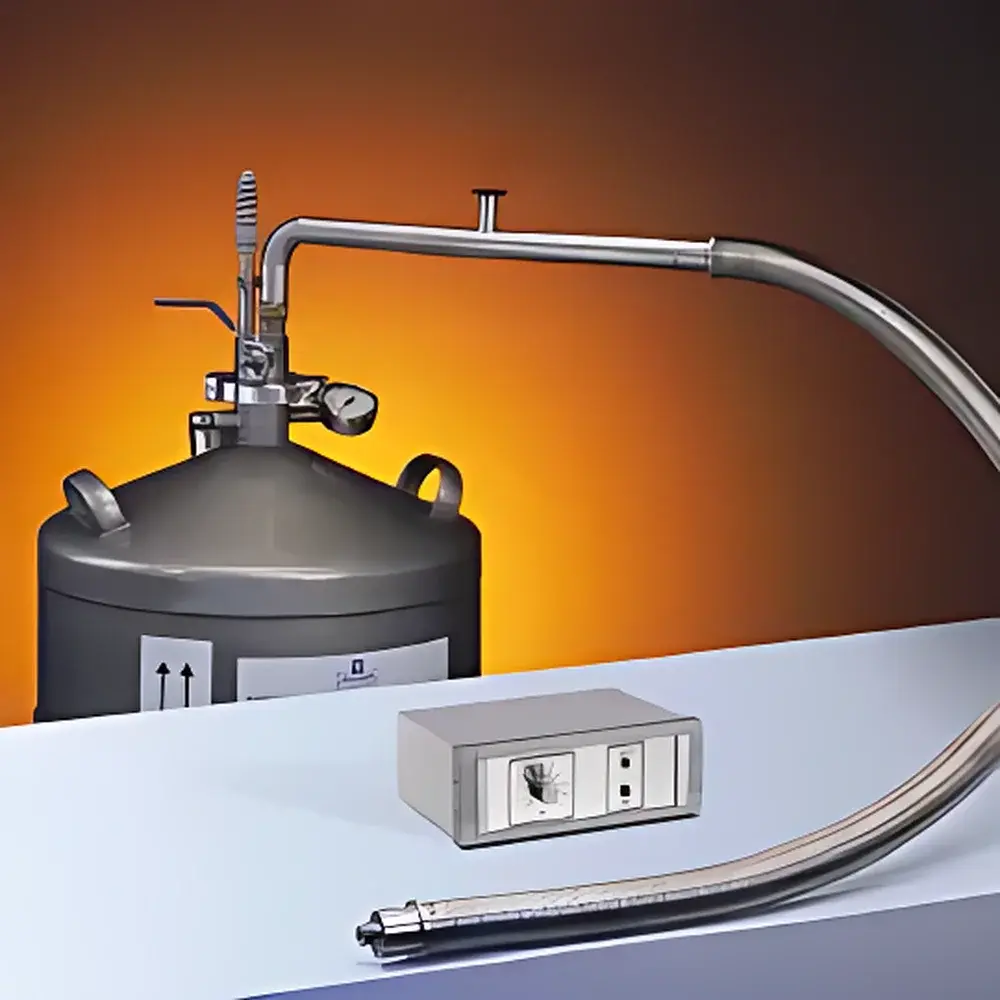
JULABO-Chemtron KALTGAS T-G Cryogenic Liquid Nitrogen Cooling & Temperature Control System
| Brand | JULABO-Chemtron |
|---|---|
| Origin | Germany |
| Model | T-G |
| Cooling Medium | Gaseous Nitrogen (N₂) |
| Minimum Operating Temperature | –180 °C |
| Liquid Nitrogen Consumption | 1.1–11 L/h |
| Vaporizer Power | 500 W (adjustable range: 100–1000 W) |
| Gas Flow Rate | up to 14,000 L/h at 1000 W |
| Insulated Flexible Transfer Line | V2A stainless steel, 1.8 m, vacuum-jacketed |
| Interface | KF NW 50, Swagelok, threaded, clamp, and nut-type fittings |
| Controller | SL1 Precision Evaporation Rate Regulator with Dual Thermal Protection |
Overview
The JULABO-Chemtron KALTGAS T-G is a high-precision cryogenic cooling and temperature control system engineered for laboratory and industrial applications requiring stable, controllable gaseous nitrogen (N₂) delivery between –180 °C and ambient. Unlike conventional refrigerated circulators or mechanical cryocoolers, the KALTGAS T-G leverages phase-change thermodynamics—specifically, the controlled evaporation of liquid nitrogen (LN₂) in a regulated vaporizer—to generate a continuous, low-humidity, inert cold gas stream. This principle ensures rapid thermal response, minimal condensation risk, and intrinsic safety due to nitrogen’s non-reactive nature. The system operates without compressors or cryogenic fluids other than LN₂, eliminating oil contamination, vibration, and long cooldown delays. Its core architecture integrates a high-efficiency vaporizer, vacuum-insulated flexible transfer line, modular heating stage (optional), and the SL1 intelligent controller—enabling precise decoupling of mass flow rate and final output temperature. Designed and manufactured in Germany, the T-G series complies with CE directives and meets essential requirements for safe operation in ISO 17025-accredited laboratories and GMP-aligned R&D environments.
Key Features
- Modular architecture: Interchangeable vaporizers, heating modules, and transfer lines allow adaptation to application-specific cooling rates and temperature stability requirements—without replacing the base unit, LN₂ dewar, or vacuum pump.
- Vacuum-jacketed V2A stainless steel transfer line (1.8 m): Minimizes parasitic heat ingress and ensures consistent delivery of sub-180 °C N₂ gas directly to sample chambers, test fixtures, or analytical instrument interfaces.
- SL1 precision controller: Enables stepless regulation of LN₂ evaporation rate (0–100% setpoint) and real-time monitoring of vaporizer and post-heater temperatures. Features dual independent thermal cutoffs with audible alarm and manual reset for fail-safe operation.
- Post-heating module (optional): Integrated into the gas path downstream of the vaporizer, this module enables accurate setpoint temperature control (e.g., –100 °C ±0.3 °C) by reheating the cryogenic N₂ stream—critical for applications demanding both low temperature and high thermal uniformity.
- Low-LN₂-consumption design: Optimized vaporizer geometry and dynamic power modulation (100–1000 W) reduce LN₂ usage by up to 40% compared to fixed-power systems under partial-load conditions.
- KF NW 50 and Swagelok-compatible interface suite: Ensures leak-tight integration with vacuum chambers, environmental test enclosures, tensile testers, and custom-built cryostats.
Sample Compatibility & Compliance
The KALTGAS T-G delivers dry, particle-free nitrogen gas—ideal for moisture-sensitive or oxidation-prone samples including polymer films, semiconductor wafers, biological tissues, pharmaceutical intermediates, and metallurgical specimens. Its inert gas output eliminates frost formation on optical windows and sensor surfaces, supporting uninterrupted in situ measurements during DSC, DMA, tensile testing (ASTM D638, ISO 527), Charpy impact testing (ISO 148-1), and low-temperature FTIR spectroscopy. The system supports GLP-compliant workflows via audit-trail-capable SL1 controller logging (when paired with optional data acquisition interface). All electrical components conform to IEC 61000-6-2/6-4 EMC standards; mechanical design adheres to PED 2014/68/EU for pressure equipment where applicable.
Software & Data Management
While the SL1 controller operates as a standalone analog/digital hybrid unit with front-panel knobs and LED indicators, it provides analog voltage outputs (0–10 V) and RS-485 Modbus RTU interface for integration into centralized lab automation platforms (e.g., LabVIEW, DeltaV, or custom SCADA). Optional firmware upgrades enable timestamped event logging—including evaporation rate setpoints, vaporizer temperature, heater status, and thermal fault triggers—for traceability in regulated environments. No proprietary software is required; configuration and monitoring can be performed via standard terminal emulation or third-party Modbus master tools. Data export is compatible with CSV and Excel formats for post-processing in statistical analysis packages (JMP, Minitab).
Applications
- Thermal analysis: Rapid quenching and isothermal hold for DSC, TMA, and DMA sample conditioning per ASTM E1356 and ISO 11357.
- Mechanical testing: Low-temperature tensile, flexural, and impact testing of polymers, composites, and aerospace alloys (per ASTM D790, ISO 179).
- Electronics reliability: Thermal cycling of PCB assemblies and semiconductor packages under controlled N₂ atmosphere to suppress oxidation and moisture ingress.
- Biological cryopreservation: Controlled-rate cooling of cell suspensions and tissue samples prior to vitrification or liquid-phase storage.
- Process development: Simulation of cryogenic reaction conditions in fine chemical synthesis and catalytic studies where solvent-free cooling is mandatory.
- Instrument cooling: Direct integration with XRD goniometers, SEM cold stages, and FTIR beamlines requiring stable, vibration-free cryogenic gas supply.
FAQ
What is the minimum achievable temperature at the outlet of the T-G system?
The system delivers gaseous nitrogen at temperatures down to –180 °C when operating without the post-heating module and at maximum vaporizer power (1000 W) with optimal LN₂ supply pressure and flow.
Can the KALTGAS T-G maintain temperature stability without the optional heating module?
Yes—but only as an open-loop cooling source. Without the post-heater, outlet temperature varies with LN₂ supply pressure, ambient load, and evaporation rate; the SL1 controller regulates flow only, not final temperature.
Is the vacuum-insulated transfer line customizable in length?
Standard length is 1.8 m; custom lengths up to 5 m are available upon request, subject to thermal performance validation and pressure-drop calculations.
Does the system require external vacuum pumping during operation?
No—the vacuum jacket is permanently sealed and pre-evacuated at the factory; no active vacuum maintenance is needed during normal operation.
How is compliance with FDA 21 CFR Part 11 addressed for electronic records?
The base SL1 controller does not include Part 11–compliant audit trails; however, when connected to a validated third-party data acquisition system with electronic signature and role-based access controls, full Part 11 alignment is achievable.



