
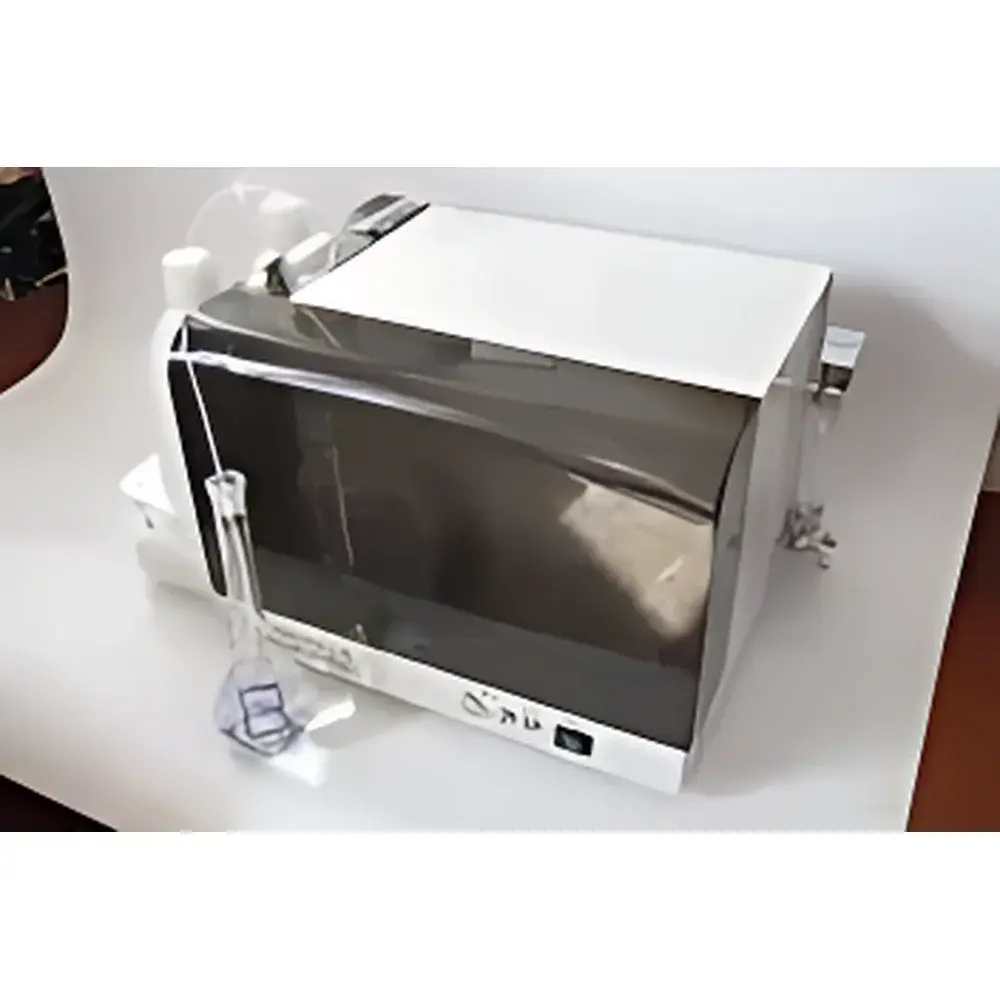
SGM HG-C Hydride Generation System
| Brand | SGM |
|---|---|
| Origin | Beijing, China |
| Manufacturer Type | Authorized Distributor |
| Country of Origin | China |
| Model | HG-C |
| Price | USD 1,780 (approx.) |
Overview
The SGM HG-C Hydride Generation System is a precision-engineered gas-phase sample introduction device designed for trace and ultra-trace determination of hydride-forming elements—including As, Se, Sb, Bi, Te, Sn, Pb, Ge, and Cd—in aqueous matrices. It operates on the principle of acid-mediated sodium borohydride (NaBH₄) reduction, where analyte species are selectively converted to volatile covalent hydrides in a continuous-flow or batch reaction chamber. These gaseous hydrides are swept by high-purity argon into a quartz atomization cell (for AAS) or directly coupled to an ICP-OES/ICP-MS interface via a dedicated transfer line. The system supports both cold vapor and hydride generation modes, enabling dual-functionality for elemental quantification and speciation analysis when integrated with HPLC or UV photolysis units.
Key Features
- Modular design compatible with multiple detection platforms: flameless atomic absorption spectrometry (GF-AAS), inductively coupled plasma optical emission spectrometry (ICP-OES), and inductively coupled plasma mass spectrometry (ICP-MS)
- Integrated gas–liquid separation with optimized phase-separation geometry to minimize foam carryover and enhance transport efficiency
- Precise reagent delivery via peristaltic pump with independent flow control for acid (HCl), reductant (NaBH₄), and sample streams
- Programmable reaction timing and gas purge cycles to accommodate kinetic differences among hydride-forming elements
- Chemically resistant fluid path constructed from PTFE, FEP, and quartz to ensure long-term stability and low memory effects
- Onboard pressure monitoring and leak detection circuitry for operational safety and method robustness
Sample Compatibility & Compliance
The HG-C accommodates liquid samples with total dissolved solids (TDS) ≤ 0.2% and chloride concentrations up to 5 mol L⁻¹. It accepts standard 12–16 mm borosilicate glass vials and integrates seamlessly with autosamplers from major AAS and ICP vendors. The system complies with ISO/IEC 17025 requirements for method validation in accredited testing laboratories. Its reagent consumption profile and waste generation rate align with EPA Method 200.9 and ASTM D5673-18 for trace metal speciation in environmental and biological matrices. While not certified to FDA 21 CFR Part 11 out-of-the-box, audit trails and user access logs can be implemented via optional software modules compliant with GLP/GMP documentation workflows.
Software & Data Management
The HG-C operates in standalone mode or under host instrument control via RS-232 or USB virtual COM port. When paired with third-party analytical software (e.g., Thermo Fisher Qtegra, PerkinElmer WinLab32, Agilent ICP Expert), it supports synchronized triggering of hydride generation events with detector acquisition windows. All method parameters—including acid concentration, NaBH₄ strength, reaction delay, and carrier gas flow—are stored as editable ASCII-based method files. Raw signal outputs (analog voltage or digital counts) are timestamped and exportable in CSV format for post-acquisition processing in MATLAB, Python (Pandas), or statistical packages such as JMP or Minitab.
Applications
- Quantitative analysis of arsenic species (As(III), As(V), MMA, DMA) in drinking water per WHO Guidelines and EU Directive 2020/2184
- Speciation of selenium metabolites (selenomethionine, selenocysteine) in dietary supplements using HPLC-HG-AFS coupling
- Monitoring antimony leaching from PET packaging materials in food simulants (ISO 11885)
- Ultra-low-level bismuth detection in pharmaceutical excipients (USP )
- High-throughput screening of lead contamination in soil extracts following EPA SW-846 Method 6020B
FAQ
Can the HG-C be used with ICP-MS instruments from non-Chinese manufacturers?
Yes — the HG-C features standardized pneumatic and electrical interfaces, and has been validated for use with Thermo Fisher iCAP RQ, Agilent 8900, and Shimadzu ICPE-9800 systems via custom interface kits.
What is the typical detection limit for arsenic using this system with GF-AAS?
Under optimized conditions (20 µL injection, 30 s integration), the characteristic mass (m₀) for As is approximately 0.15 pg, corresponding to a 3σ blank-based LOD of 0.03 ng mL⁻¹ in aqueous standards.
Is post-column UV irradiation supported for photochemical hydride generation?
Yes — the system includes a dedicated UV lamp mounting bracket and quartz transfer tubing compatible with 254 nm low-pressure mercury lamps for enhanced reduction of refractory species such as Se(IV) and Te(IV).
Does the HG-C require annual recalibration?
No routine factory recalibration is mandated; however, quarterly performance verification using NIST SRM 1640a (Trace Elements in Natural Water) is recommended to maintain data integrity per ISO/IEC 17025 Clause 7.7.
Are spare parts and consumables available globally?
All critical components—including reaction coils, gas–liquid separators, and peristaltic pump tubing—are stocked by SGM’s regional distribution partners in Germany, USA, and Singapore, with average lead time of 5–10 business days.





