
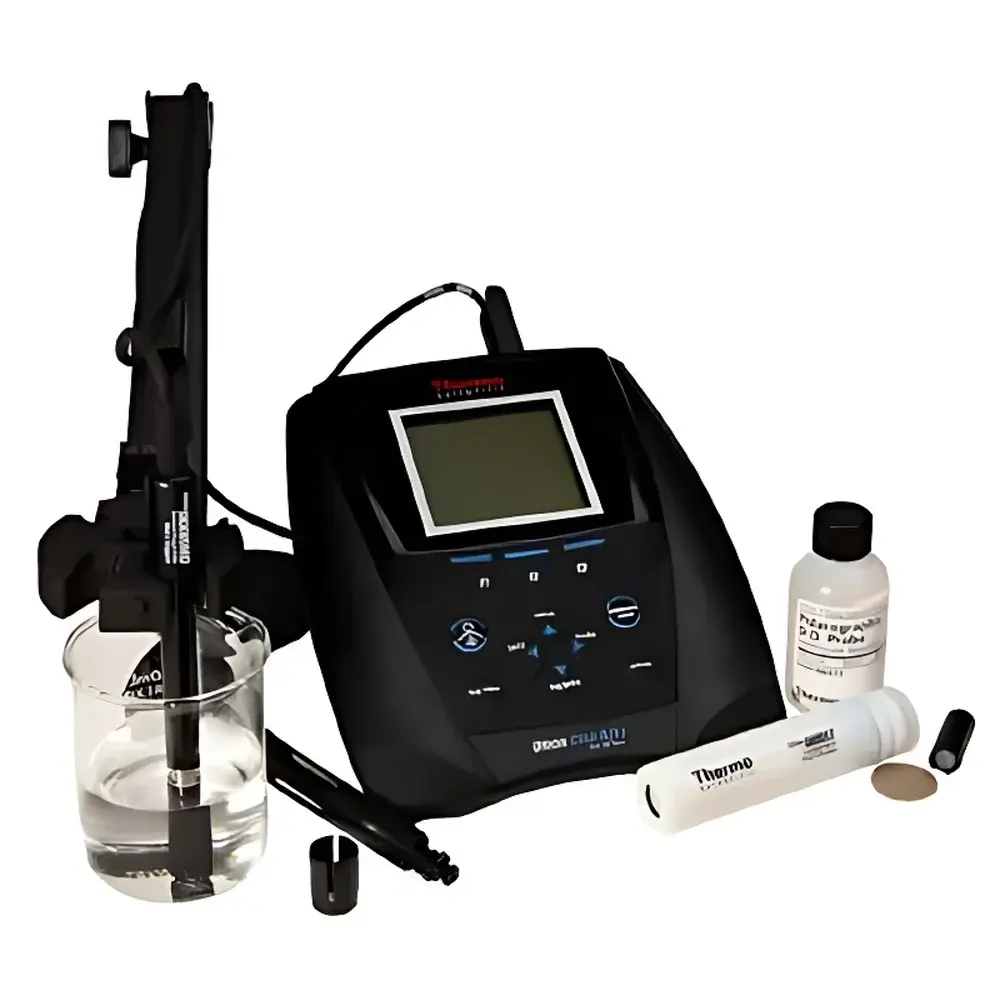
Thermo Fisher Scientific Orion Star A213/A223 Benchtop & Portable Dissolved Oxygen Meters
| Brand | Thermo Fisher Scientific |
|---|---|
| Origin | Singapore |
| Manufacturer | Thermo Fisher Scientific |
| Product Type | Imported Laboratory Instrument |
| Model | A213 (Benchtop), A223 (Portable) |
| Measurement Principle | Electrochemical (Galvanic Cell) and Optical (RDO Fluorescence) |
| DO Range | 0–90 mg/L (Galvanic), 0–50 mg/L (RDO) |
| Accuracy | ±0.2 mg/L (Galvanic) |
| Saturation Range | 0–600% (Galvanic), 0–500% (RDO) |
| Atmospheric Pressure Compensation | 450.0–850.0 mmHg |
| Salinity Correction | 0–45 ppt |
| Temperature Range | 0–50 °C |
| Resolution | 0.01/0.1 mg/L |
| Data Storage | 2000 entries (A213), 1000 entries (A223), GLP-compliant |
| Interface | RS232, USB |
| Power | AC adapter (100–240 V AC) or 4 × AA batteries |
| IP Rating | IP54 (A213), IP67 (A223) |
Overview
The Thermo Fisher Scientific Orion Star A213 (benchtop) and A223 (portable) Dissolved Oxygen (DO) Meters are precision electrochemical and optical instrumentation platforms engineered for rigorous water quality analysis in laboratory, field, and process environments. These meters support dual-sensor interoperability—accepting both galvanic (electrochemical, zero-current cell) and RDO (Ruthenium-based fluorescence quenching) dissolved oxygen probes—enabling method flexibility aligned with application-specific requirements such as regulatory compliance, low-maintenance operation, or rapid response in variable salinity or temperature conditions. The instruments operate on well-established physicochemical principles: galvanic sensors generate a current proportional to oxygen partial pressure via spontaneous redox reactions at noble metal electrodes, while RDO probes quantify oxygen concentration through phase-shifted luminescence decay kinetics of an immobilized fluorophore. Both measurement modalities are fully integrated into a unified firmware architecture that applies real-time compensation for temperature, atmospheric pressure, and salinity—critical variables affecting oxygen solubility per the APHA Standard Methods 4500-O and ISO 5814:2012.
Key Features
- Auto-Recognition Technology: Automatically detects connected probe type (galvanic or RDO) and loads corresponding calibration and measurement algorithms without manual configuration.
- Multi-Language Interface: Supports six display languages—including English, Chinese, Spanish, French, German, and Portuguese—for global laboratory and field deployment.
- Stability-Optimized Readout: AUTO-READ™ function locks values upon signal stabilization, indicated by a dedicated icon; configurable averaging and stability thresholds enhance reproducibility in turbulent or low-conductivity samples.
- Comprehensive Environmental Compensation: Integrated barometric pressure sensor (450.0–850.0 mmHg range) and user-adjustable salinity correction (0–45 ppt) ensure traceable DO reporting per ASTM D888 and EPA Method 360.1.
- Dual-Power Flexibility: Benchtop A213 operates via universal AC adapter (100–240 V AC); portable A223 functions up to 1,000 hours on four standard AA alkaline cells—with optional battery-saver mode extending field runtime.
- Ruggedized Design: A213 meets IP54 (dust-protected, splash-resistant); A223 achieves IP67 (dust-tight, submersible to 1 m for 30 min), validated per IEC 60529 standards for wastewater, marine, and winery applications.
Sample Compatibility & Compliance
The Star A platform is validated for use across freshwater, seawater, wastewater, fermentation broths (e.g., beer and wine production), and BOD incubation vessels. Galvanic probes (e.g., 083005MD, 086030MD) are recommended for long-term continuous monitoring and low-maintenance scenarios, whereas RDO probes (e.g., 087010MD, 087020MD) offer superior performance in high-sediment, low-flow, or biofouling-prone matrices due to their membrane-free optical sensing surface. All configurations comply with Good Laboratory Practice (GLP) data integrity requirements: each stored measurement includes timestamp, operator ID, sample ID, probe serial number, calibration history, and environmental parameters. Audit trails meet FDA 21 CFR Part 11 readiness when used with Orion CombiData software and enabled electronic signature workflows.
Software & Data Management
Data export and instrument management are supported via native RS232 or USB virtual COM port interfaces. Orion CombiData software (Windows-compatible) enables secure transfer of GLP-compliant datasets—including raw sensor output, compensated DO values, temperature traces, and calibration logs—to CSV or PDF reports. Firmware updates, method templates, and custom calibration curve import are performed directly through the software interface. No cloud dependency or proprietary dongles are required; all communication protocols adhere to standard serial command syntax documented in the Orion Star A Communication Protocol Manual (PN 00300601).
Applications
- Regulatory Wastewater Monitoring: BOD₅ assessment per ISO 5815-1 and EPA 40 CFR Part 136 using self-stirring galvanic probes (086030MD) in sealed dilution bottles.
- Drinking Water Distribution: Field verification of residual DO in chloraminated systems using IP67-rated A223 with 6-m RDO probe (087020MD) for deep-well or reservoir profiling.
- Bioprocess Control: Real-time DO trending during aerobic fermentation, where RDO’s non-consumptive measurement avoids oxygen depletion artifacts common with polarographic sensors.
- Environmental Research: Multi-point saturation mapping in estuarine transects, applying simultaneous salinity and barometric correction to resolve diurnal oxygen dynamics per UNESCO Technical Papers in Marine Science guidelines.
- Food & Beverage QA: Dissolved oxygen quantification in packaged beer and wine—where sub-0.01 mg/L resolution and stainless-steel沉降套 (087010MD/087020MD) enable minimally invasive headspace sampling.
FAQ
Can the A213 and A223 accept both galvanic and RDO probes interchangeably?
Yes—both models feature automatic probe detection via the 9-pin mini-DIN interface and dynamically load appropriate calibration curves and units without user intervention.
Is atmospheric pressure compensation mandatory for accurate DO reporting?
Yes—oxygen solubility varies by ~10% across typical barometric ranges (650–760 mmHg); built-in pressure sensing eliminates manual correction errors per ISO 5814 Annex A.
How does GLP compliance manifest in data storage?
Each record stores date/time, operator ID, sample ID, probe serial number, calibration date/stamp, temperature, pressure, salinity, and measurement mode—fully traceable and exportable without metadata loss.
What is the recommended recalibration frequency for RDO probes?
Annual verification against air-saturated water is advised; however, RDO sensors require no electrolyte refills or membrane replacements—reducing lifecycle cost versus galvanic counterparts.
Does the instrument support Winkler titration validation?
Yes—the “Winkler” calibration option allows direct entry of reference titration results (mg/L) to establish a secondary validation point alongside air-saturation calibration.
Related Products







