
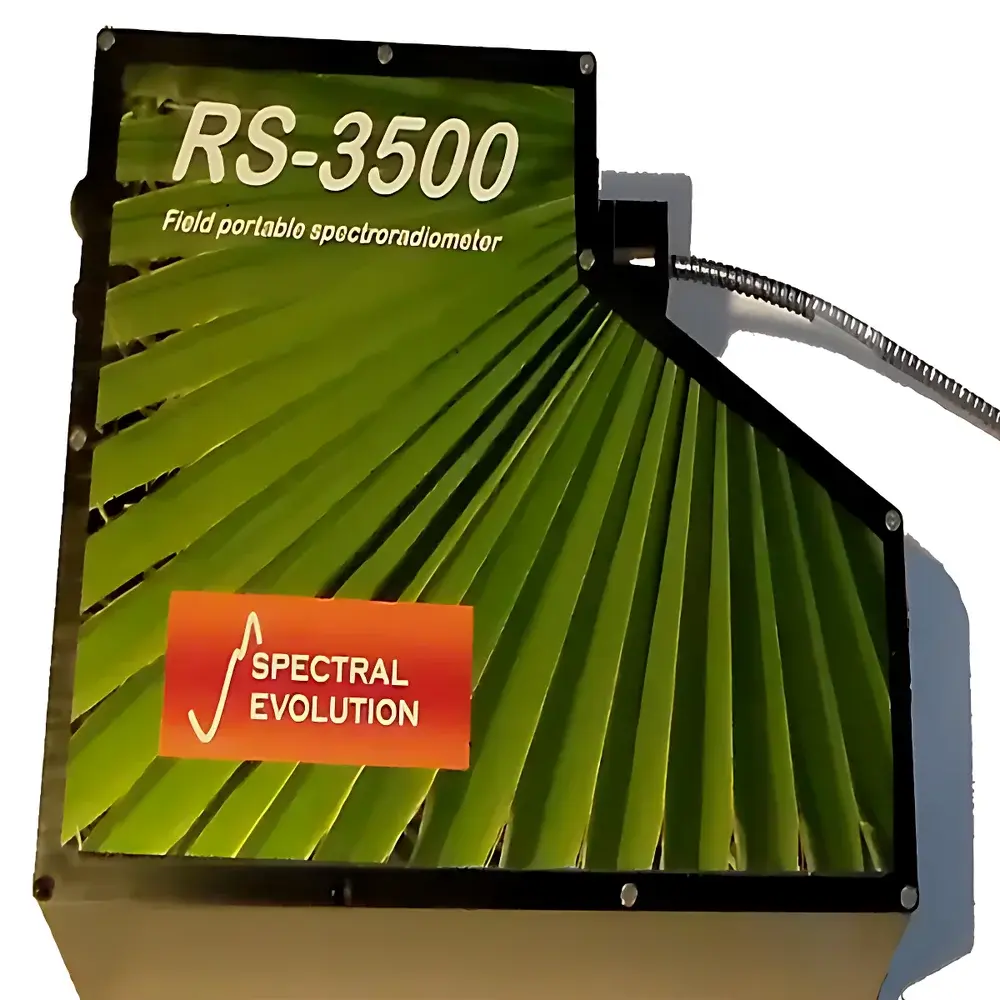
SEI RS-3500 Field-Portable Hyperspectral Radiometer
| Brand | SEI |
|---|---|
| Origin | USA |
| Distributor Type | Authorized Distributor |
| Import Status | Imported |
| Model | RS-3500 |
| Spectral Range | 350–2500 nm |
| Spectral Resolution | 2.8 nm @ 700 nm |
| NEΔL (Noise-Equivalent Delta Radiance) | 0.8×10⁻⁹ W/cm²/nm/sr @ 700 nm |
| Weight | ~4 kg |
| Power | Dual removable Li-ion rechargeable batteries (4 h each) |
Overview
The SEI RS-3500 Field-Portable Hyperspectral Radiometer is a rigorously engineered optical measurement system designed for high-fidelity in-situ spectral radiance, reflectance, and irradiance characterization across terrestrial and aquatic surfaces. Operating on the principle of fiber-coupled grating-based spectroscopy with dual-detector architecture (Si CCD for VIS-NIR and InGaAs for SWIR), the RS-3500 delivers calibrated, NIST-traceable spectral data from 350 to 2500 nm—spanning the full photosynthetically active radiation (PAR) band through the shortwave infrared (SWIR) region critical for vegetation water content, mineral identification, and soil organic matter analysis. Its compact, ruggedized chassis—weighing just 4 kg—and integrated thermal stabilization ensure stable performance under variable field conditions, including rapid ambient temperature shifts common during diurnal ecological surveys. Unlike laboratory-grade benchtop spectrometers, the RS-3500 is purpose-built for operational continuity in remote deployments, featuring passive cooling, shock-absorbing housing, and IP54-rated ingress protection against dust and light rain.
Key Features
- NIST-traceable absolute radiometric calibration delivered with each unit, enabling quantitative inter-comparison across campaigns and instruments without re-calibration in the field;
- Automated acquisition workflow: motorized shutter control, real-time exposure optimization, and on-board dark current subtraction eliminate manual parameter tuning;
- Dual-detector configuration ensures seamless spectral stitching with <1% radiometric discontinuity at detector overlap regions (900–1000 nm and 1700–1800 nm);
- Modular optical interface: detachable SMA 905 fiber optic coupling supports rapid interchange between contact probes, cosine correctors, and fore-optics for directional or hemispherical measurements;
- Integrated field computing: Android-based tablet preloaded with SEI SpectraField™ v3.2 software enables GPS-tagged spectral logging, real-time NDVI/NDWI index calculation, and spectral library matching;
- Hot-swappable dual lithium-ion battery system provides continuous 8-hour operation—critical for multi-site transects or UAV-ground truth synchronization.
Sample Compatibility & Compliance
The RS-3500 is optimized for non-contact, non-destructive measurement of heterogeneous natural surfaces—including leaf canopies, bare soils, sediment-laden water bodies, and snow-covered terrain—without requiring sample preparation. Its 1° field-of-view fore-optic (optional 5° and 25° variants available) ensures spatially resolved spectral sampling aligned with common satellite sensor footprints (e.g., Landsat OLI, Sentinel-2 MSI). All radiometric calibrations conform to ASTM E275-22 (Standard Practice for Calibration of Spectroradiometers) and ISO 17123-7:2021 (Optics and photonics — Field procedures for testing geodetic and surveying instruments — Part 7: Spectroradiometers). Data integrity complies with GLP principles via embedded audit trail functionality, including timestamped operator ID, GPS coordinates, atmospheric pressure/temperature/humidity metadata, and raw + processed spectral file pairing.
Software & Data Management
SpectraField™ software provides a validated, export-ready environment supporting both standalone field acquisition and post-processing workflows. Raw spectra are stored in vendor-neutral, self-documenting ENVI-compatible .hdr/.sli format with embedded wavelength arrays, calibration coefficients, and uncertainty budgets. Batch processing modules support BRDF correction using empirical models (e.g., Rahman-Pinty-Verstraete), atmospheric compensation via MODTRAN-derived lookup tables, and spectral unmixing using constrained non-negative least squares (CNLS). Export options include CSV, NetCDF-4, and direct integration with ENVI, Python (via seiradlib), and R (hyperSpec package). All software binaries undergo annual third-party validation per FDA 21 CFR Part 11 Annex 11 requirements for electronic records and signatures in regulated environmental monitoring applications.
Applications
- Vegetation phenotyping and stress detection: quantification of chlorophyll-a/b, carotenoid, and anthocyanin absorption features; early detection of drought, nutrient deficiency, or pathogen infection;
- Soil property mapping: estimation of clay content, iron oxide abundance, organic carbon concentration, and salinity via diagnostic SWIR absorption bands (e.g., 1400 nm, 1900 nm, 2200 nm);
- Aquatic optics: derivation of inherent optical properties (IOPs) including absorption (aph, adg) and backscattering (bb) coefficients for coastal and inland waters;
- Climatology and carbon cycle studies: long-term monitoring of surface albedo trends, snow grain size evolution, and permafrost thaw indicators;
- Forestry inventory and fire risk assessment: canopy closure estimation, live/dead fuel ratio classification, and post-burn char residue quantification;
- Calibration/validation of airborne and spaceborne sensors: generation of vicarious calibration targets meeting CEOS WGCV specifications for EO mission QA/QC protocols.
FAQ
Is the RS-3500 suitable for use with unmanned aerial systems (UAS)?
Yes—the RS-3500’s low mass, vibration-damped mounting interface, and synchronized trigger input/output ports enable direct integration with UAS payloads for coordinated ground-truthing and sensor cross-calibration.
Can spectral data be exported in formats compatible with NASA’s ASF DAAC or ESA’s PEPS archive?
All spectral products comply with the CEOS Analysis Ready Data (ARD) specification v2.1 and are exportable as STAC-compliant JSON manifests with associated COG-optimized GeoTIFF spectral cubes.
Does the instrument support automated BRDF correction during acquisition?
BRDF modeling is performed in post-processing using SpectraField™’s built-in kernel-driven models; real-time correction is not implemented to preserve raw measurement fidelity and traceability.
What is the recalibration interval recommended for maintaining NIST traceability?
Annual factory recalibration is recommended; however, users may perform in-field verification using the included 99% Spectralon® reference panel and SEI’s TraceCheck™ validation protocol.
Are firmware updates provided free of charge for the lifetime of the instrument?
Yes—SEI provides no-cost firmware and software updates for all RS-3500 units registered under active support contracts, including security patches and spectral algorithm enhancements.
Related Products





