
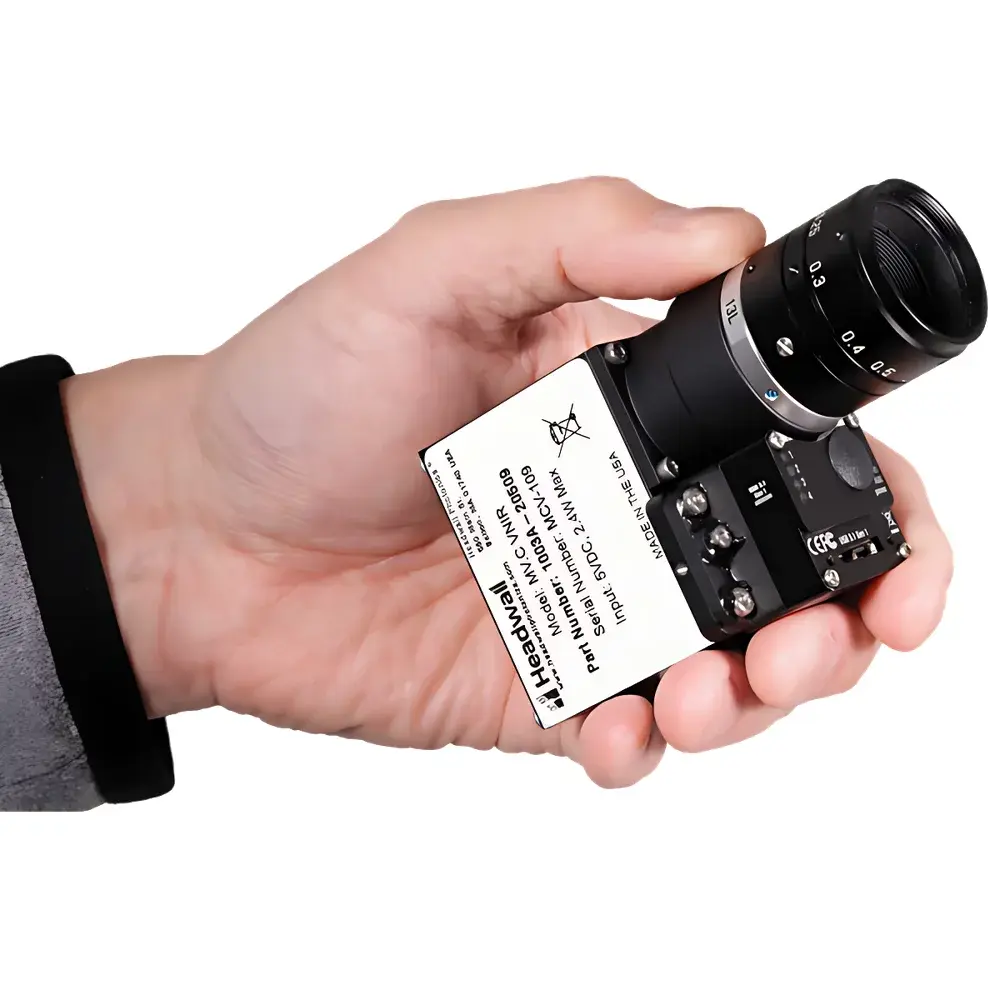
HeadWall MV.C VNIR OEM Hyperspectral Imaging Sensor
| Brand | HeadWall |
|---|---|
| Origin | USA |
| Model | MV.C VNIR |
| Operating Principle | Push-broom |
| Platform | Ground-based |
| Spectral Range | 400–1000 nm |
| Spectral Resolution (FWHM) | 6 nm |
| Spatial Pixels | 1024 |
| Detector | CMOS |
| Pixel Size | 5.86 µm |
| Aperture | f/2.5 |
| Sampling Interval | 1.75 nm/pixel |
| Slit Width | 20 µm |
| A/D Conversion | 12-bit |
| Interface | USB 3.1 |
| Weight (no lens) | 0.3 kg |
| Dimensions | 64 × 50 × 38 mm |
| Operating Temperature | 0–50 °C |
| Storage Temperature | −20–60 °C |
Overview
The HeadWall MV.C VNIR is a compact, high-performance OEM hyperspectral imaging sensor engineered for integration into industrial machine vision systems, embedded platforms, and resource-constrained environments. Based on push-broom scanning architecture, it acquires spatial-spectral data line-by-line using a reflective concentric optical design that corrects off-axis aberrations without refractive elements—ensuring high radiometric fidelity and geometric stability across the visible to near-infrared (VNIR) spectrum (400–1000 nm). Its core detector is a high-quantum-efficiency CMOS array with 1024 spatial pixels and 342 spectral channels, delivering a spectral sampling interval of 1.75 nm/pixel and a full-width-at-half-maximum (FWHM) resolution of 6 nm. Designed explicitly for ground-based operation—including laboratory scanning rigs, robotic arms, conveyor-mounted inspection stations, and UAV payloads—the MV.C VNIR operates without active cooling and maintains calibration integrity under thermal drift within its specified operating range (0–50 °C).
Key Features
- Ultra-compact form factor: 64 × 50 × 38 mm footprint and 0.3 kg mass (lens excluded), enabling deployment in space-limited enclosures and mobile platforms.
- USB 3.1 interface provides both power delivery and high-throughput data streaming (up to 200 MB/s sustained), eliminating the need for external power supplies or frame grabbers.
- C-mount lens compatibility supports flexible field-of-view adaptation using industry-standard optics (e.g., 12 mm, 25 mm, or telecentric lenses).
- Industrial-grade mechanical construction with IP-rated housing options (available upon request) ensures reliability in dusty, humid, or vibration-prone production environments.
- Optimized optical train featuring all-reflective concentric design eliminates chromatic aberration and thermal focus shift—critical for long-duration, unattended spectral monitoring.
- Onboard FPGA preprocessing enables real-time dark-current subtraction and non-uniformity correction, reducing host CPU load during live classification workflows.
Sample Compatibility & Compliance
The MV.C VNIR is compatible with solid, semi-solid, and particulate samples commonly encountered in quality assurance and process analytical technology (PAT) applications. Its 400–1000 nm spectral coverage captures diagnostic absorption features of pigments, chlorophyll, moisture, protein, and oxidation markers—making it suitable for food, pharmaceutical, agricultural, and cultural heritage analysis. The sensor complies with CE and FCC electromagnetic compatibility directives. While not intrinsically certified for hazardous locations, its low-voltage (5 V DC) operation and absence of moving parts support integration into Class I, Division 2 (CID2) compliant systems when housed appropriately. Data acquisition protocols align with ASTM E1798 (Standard Practice for Hyperspectral Imaging Systems) and ISO 13406-2 (for display-related spectral characterization), and raw data formats adhere to ENVI-compatible BIL/BIP conventions for interoperability with third-party spectral libraries.
Software & Data Management
HeadWall provides a comprehensive SDK supporting Windows and Linux environments, with native bindings for Python (NumPy/Pandas), MATLAB, and LabVIEW. The SDK includes calibrated radiance conversion routines, spectral library matching tools, and ROI-based extraction APIs. Integration with perClass Mira—a commercially supported machine learning platform—enables supervised training of spectral classifiers directly from acquired cube data, including SVM, Random Forest, and deep learning backends (e.g., CNNs via TensorFlow/Keras wrappers). All processing pipelines support audit-trail logging and metadata embedding (including GPS, IMU, exposure time, and temperature telemetry) to meet GLP/GMP documentation requirements. Exported models can be deployed as lightweight inference engines compatible with edge hardware (e.g., NVIDIA Jetson, Intel NUC), satisfying FDA 21 CFR Part 11 expectations for electronic records and signatures when paired with validated workflow software.
Applications
- Real-time food safety inspection: Detection of foreign material (e.g., plastic, glass), bruising in fruits, mold contamination in grains, and fat/moisture distribution in meat products.
- Pharmaceutical tablet coating uniformity and API concentration mapping in continuous manufacturing lines.
- In-line LED wafer sorting based on spectral emission profile consistency and peak wavelength deviation.
- Non-invasive pigment identification and degradation state assessment in historical manuscripts and painted surfaces.
- Vegatation phenotyping via chlorophyll fluorescence ratio analysis (e.g., NDVI, PRI) on robotic field scanners or greenhouse gantries.
- Recyclable material classification (e.g., PET vs. PVC, black plastic sorting) in automated waste sorting systems.
FAQ
What spectral calibration standards are supported?
The MV.C VNIR ships with NIST-traceable reflectance and irradiance calibration files generated using certified integrating sphere sources and monochromators. Users may perform field recalibration using portable reference panels (e.g., Spectralon®) via the included calibration utility.
Can the sensor operate continuously for extended periods?
Yes—thermal management relies on passive conduction; no fan or TEC is required. Continuous operation up to 8 hours at ambient temperatures ≤40 °C has been validated under load, with <0.5 pixel spectral shift observed over 4-hour acquisitions.
Is GigE Vision support available?
GigE Vision is not natively implemented in the MV.C VNIR; however, USB 3.1 Vision-compliant drivers are provided, and third-party USB-to-GigE bridge solutions (e.g., Teledyne DALSA Boa X) have been successfully integrated by OEM partners.
Does the SDK include GPU-accelerated processing modules?
Basic GPU offloading (CUDA/OpenCL) is available for radiometric correction and PCA-based dimensionality reduction; full deep learning inference acceleration requires integration with perClass Mira’s optimized runtime engine.
How is spectral data synchronized with motion systems?
The sensor provides TTL-compatible line-scan trigger output and accepts external position-encoded triggers (e.g., encoder pulses) to ensure sub-pixel spatial registration in conveyor or robotic scan modes.
Related Products






