
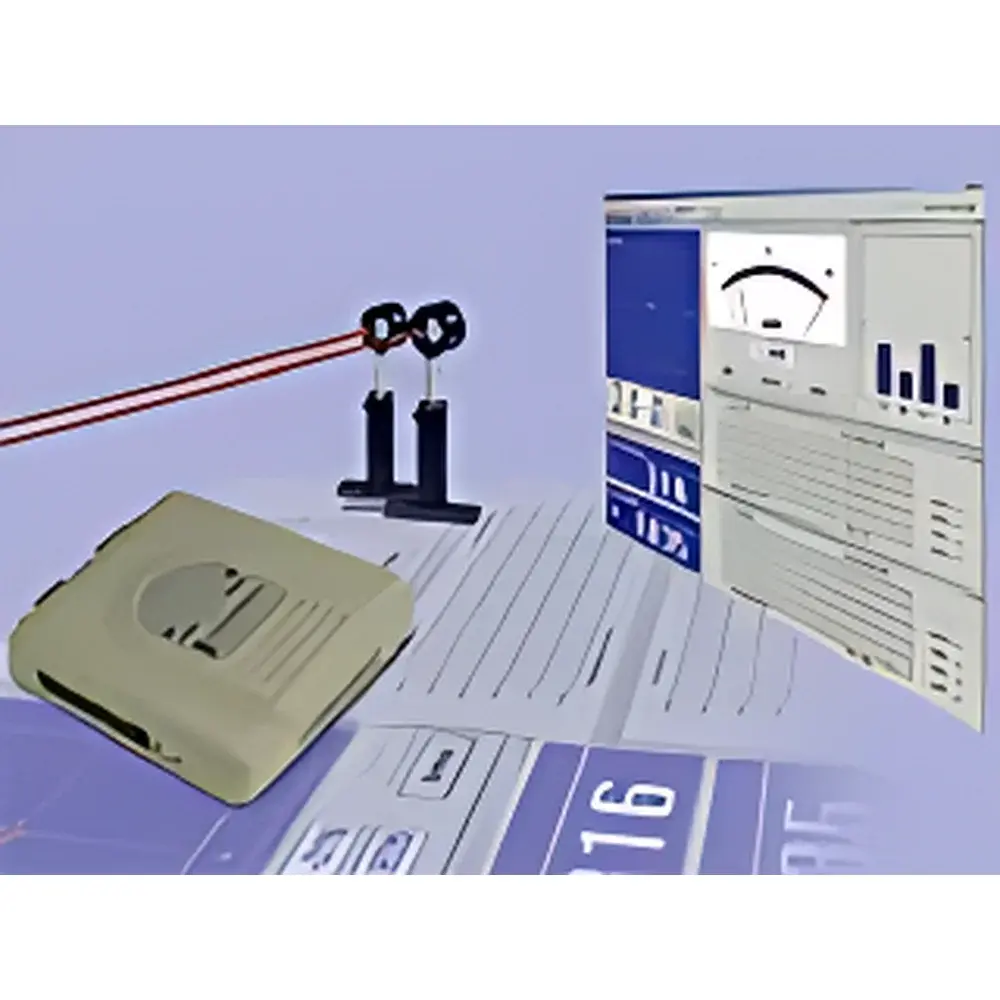
Duma Optronics SpotOn Position-Sensitive Detector (PSD) System
| Brand | Duma Optronics |
|---|---|
| Origin | Israel |
| Model | SpotOn Series (SPOTUSB-L, SPOTUSB-N, SPOTUSB-Q, SPOTUSB-U, SPOTON-LA) |
| Spectral Range | 350–1100 nm |
| Position Accuracy | ±0.1 µm or ±0.025% of beam size |
| Active Area Options | 4×4 mm to 135×100 mm |
| Detector Types | Lateral-Effect PSD & Quadrant PSD |
| Interface | USB 2.0 (digital PnP), Analog Output Optional |
| Filter Options | NG4 / NG9 / NG10 housed ND filters (3/4"-32 thread) |
| Ambient Light Suppression | Optional 55-mm hood |
| Compliance | CE, RoHS |
Overview
The Duma Optronics SpotOn Position-Sensitive Detector (PSD) System is a high-resolution, real-time optical metrology platform engineered for precise measurement of laser beam centroid position, displacement, intensity distribution, and relative power. Based on solid-state lateral-effect photodiode (LEPD) or quadrant photodiode (QPD) technology, the system operates across a broad spectral range (350–1100 nm), enabling compatibility with visible, near-infrared, and UV-enhanced diode lasers. Unlike camera-based beam profilers, SpotOn delivers sub-micron positional resolution (±0.1 µm) and nanosecond-level temporal response—critical for dynamic alignment, closed-loop feedback control, and high-speed vibration monitoring in industrial and research-grade optical systems. Its analog and digital output architectures support integration into OEM instrumentation, automated alignment stations, and ISO-compliant calibration workflows.
Key Features
- Real-time centroid tracking with ±0.1 µm absolute position accuracy or ±0.025% relative beam-size uncertainty, traceable to NIST-traceable calibration standards.
- Modular detector head architecture: Select from lateral-effect PSDs (SPOTUSB-L/N, L4/L18/L44, SPOTON-LA) or quadrant PSDs (SPOTUSB-Q/U) optimized for linearity, dynamic range, or large-aperture coverage up to 135 × 100 mm.
- Dual-interface capability: Native USB 2.0 plug-and-play digital output with 16-bit ADC resolution; optional analog voltage outputs (X/Y/Vsum) for legacy DAQ integration.
- Configurable optical conditioning: Interchangeable ND filter housings (NG4, NG9, NG10) with standard 3/4″-32 threading for attenuation up to OD 10; optional 55-mm ambient-light suppression hood for low-signal environments.
- Robust mechanical design: Aluminum housing with thermal stabilization features; glass-covered variants (e.g., SPOTUSB-N, SPOTUSB-U) provide scratch resistance and environmental sealing per IP52 specifications.
Sample Compatibility & Compliance
The SpotOn system accommodates continuous-wave (CW) and pulsed laser sources with repetition rates up to 100 kHz and pulse widths ≥10 ns. Beam diameters from 10 µm to >100 mm are supported via interchangeable heads—including the ultra-compact L4 (4 × 4 mm), mid-range L18 (18 × 18 mm), and large-format SPOTON-LA (135 × 100 mm). All detectors meet IEC 61000-6-3 (EMC emissions) and IEC 61000-6-2 (immunity) requirements. The system is CE-marked and RoHS-compliant. For regulated environments (e.g., medical laser manufacturing or aerospace QA labs), raw data streams support 21 CFR Part 11–compliant audit trails when paired with validated third-party acquisition software.
Software & Data Management
Duma’s proprietary SpotOn Software (v5.x, Windows 10/11) provides real-time visualization of X/Y centroid trajectories, power normalization, statistical trend analysis (σx, σy, RMS jitter), and CSV export with timestamped metadata. SDKs (C/C++, .NET, LabVIEW, Python) enable custom automation for integration with PLCs, motion controllers, or MATLAB-based optical modeling pipelines. Data logging conforms to GLP/GMP documentation standards: each measurement session records detector ID, calibration date, filter configuration, exposure settings, and user-defined annotations. Optional time-synchronized multi-head acquisition supports spatial correlation analysis across distributed optical paths.
Applications
- Laser alignment & collimation verification: Quantitative assessment of beam walk, tilt, and pointing stability in fiber coupling, interferometer setup, and free-space optical communication links.
- Optomechanical quality control: In-process monitoring of mirror flatness, lens decentering, and stage positioning repeatability during assembly of precision optics assemblies.
- Vibration & dynamic deflection analysis: Sub-micron displacement tracking of MEMS mirrors, piezo actuators, or cantilevers under harmonic excitation (1 Hz–5 kHz bandwidth).
- Beam stabilization feedback: Integration as error-sensing element in active beam steering loops compliant with ISO 10110-7 (surface form tolerances) and ISO 11146 (laser beam parameters).
- Academic & metrology lab use: Calibration reference for Shack-Hartmann sensors, M² measurement systems, and wavefront analyzers per ISO 13694 and ASTM E1423.
FAQ
What is the difference between lateral-effect and quadrant PSD configurations?
Lateral-effect PSDs (e.g., SPOTUSB-L) offer continuous, analog centroid calculation over their full active area with excellent linearity (>99.9%) but reduced sensitivity at extreme off-center positions. Quadrant PSDs (e.g., SPOTUSB-Q) provide higher signal-to-noise ratio and faster response for small-beam, high-dynamic-range applications—but require careful beam centering within the 30 µm or 10 µm inter-quadrant gap.
Can SpotOn be used with pulsed lasers?
Yes—provided pulse energy remains below the detector’s damage threshold (typically 10 mJ/cm² for nanosecond pulses at 1064 nm) and repetition rate does not exceed 100 kHz. Analog output mode is recommended for pulse-to-pulse centroid analysis.
Is factory recalibration required annually?
Duma recommends annual recalibration against traceable standards for applications requiring ISO/IEC 17025 compliance. Each unit ships with a certificate of conformance and calibration report referencing NIST-traceable reference beams.
Does the system support synchronization with external triggers?
Yes—via TTL-compatible trigger input on all USB models, enabling gated acquisition aligned to laser pulses, motion stages, or oscilloscope sweeps.
How is ambient light rejection achieved?
Through combination of narrowband optical filtering (optional NG series), physical light baffling (55-mm hood), and synchronous detection algorithms embedded in firmware that suppress DC drift and low-frequency noise.




