
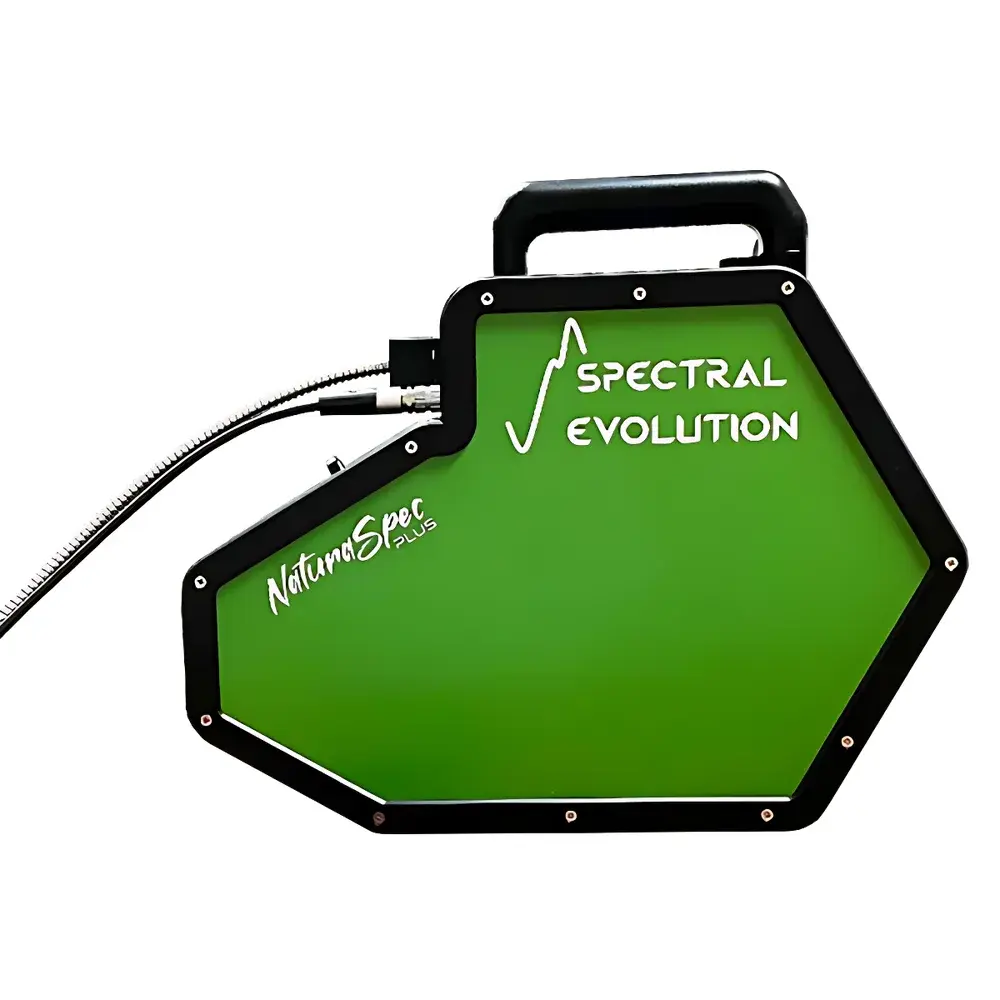
Spectral Evolution NaturaSpec Plus High-Resolution Field Spectroradiometer
| Brand | Spectral Evolution |
|---|---|
| Origin | USA |
| Model | NaturaSpec Plus |
| Spectral Range | 350–2500 nm |
| Detector | InGaAs (with Si CCD for VIS-NIR) |
| Resolution | 2.7 nm @ 700 nm |
| SNR | 0.3×10⁻⁹ W/cm²/nm/sr @ 400 nm |
| Weight | 4.5 kg (without internal battery) |
| Data Format | ASCII (.txt), compatible with ENVI, MATLAB, Python, and other spectral analysis platforms |
Overview
The Spectral Evolution NaturaSpec Plus is a high-resolution, field-deployable spectroradiometer engineered for rigorous terrestrial remote sensing, vegetation biophysics, soil characterization, and environmental monitoring applications. Operating across the full solar-reflected spectrum—from 350 nm in the ultraviolet through visible and near-infrared to 2500 nm in the shortwave infrared—the instrument employs a dual-detector architecture: a silicon charge-coupled device (Si CCD) for the 350–1000 nm range and a thermoelectrically cooled indium gallium arsenide (InGaAs) detector for 950–2500 nm. Its optical design utilizes a fixed grating monochromator, eliminating moving parts and ensuring long-term calibration stability under thermal and mechanical stress encountered in outdoor environments. The system adheres to radiometric traceability principles aligned with NIST-calibrated standards and supports absolute radiance, reflectance, and irradiance measurements when paired with calibrated reference panels and cosine correctors.
Key Features
- Fixed-grating optical path with no scanning or rotating components—maximizes mechanical robustness and measurement repeatability in field conditions.
- Integrated intelligent handgrip (SensaProbe+): includes a built-in HD camera for real-time field-of-view visualization, a precision inclinometer for zenith-angle validation, and an ultrasonic distance sensor for consistent source-to-sensor geometry control.
- Modular fiber-optic interface with quick-release coupling; factory-characterized fiber assemblies maintain spectral fidelity post-replacement without recalibration.
- Onboard lithium-ion battery (swappable and hot-swappable) plus support for external power banks—enables >12 hours of continuous operation in ambient temperatures from –10 °C to +45 °C.
- Automated acquisition routines: auto-shutter, auto-exposure, and real-time dark-current subtraction eliminate manual optimization—critical for rapid multi-site surveys and unattended deployments.
- Lightweight aluminum-magnesium chassis weighing only 4.5 kg (without battery); designed for backpack portability and tripod-mount compatibility with standard 1/4″–20 threads.
Sample Compatibility & Compliance
The NaturaSpec Plus is optimized for non-contact, non-destructive spectral sampling of natural surfaces including vegetation canopies, soil profiles, snow/ice, water bodies, and man-made materials. Its spectral response conforms to ASTM E275, ISO 9001:2015 (quality management), and supports data acquisition protocols compliant with NASA’s AVIRIS-NG and ESA’s PRISMA mission ground-truthing requirements. All radiometric calibrations are performed using NIST-traceable tungsten-halogen and deuterium lamps, with uncertainty budgets documented per ISO/IEC 17025. The system meets MIL-STD-810G for shock, vibration, and humidity resistance, and operates within IP54-rated environmental protection specifications.
Software & Data Management
Data are output in plain ASCII text format (.txt), with wavelength (nm) and radiance/reflectance (W/cm²/nm/sr or unitless %) columns—ensuring immediate interoperability with industry-standard analytical environments including ENVI, ERDAS IMAGINE, MATLAB, Python (NumPy/SciPy), and R. The included DARWin SP software (Windows-based) provides full instrument control, spectral library management, real-time preview, geometric correction tools, and batch processing for reflectance normalization against reference panels. DARWin SP supports audit-trail logging and user-defined metadata tagging—facilitating GLP-compliant workflows and FDA 21 CFR Part 11 readiness when configured with electronic signatures and access controls.
Applications
- Vegetation phenotyping and chlorophyll/carotenoid/water content estimation via narrowband indices (e.g., NDVI, PRI, WI, SIPI).
- Soil organic carbon and moisture mapping using SWIR absorption features at 1400 nm, 1900 nm, and 2200 nm.
- Mineral identification and lithological mapping in geological prospecting (e.g., clay, carbonate, sulfate diagnostic bands).
- Calibration/validation of airborne and satellite sensors (e.g., Sentinel-2, Landsat 9, PACE, ECOSTRESS).
- Urban material classification (roofs, pavements, façades) and solar reflectance index (SRI) assessment per ASTM E1980.
- Ecological monitoring of wetland health, algal bloom detection, and coastal water quality assessment.
FAQ
What calibration standards are used for factory radiometric calibration?
NaturaSpec Plus units are calibrated using NIST-traceable tungsten-halogen (VIS-NIR) and blackbody (SWIR) sources, with full spectral responsivity curves delivered in certified calibration reports.
Is the system suitable for UAV-mounted deployment?
While designed primarily for handheld and tripod use, the NaturaSpec Plus has been successfully integrated into stabilized gimbal systems on medium-class UAVs; users must provide custom mounting, power regulation, and thermal management solutions.
How frequently is recalibration recommended?
Annual recalibration is recommended for quantitative research applications; field validation using calibrated reference panels before each campaign is required per ISO 17025 best practices.
Does the system support irradiance measurements?
Yes—when equipped with an optional cosine-corrected foreoptic and calibrated irradiance standard, the NaturaSpec Plus delivers traceable downwelling solar irradiance spectra compliant with BSRN and AERONET protocols.
Can raw detector counts be accessed for custom processing?
Yes—DARWin SP exports uncorrected digital numbers (DN), dark frames, and flat-field references, enabling advanced users to implement proprietary radiometric correction models.





