
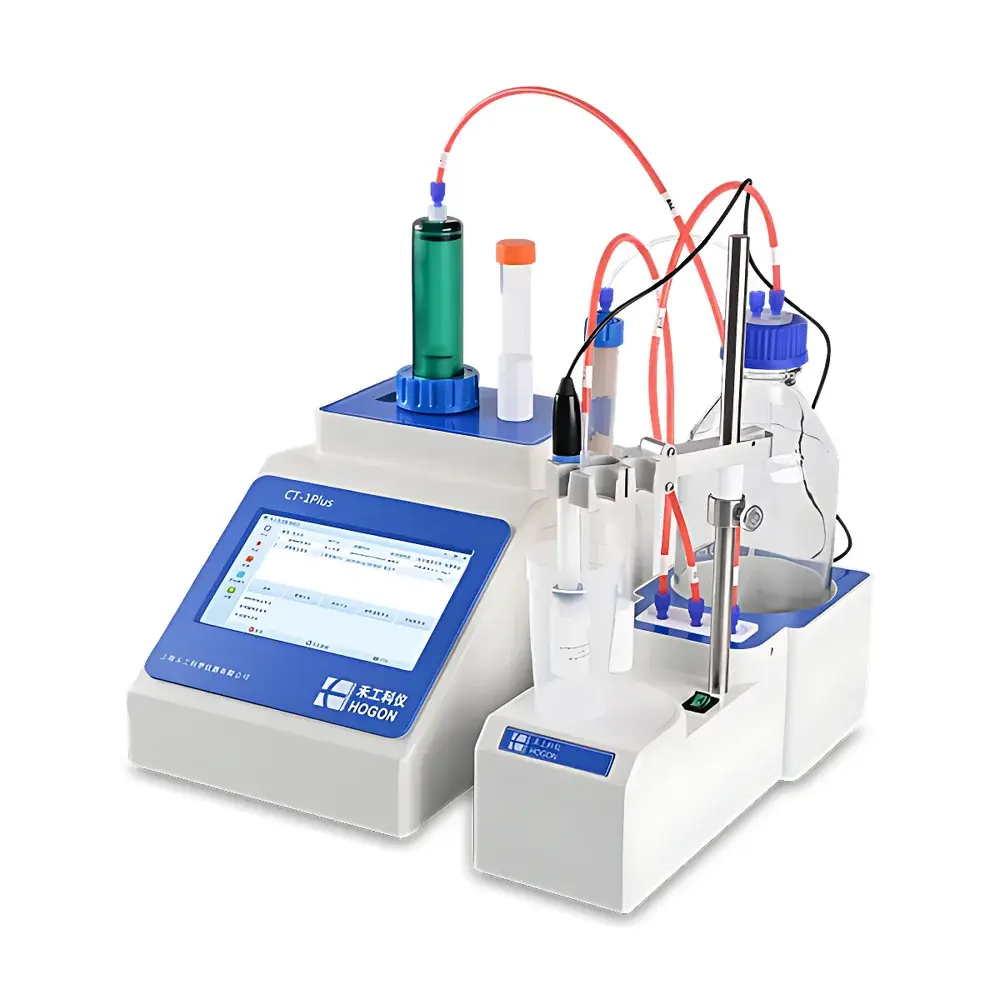
HOGON CT-1Plus Automatic Potentiometric Titrator for Chloride Ion Analysis in Fertilizers
| Brand | HOGON |
|---|---|
| Origin | Shanghai, China |
| Manufacturer Type | Direct Manufacturer |
| Instrument Category | Domestic |
| Model | CT-1Plus |
| Instrument Type | General-purpose Potentiometric Titrator |
| Application Scope | General-purpose |
| Measurement Range | Potential: ±2000 mV |
| pH | 0–14 |
| Temperature | −5 to 125 °C |
| Meter Accuracy | ±0.3% of full scale |
| Meter Resolution | 0.1 mV (potential), 0.001 pH unit, 0.1 °C |
| Titration Accuracy | (±0.3 mV ±1 digit) over 3 h |
| Titration Resolution | ±2000 mV range, 0.1 mV resolution, ±0.2 mV absolute accuracy |
Overview
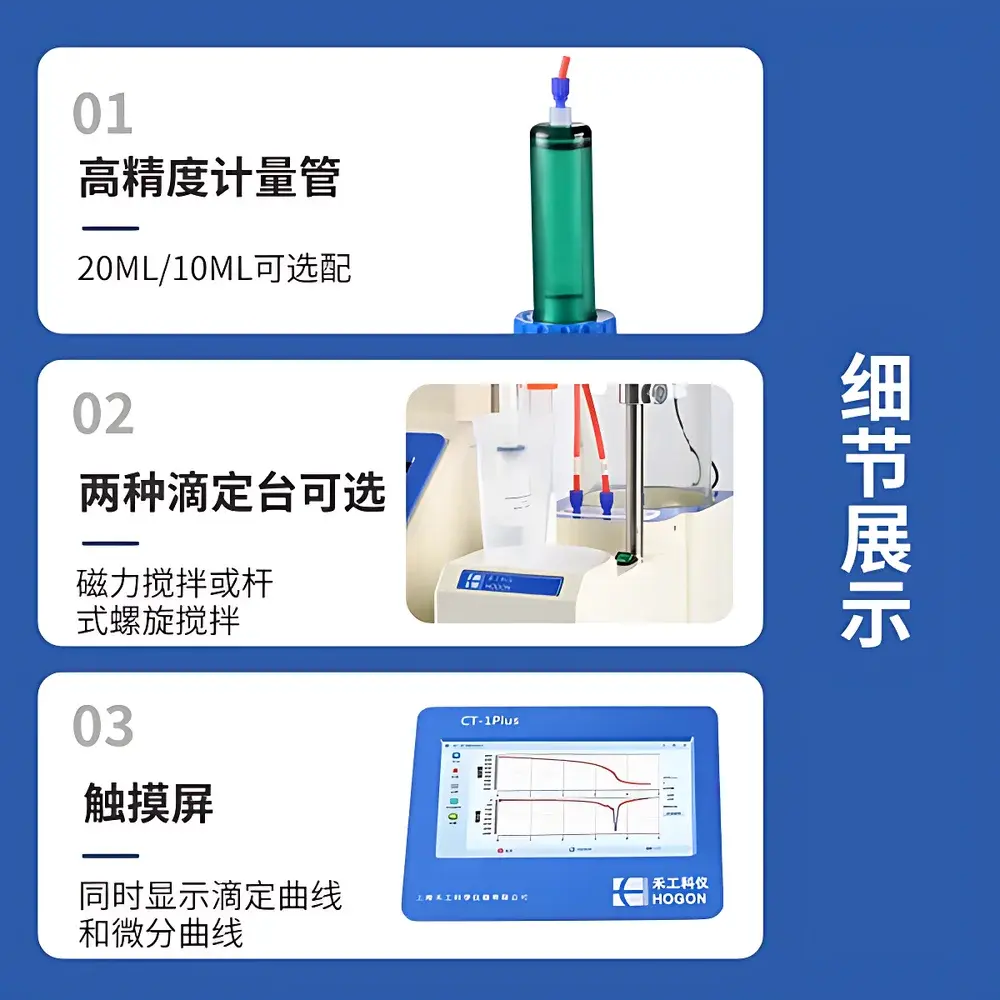
The HOGON CT-1Plus Automatic Potentiometric Titrator is a dedicated, high-reproducibility analytical platform engineered for the precise quantification of chloride ion (Cl⁻) in complex solid fertilizer matrices—particularly compound fertilizers—via argentometric titration using standardized silver nitrate (AgNO₃) solution. It operates on the fundamental principle of potentiometric endpoint detection, leveraging the Nernstian response of a silver/silver chloride (Ag/AgCl) sensing element to monitor real-time potential shifts during titration. The integrated Ag-101C composite electrode exhibits stable liquid-junction potential, low drift (<0.2 mV/h), and rapid response time (<15 s to 95% of final value), enabling robust endpoint identification even in turbid or partially suspended samples common in fertilizer dissolution workflows. Unlike manual or semi-automated methods, the CT-1Plus eliminates subjective visual interpretation by replacing colorimetric indicators with objective, algorithm-driven first-derivative (dE/dV) threshold detection—minimizing inter-operator variability and ensuring compliance with ISO 8466-1 and AOAC Official Method 971.21 for volumetric analysis in agricultural products.
Key Features
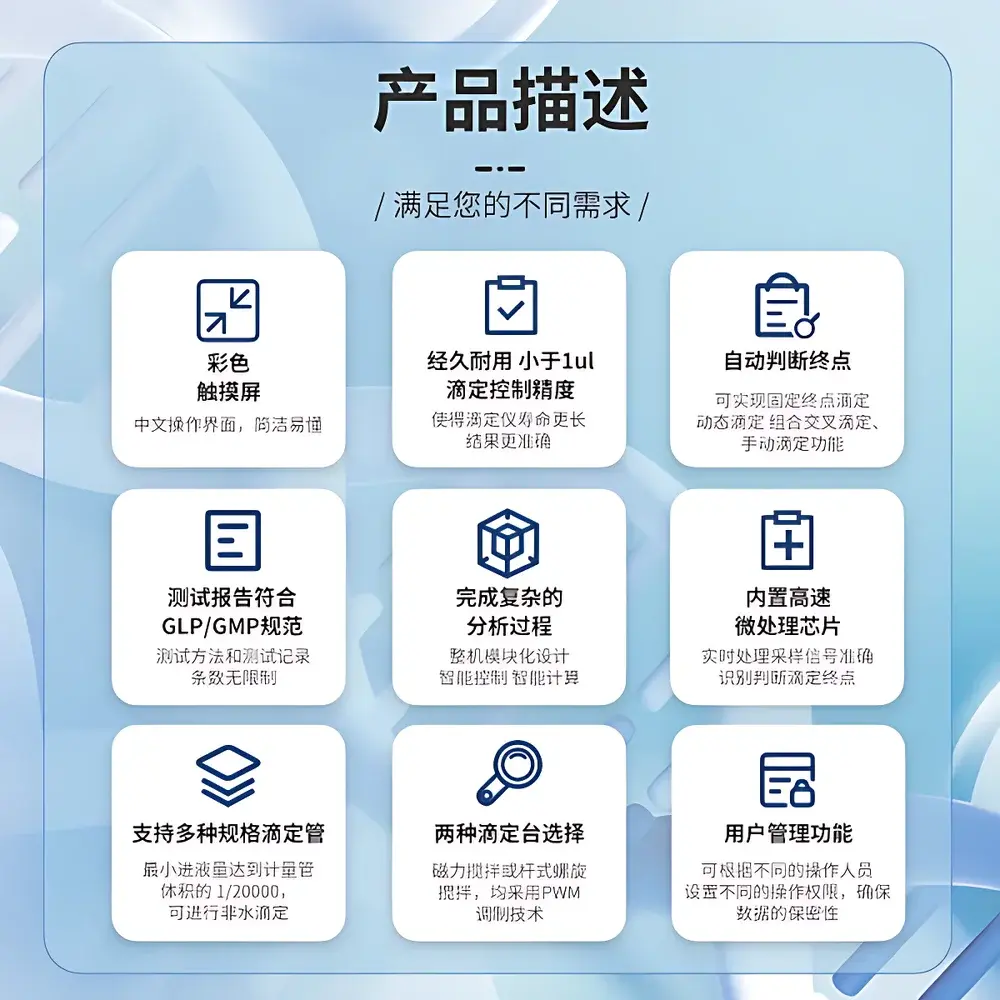
- Integrated dual-mode operation supporting both potentiometric and optional colorimetric titration protocols, enhancing method flexibility across R&D and QC labs.
- Precise micro-dosing system with programmable minimum dispensing volume of 20 µL and maximum per-step volume of 100 µL, optimized for low- and high-chloride fertilizers (0.1–15 wt% Cl⁻).
- Stirring control at fixed 200 rpm with adjustable magnetic stir bar coupling, ensuring homogeneous sample dispersion without vortex-induced electrode displacement or bubble entrapment.
- Endpoint determination via differential threshold algorithm (dE/dV ≥ 200 mV/mL), configurable with adaptive smoothing to suppress noise from particulate interference inherent in undissolved fertilizer residues.
- Thermal stabilization support: built-in temperature sensor (−5 to 125 °C, ±0.1 °C resolution) enables automatic temperature compensation of electrode slope and titrant activity per NIST SRM 1863 guidelines.
- Robust architecture with IP20-rated enclosure, CE-marked power supply, and ESD-protected analog input stage for long-term reliability in shared lab environments.
Sample Compatibility & Compliance
The CT-1Plus is validated for direct analysis of ground compound fertilizers following standardized sample preparation: 0.3–0.5 g accurately weighed into a 100 mL beaker, dissolved in 60 mL deionized water (≥18.2 MΩ·cm), and stirred for ≥90 s prior to transfer to the titration vessel. It accommodates heterogeneous suspensions containing phosphate, sulfate, nitrate, and urea without requiring pre-filtration—leveraging its high-sensitivity electrode design to resolve true stoichiometric endpoints amid background ionic strength up to 0.5 mol/L. The instrument conforms to GLP documentation requirements through timestamped audit trails, user-access-controlled method storage, and non-editable raw data export (CSV/Excel). Its measurement uncertainty profile aligns with ISO/IEC 17025:2017 clause 7.7 for volumetric determinations and supports traceability to national standards (e.g., GB/T 8572–2010, ISO 11260:2021) in fertilizer testing laboratories.
Software & Data Management
The embedded firmware provides a menu-driven interface with preloaded, editable methods—including “Fertilizer_Cl_AgNO3” compliant with Chinese National Standard GB/T 19203–2022. All titration sequences are logged with metadata: operator ID, sample ID, weight (g), ambient temperature (°C), titrant concentration (mol/L), equivalence volume (mL), calculated Cl⁻ content (% w/w), and dE/dV curve parameters. Raw potential vs. volume datasets export in ASCII format for external validation in MATLAB or OriginLab. While not FDA 21 CFR Part 11 certified out-of-the-box, the system supports ALCOA+ principles via password-protected user roles (Admin/Operator/Viewer), electronic signature prompts for method changes, and immutable local storage—facilitating internal GMP-aligned workflows upon configuration review.
Applications
Beyond chloride quantification in NPK and specialty compound fertilizers, the CT-1Plus supports multiple ISO- and ASTM-standardized assays: total alkalinity (ASTM D1093), free acid content in superphosphate (ISO 8466-2), calcium hardness in irrigation water extracts, and bromide in potassium-based fertilizers. Its modular electrode port allows rapid switching between Ag-101C (Cl⁻, Br⁻, I⁻), glass pH, and redox electrodes—enabling multi-parameter QC without hardware duplication. In agronomic research, it facilitates kinetic solubility profiling of slow-release formulations by sequential titration of leachates collected at defined intervals.
FAQ
What sample preparation protocol is required for compound fertilizer analysis?
Dissolve 0.3–0.5 g of finely ground sample in 60 mL deionized water; stir magnetically for ≥90 s before titration. No filtration is needed unless visible undissolved silicates persist.
Can the CT-1Plus validate compliance with GB/T 19203–2022?
Yes—the preconfigured “Fertilizer_Cl_AgNO3” method implements all procedural controls specified in Clause 6.3, including endpoint criteria (dE/dV ≥ 200 mV/mL), titrant standardization frequency, and repeatability thresholds (RSD ≤ 1.5%).
Is temperature compensation applied automatically during titration?
Yes—real-time temperature measurement adjusts the theoretical Nernst slope (59.16 mV/pCl at 25 °C) using the measured bath temperature; slope correction is recalculated every 10 s.
How is data integrity maintained for regulatory audits?
All runs generate tamper-evident logs with digital timestamps, operator IDs, and checksummed raw data files stored in internal flash memory—accessible only via USB export with read-only permissions.
What maintenance is required for the Ag-101C electrode?
Rinse with deionized water after each use; store immersed in 3 mol/L KCl solution. Perform daily open-circuit potential verification (target: +195 ± 10 mV vs. Ag/AgCl reference); recalibrate if drift exceeds 5 mV/h.



