
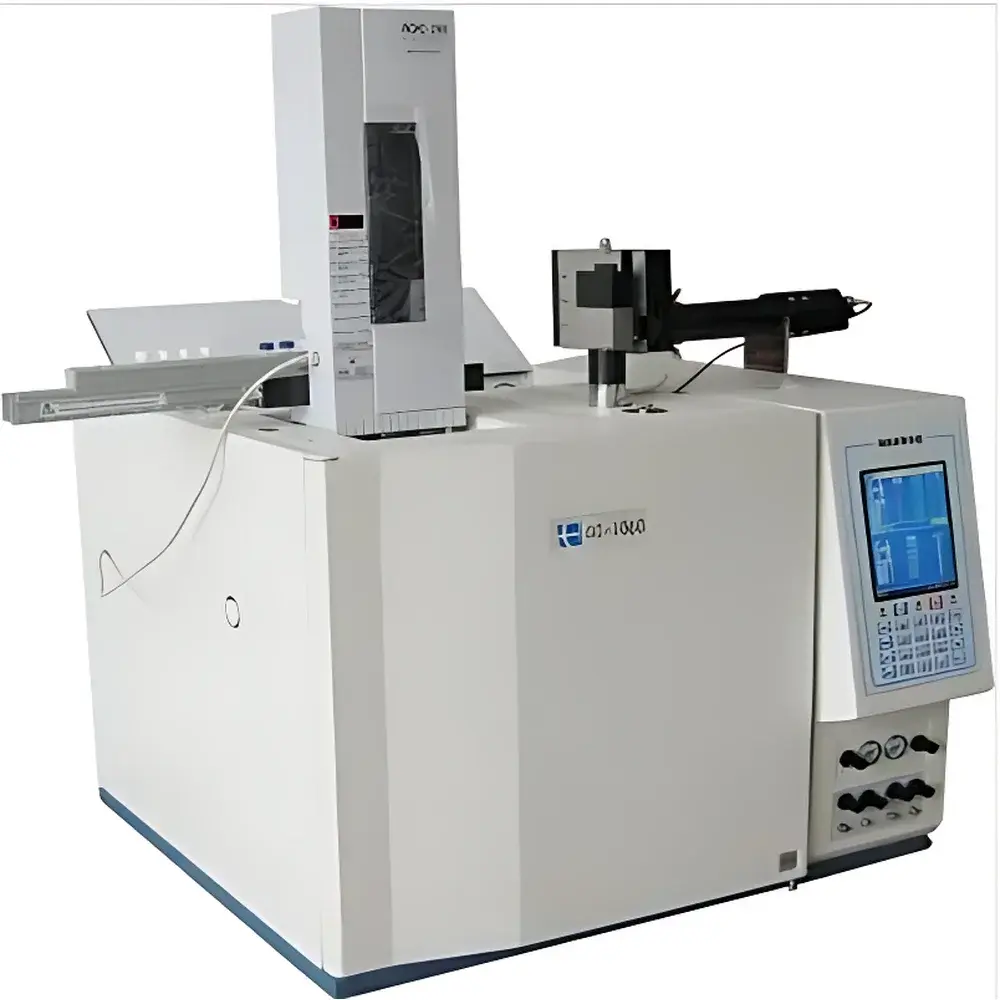
HOGON GC1860III Networked Intelligent Gas Chromatograph
| Brand | HOGON |
|---|---|
| Origin | Shanghai, China |
| Manufacturer Type | Direct Manufacturer |
| Instrument Type | Laboratory Gas Chromatograph |
| Model | GC1860III |
| Temperature Control Range | 4 °C to 450 °C |
| Oven Ramp Rate | 0.1–39 °C/min |
| Oven Cooling Rate | 40 °C/min |
| Carrier Gas Flow Range & Control | 0–500 mL/min |
| Carrier Gas Pressure Range & Control | 0–300 kPa |
| Injector Max Operating Temperature | 450 °C |
| Injector Pressure Setpoint Range | 0–300 kPa |
| Injector Total Flow Setpoint Range | 200 mL/min |
| Temperature Zones | 6 independent zones |
| Max Programmed Temperature Steps | 16 |
| Max Ramp Rate (with auxiliary heating) | 80 °C/min |
| Detector Compatibility | FID, TCD, ECD, FPD, NPD (up to 3 simultaneously) |
| Electronic Pressure Control (EPC) | Yes, dual-mode (constant pressure / constant flow) |
| Supported Gases | N₂, H₂, Air, He, Ar |
| Communication Interface | 10/100 M Adaptive Ethernet with embedded TCP/IP stack |
| Modbus/TCP & Profibus-DP Protocol Support | Yes |
| Software | STI-netChrom (supports up to 253 instruments, DCS integration via built-in Modbus/TCP server) |
| Display | Vacuum Fluorescent Display (VFD), bilingual (English/Chinese) |
| Auto-Start Scheduling | Yes |
| Auto-sampler Interface | Standard RS-232 and TTL trigger support |
Overview
The HOGON GC1860III is a networked, intelligent laboratory gas chromatograph engineered for high-reliability quantitative and qualitative analysis of volatile and semi-volatile organic compounds. It operates on the fundamental principle of differential partitioning between a mobile phase (inert carrier gas) and a stationary phase (capillary or packed column), enabling precise separation based on analyte volatility, polarity, and molecular interaction. Designed for continuous operation in regulated and industrial environments, the GC1860III integrates full electronic pressure and flow control (EPC), eliminating mechanical valves and analog pressure gauges—thereby enhancing method reproducibility, retention time stability, and long-term operational consistency. Its architecture supports seamless integration into process analytical technology (PAT) frameworks, particularly where real-time data exchange with distributed control systems (DCS) is required under ISA-88/ISA-95 or ASTM E2500-compliant workflows.
Key Features
- 6 independently programmable temperature zones with precision control (±0.1 °C) across a range of 4 °C to 450 °C, supporting complex multi-step temperature programs (up to 16 ramps)
- Modular detector bay accommodating up to three simultaneous detectors—including FID, TCD, ECD, FPD, and NPD—with factory-calibrated baseline stability and documented detection limits per ICH Q2(R2) and USP guidelines
- Embedded 10/100 M Ethernet interface with native TCP/IP stack and configurable static/dynamic IP addressing—enabling remote instrument monitoring, parameter adjustment, and run initiation from any networked workstation
- STI-netChrom chromatography data system (CDS) compliant with FDA 21 CFR Part 11 requirements for audit trails, electronic signatures, and role-based access control; supports concurrent management of up to 253 GC units
- Integrated Modbus/TCP server functionality for direct OPC-UA or DCS-level data ingestion—eliminating middleware and reducing latency in closed-loop process feedback applications
- Vacuum fluorescent display (VFD) with intuitive bilingual (English/Chinese) GUI, supporting local operation without PC dependency while retaining full method editing and diagnostic capability
- Automated safety protocols including flame-out detection and auto-reignition for FID, pressure fault shutdown, and leak-aware gas control logic—aligned with ISO/IEC 17025:2017 clause 6.4.2 on equipment integrity
Sample Compatibility & Compliance
The GC1860III accommodates diverse sample introduction modalities: split/splitless capillary injection, packed-column injection, gas sampling via 6-port or 10-port valves, headspace analysis (with optional autosampler interface), and purge-and-trap configurations. Its universal inlet design supports both standard septum-based and pressurized backflush-capable modules. The system meets essential electromagnetic compatibility (EMC) requirements per EN 61326-1:2013 and electrical safety standards per EN 61010-1:2010. While not pre-certified for ATEX or IECEx Zone 1 deployment, its EPC architecture and sealed electronics permit installation in Class 1 Div 2 environments when housed in appropriate enclosures. All firmware and CDS software undergo periodic revision control, with version history traceable per GLP Annex 11 and ISO/IEC 17025 documentation requirements.
Software & Data Management
STI-netChrom serves as the validated chromatography data system for the GC1860III, offering complete bidirectional instrument control, peak integration using dynamic baseline algorithms, and customizable report generation (PDF, CSV, XML). Audit trail logging captures all user actions—including method changes, sequence edits, calibration events, and result overrides—with immutable timestamps and operator identifiers. The CDS supports automated calibration curve generation (linear, quadratic, or weighted least-squares), limit checking against configurable specification ranges, and export to LIMS via HL7 or ASTM E1384-compliant interfaces. For regulated laboratories, optional 21 CFR Part 11 compliance packages include digital certificate enrollment, biometric-ready login modules, and encrypted database storage with SHA-256 hashing.
Applications
The GC1860III is routinely deployed in pharmaceutical QC labs for residual solvent analysis (ICH Q3C), environmental testing for VOCs in soil/water (EPA Method 8260D), petrochemical refineries for hydrocarbon speciation (ASTM D3606, D5599), food safety screening for pesticide residues (AOAC 2007.01), and polymer manufacturing for monomer purity verification. Its robust EPC performance ensures consistent retention indexing across shifts and operators—critical for trending studies under ISO 9001 Clause 8.5.1. In-process applications include reactor off-gas monitoring, catalyst deactivation tracking, and distillation cut-point validation—leveraging its Modbus/TCP output for direct feed to APC controllers.
FAQ
Does the GC1860III support FDA 21 CFR Part 11 compliance?
Yes—when configured with the validated STI-netChrom CDS package, including electronic signature enforcement, audit trail encryption, and role-based permission sets.
Can the instrument operate unattended for extended periods?
Yes—scheduled auto-start sequences, integrated fault recovery logic, and remote health monitoring enable 7×24 operation in supervised industrial settings.
Is third-party detector integration supported?
Only HOGON-certified detectors (FID, TCD, ECD, FPD, NPD) are fully supported; non-OEM detectors may compromise EPC calibration integrity and void warranty coverage.
What communication protocols are natively embedded?
Modbus/TCP, Profibus-DP, and standard TCP/IP socket communication—no external protocol converters required for DCS or SCADA connectivity.
How is temperature stability verified during qualification?
Per IQ/OQ protocols aligned with ASTM E1510-18, oven uniformity is mapped using calibrated PT100 probes at nine spatial points; zone gradient deviation must remain ≤±0.3 °C at 200 °C.
Related Products




