
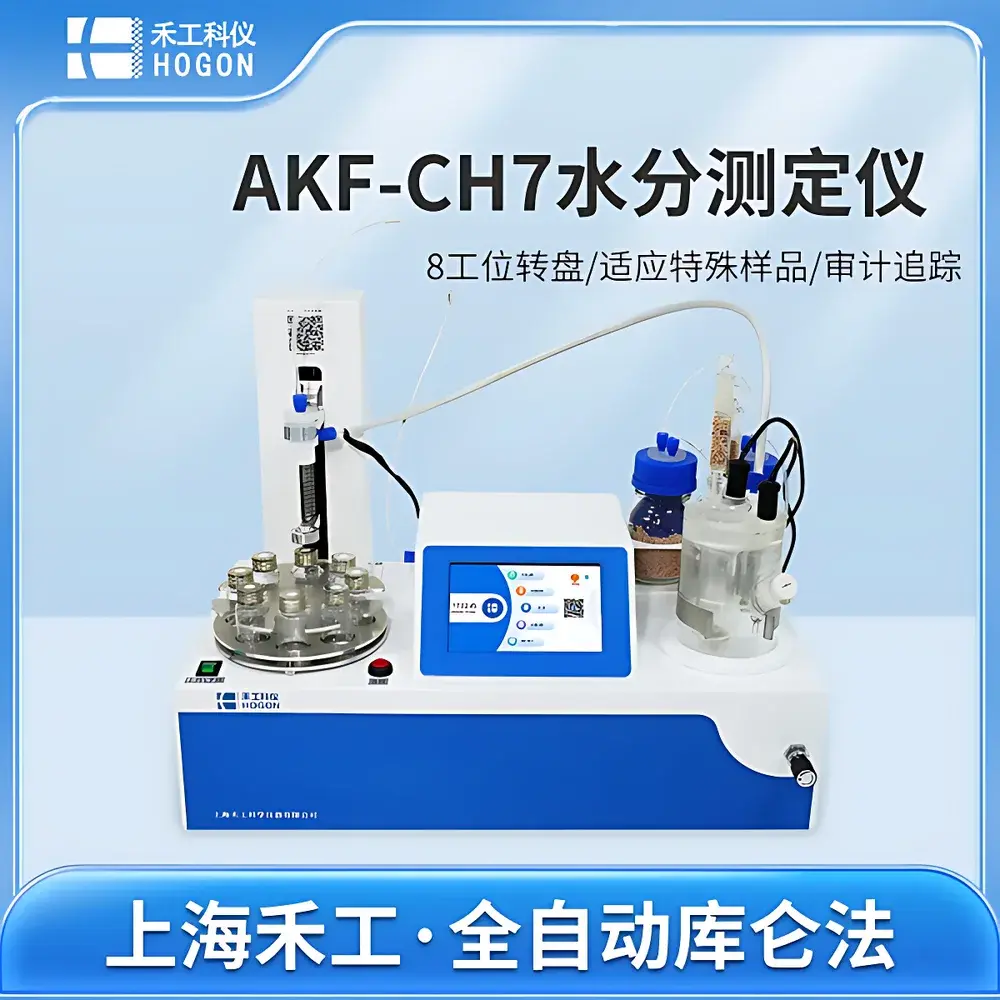
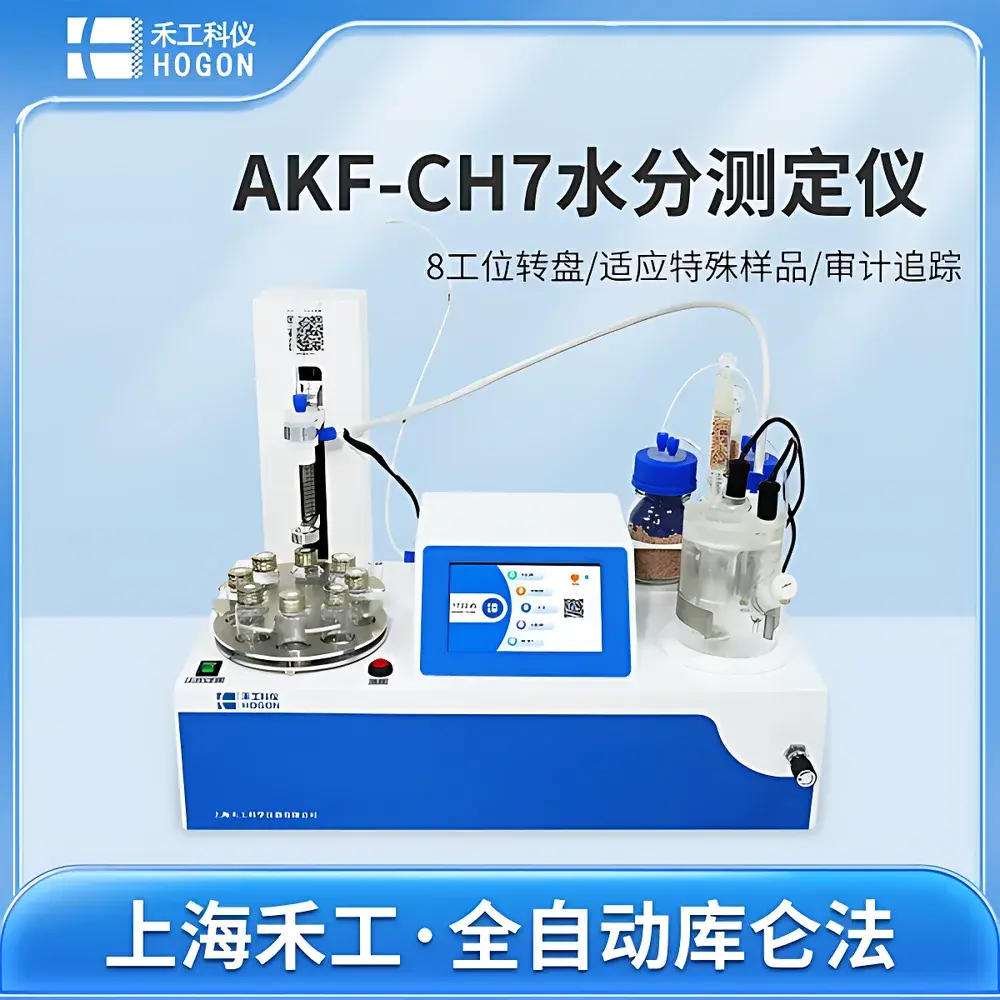
HOGON AKF-CH7 Multi-Position Coulometric Karl Fischer Moisture Analyzer
| Brand | HOGON |
|---|---|
| Origin | Shanghai, China |
| Manufacturer Type | Direct Manufacturer |
| Instrument Type | Coulometric Karl Fischer Moisture Analyzer |
| Titration Method | Fully Automatic Coulometric Titration |
| Moisture Range | 1 ppm to 100% w/w |
| Measurement Resolution | ±0.1 µA |
| Accuracy | ≤0.3% RSD |
| Minimum Dispensing Increment | 1/2000 of burette volume |
| Repeatability | ≥99.7% (n=6) |
| Linearity (r²) | ≥0.999 |
| Polarization Voltage | Not applicable (coulometric mode) |
| Electrolysis Electrode | Integrated dual-platinum electrode system |
| Current Control Precision | 0.1 mA |
| Power Supply | 110–240 V AC, 50–61 Hz |
| Data Storage | Internal non-volatile memory with timestamped records |
Overview
The HOGON AKF-CH7 Multi-Position Coulometric Karl Fischer Moisture Analyzer is an engineered solution for high-precision, trace-level moisture quantification in solid, liquid, and semi-solid samples across pharmaceutical, battery materials, polymer, petrochemical, and diagnostic reagent industries. Based on the fundamental electrochemical principle of coulometric Karl Fischer titration, the instrument generates iodine *in situ* via controlled electrolysis of iodide-containing reagent, enabling stoichiometric reaction with water (H₂O + I₂ + SO₂ + 3RN + CH₃OH → 2RN·HI + RN·HSO₄CH₃). This method eliminates volumetric reagent consumption variability and delivers inherent accuracy for ultra-low moisture determination (1 ppm detection limit), making it especially suitable for hygroscopic, low-water-content, or solvent-sensitive materials such as lithium-ion battery cathode/anode powders, separator films, lyophilized biologics, and high-purity solvents.
Key Features
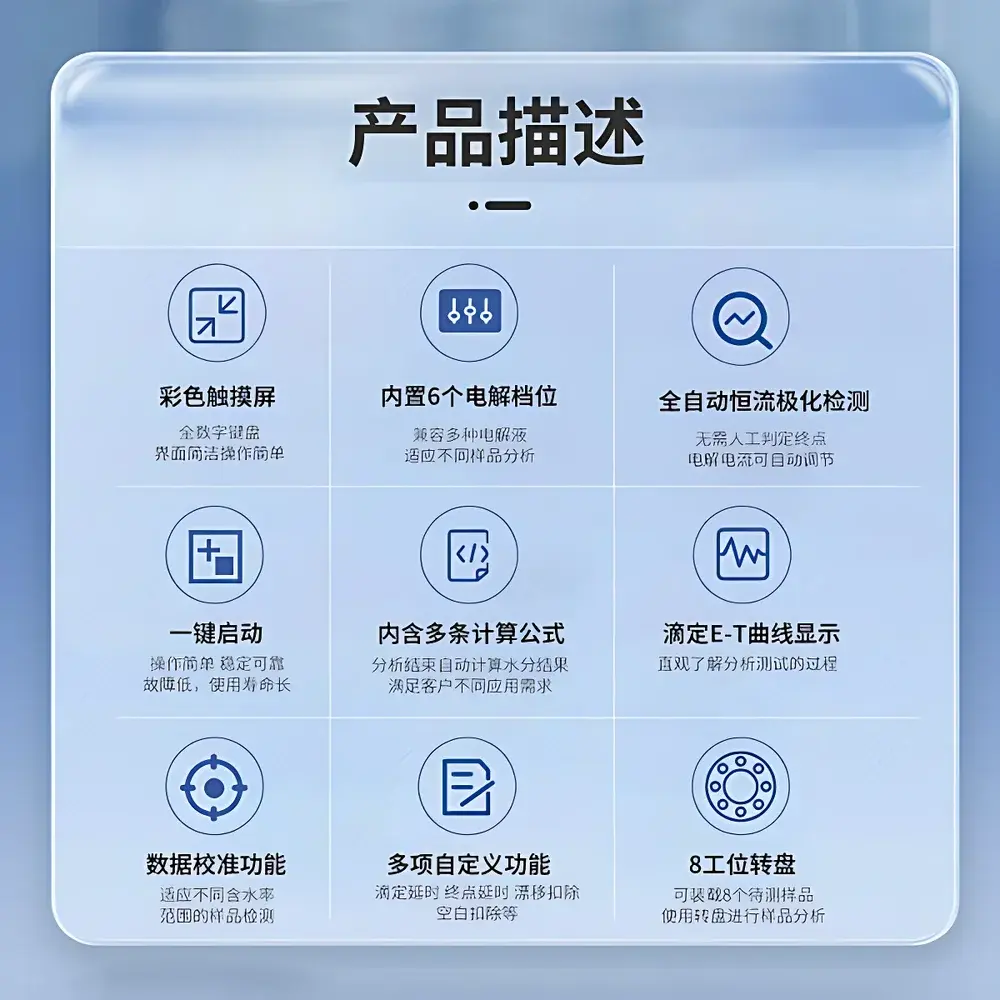
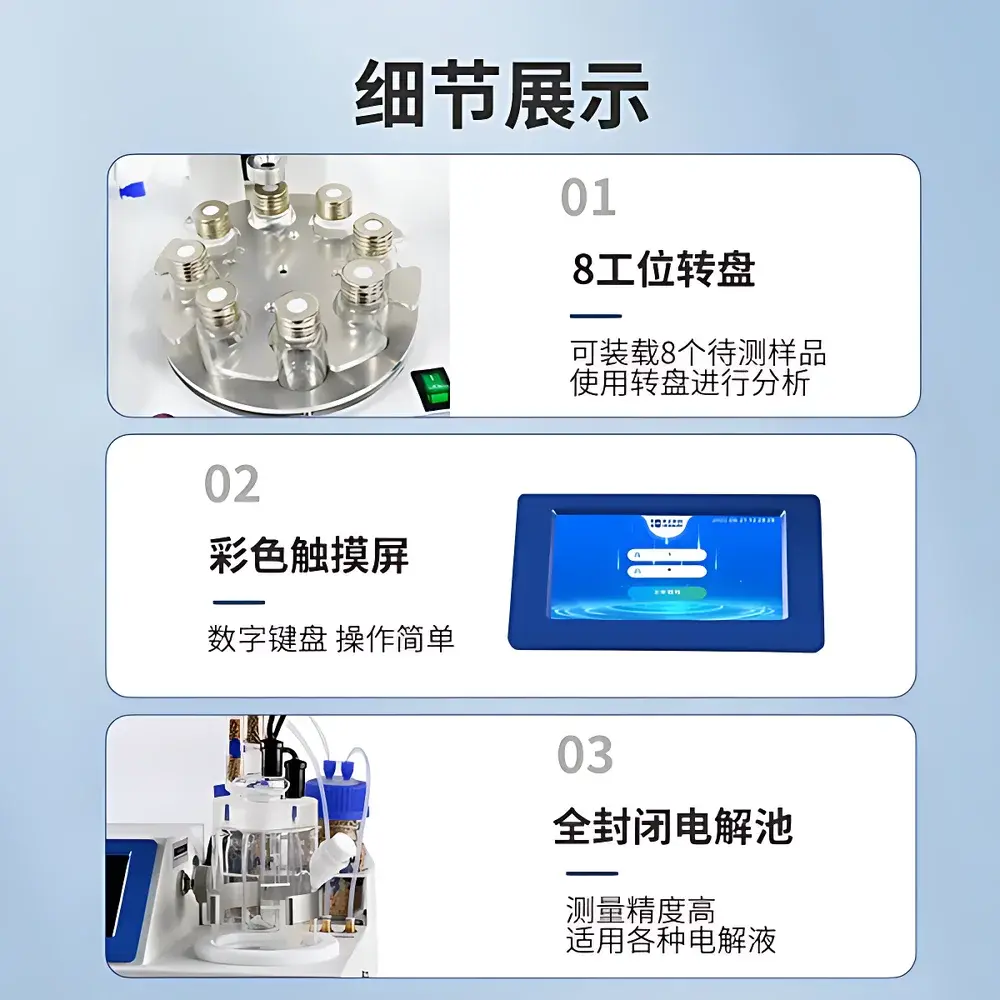
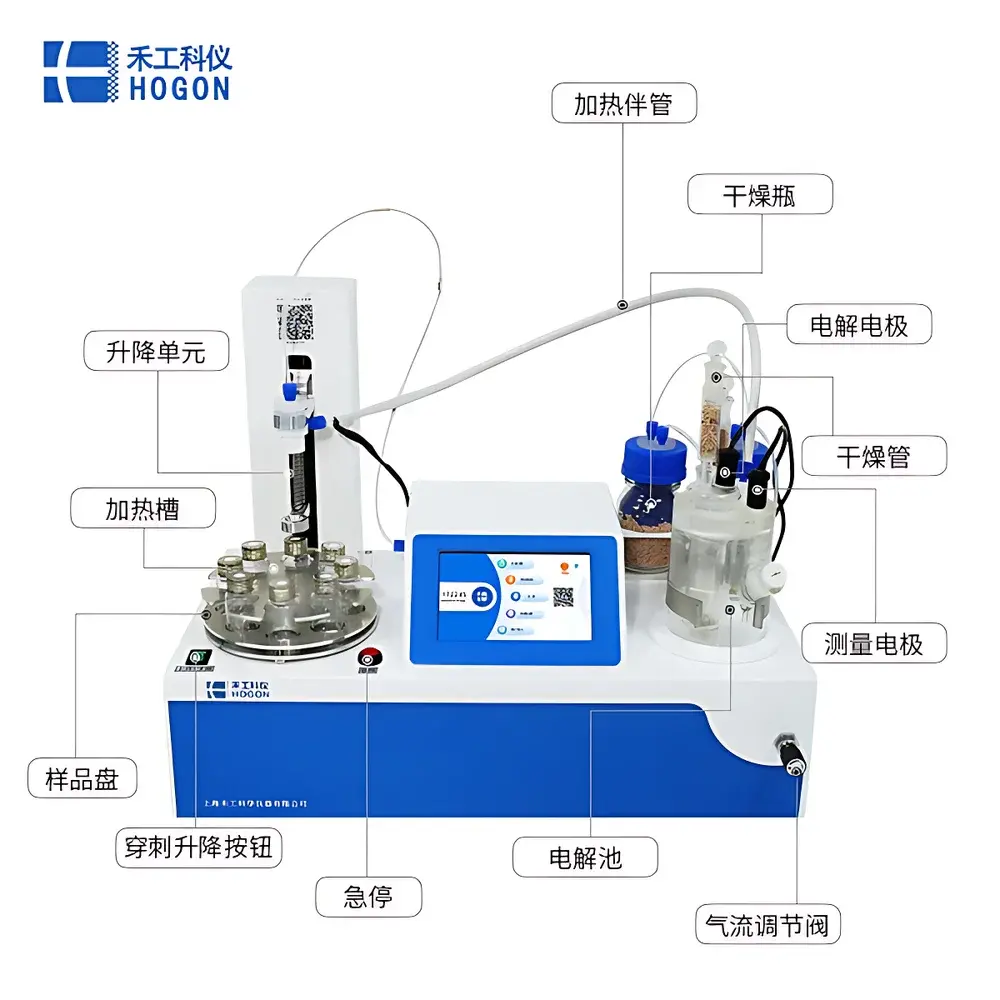
- 8-position manual sample carousel enables sequential analysis of up to eight samples without operator intervention between runs—ideal for routine QC batch testing and method validation workflows.
- Integrated dual-platinum electrolysis electrode with auto-balancing current control (0–400 mA range) ensures stable endpoint detection and minimizes over-titration risk, even for heterogeneous or slow-reacting matrices.
- Six pre-configured electrolysis current ranges allow dynamic adaptation to varying sample water content and reagent conductivity—optimizing both speed and resolution across diverse applications.
- 7-inch color capacitive touchscreen with full numeric keypad provides intuitive navigation, real-time E–t (current vs. time) curve visualization, and immediate access to method parameters, calibration logs, and raw data traces.
- Automated endpoint recognition via constant-current coulometric detection eliminates subjective visual or potentiometric endpoint interpretation—ensuring consistent, operator-independent results compliant with GLP/GMP documentation requirements.
- Built-in calculation engine supports multiple moisture expression formats (ppm, % w/w, mg H₂O, absolute µg), automatic blank subtraction, drift correction, endpoint delay, and fixed-duration titration modes—fully configurable per SOP.
- Non-volatile internal memory stores ≥10,000 test records with date/time stamp, operator ID, method name, raw current-time data, and final result—facilitating audit-ready data retrieval and export via USB interface.
Sample Compatibility & Compliance
The AKF-CH7 accommodates a broad spectrum of sample types—including freeze-dried pharmaceuticals, IVDR-compliant diagnostic reagents, lithium cobalt oxide (LCO) and NMC cathode materials, polyolefin separators, PET/PC granules, silicone oils, epoxy adhesives, and halogenated hydrocarbons—without requiring solvent exchange or derivatization. Its coulometric design avoids reagent degradation issues common in volumetric systems, ensuring long-term stability during unattended operation. The analyzer complies with key international standards including ASTM E1064 (Organic Liquids), ASTM D6869 (Plastics), ISO 15512 (Plastics – Water Content), GB/T 6023 (Butadiene), GB/T 7376 (Fluoroalkanes), and ChP 2020 General Chapter 0832 (Karl Fischer Method). All measurement protocols support 21 CFR Part 11–compatible electronic signatures and audit trail functionality when paired with optional LIMS integration.
Software & Data Management
Data integrity is maintained through embedded firmware that enforces secure user authentication (admin/operator levels), immutable timestamped record generation, and automatic checksum validation for stored datasets. Raw E–t curves and calculated results are exportable in CSV format for external statistical analysis (e.g., JMP, Minitab) or regulatory submission packages. Calibration verification logs—including standard addition tests and multi-point linearity checks—are retained alongside each analysis. Optional PC-based software (HOGON KF-Link Suite) provides advanced reporting templates aligned with ISO/IEC 17025 laboratory accreditation requirements, including uncertainty estimation per GUM principles and automated compliance flagging against predefined acceptance criteria.
Applications
- Pharmaceutical QA/QC: Quantification of residual moisture in lyophilized monoclonal antibodies, excipients, and sterile APIs—critical for stability prediction and shelf-life assignment per ICH Q5C.
- Battery Materials Characterization: Precise moisture assessment in cathode precursors (e.g., Ni-rich NCA), anode graphite, and ceramic-coated separators—directly impacting slurry rheology, cell gassing, and cycle life.
- Polymer & Packaging: Validation of drying efficacy for PET preforms, nylon films, and desiccant-filled blister packaging—ensuring barrier performance and preventing hydrolytic degradation.
- Chemical Manufacturing: Trace water monitoring in acetonitrile, THF, DMF, and other aprotic solvents used in Grignard or lithiation reactions—where ppm-level contamination compromises yield and selectivity.
- In Vitro Diagnostics: Verification of moisture limits in lyophilized enzyme conjugates and calibrators—supporting FDA 21 CFR Part 820 design control and verification protocols.
FAQ
What distinguishes coulometric from volumetric Karl Fischer titration in practical use?
Coulometric KF is optimized for samples containing ≤1% water (typically 1 ppm–1000 ppm), offering superior precision and reagent economy due to *in situ* iodine generation. Volumetric KF is preferred for higher water content (>0.1%) and viscous or particulate-laden samples where reagent delivery consistency is more critical than ultimate sensitivity.
Can the AKF-CH7 be integrated into an automated lab environment?
Yes—the instrument features RS-232 and USB Device interfaces for bidirectional communication with LIMS or ELN platforms. Optional relay outputs enable hardware-triggered start/stop signals synchronized with autosamplers or robotic arms.
Is method validation support available for regulated environments?
HOGON provides IQ/OQ documentation templates, system suitability test procedures, and traceable calibration standards (certified water standards per NIST SRM 2890) to support analytical method validation per ICH Q2(R2) and USP .
How does the 8-position carousel handle sample carryover or cross-contamination?
Each position uses dedicated, disposable glass or PTFE reaction vessels; the carousel design prevents physical contact between vessels. Optional purge gas (dry nitrogen) flow during titration further suppresses ambient moisture ingress and residue accumulation.
What maintenance intervals are recommended for long-term operational reliability?
Electrode cleaning with methanol every 50–100 analyses; reagent replacement every 3–6 months depending on usage frequency; annual verification of current source linearity and temperature sensor calibration using certified reference instruments.
Related Products





