
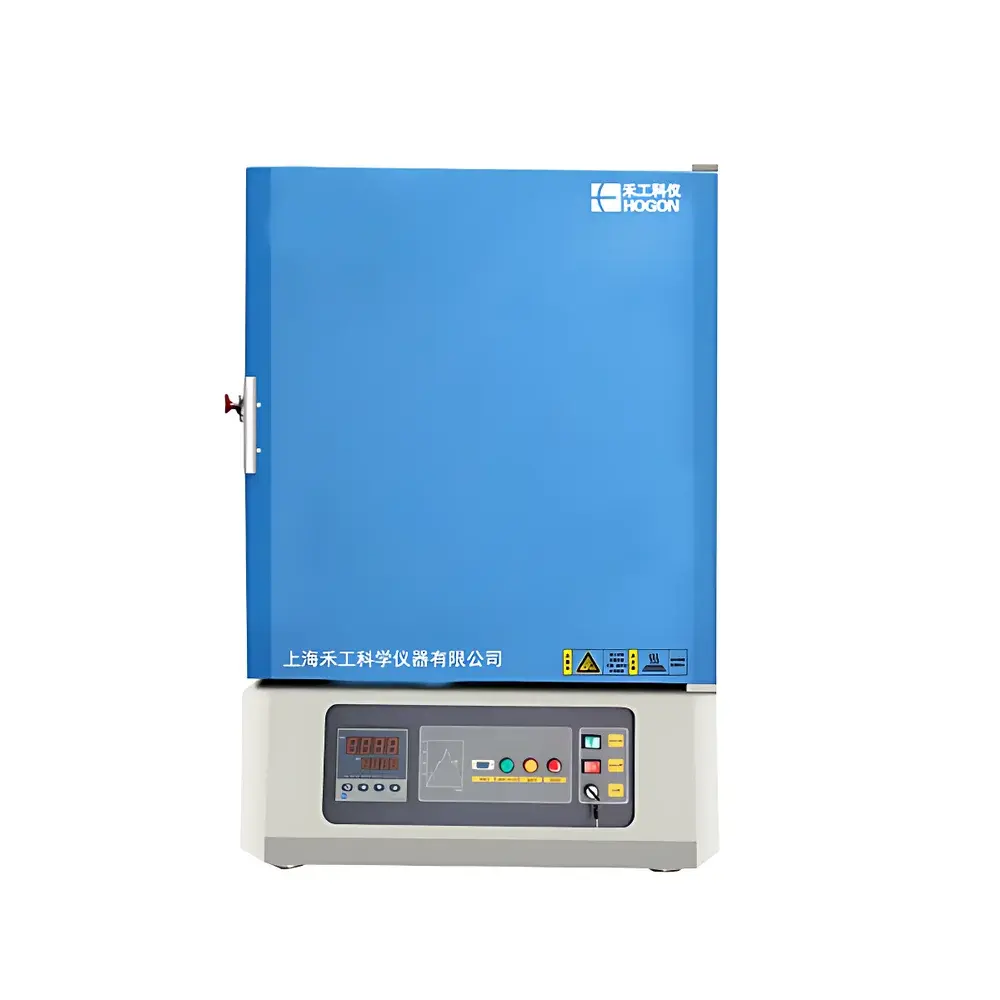
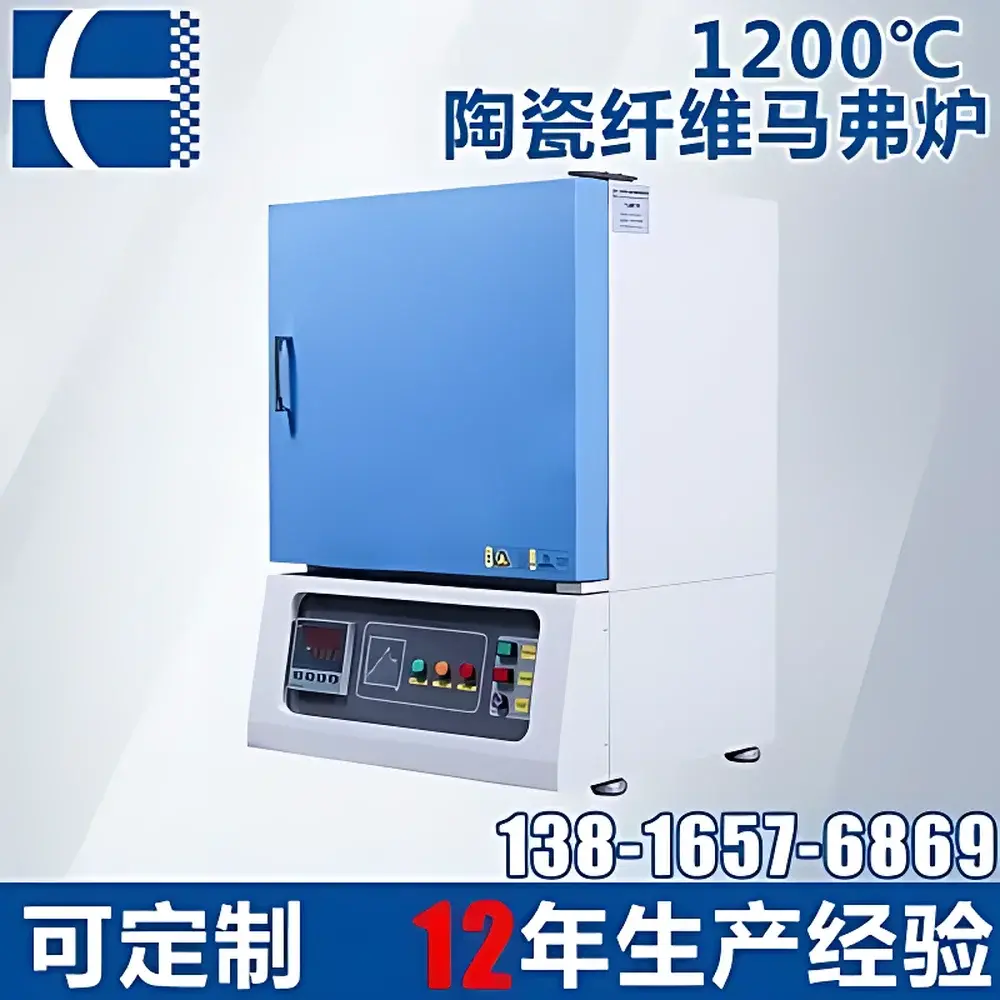
HG-12-4B Ceramic Fiber Muffle Furnace by HOGON
| Brand | HOGON |
|---|---|
| Origin | Shanghai, China |
| Manufacturer Type | Direct Manufacturer |
| Instrument Type | Box-Type Muffle Furnace |
| Max Temperature | 1200 °C |
| Temperature Control Accuracy | ±1 °C |
| Rated Power | 3000 W |
| Heating Rate to Max Temp | ≤30 min |
| Heating Element Material | 0Cr27Al7Mo2 Alloy Wire (Kanthal® Super) |
| Internal Chamber Dimensions | 300 × 200 × 120 mm (L×W×H) |
| Insulation Material | Sintered Al₂O₃ Polycrystalline Fiber |
| Thermocouple Type | N-Type (OMEGA®) |
| Control System | AI-PID with Self-Tuning & 30-Stage Programmable Ramp/Soak |
| Interface | VMCI Protocol-Compatible Data Port |
| Safety Features | Over-Temperature Cut-off, Thermocouple Break Detection, Earth Leakage Protection |
| Cooling Rate (from 700 °C) | ≤10 °C/min |
| External Surface Temperature | <50 °C during operation |
| Power Supply | AC 220 V, 50/60 Hz |
Overview
The HG-12-4B Ceramic Fiber Muffle Furnace is a high-performance, energy-efficient laboratory furnace engineered for precision thermal processing in research, quality control, and routine analytical workflows. Unlike traditional refractory brick muffle furnaces—characterized by high thermal mass, slow response, and mechanical fragility—the HG-12-4B employs sintered polycrystalline alumina fiber as its primary insulation material. This advanced ceramic fiber exhibits exceptional thermal stability up to 1200 °C, ultra-low heat capacity, and superior thermal shock resistance. Its lightweight monolithic chamber structure enables rapid heating (up to 30 °C/min) and precise temperature uniformity across the working zone, making it suitable for applications demanding strict thermal reproducibility—including ashing, calcination, sintering, pre-treatment of environmental and pharmaceutical samples, and thermal gravimetric preparation.
Key Features
- Ultra-Lightweight Sintered Alumina Fiber Chamber: Manufactured via vacuum-assisted forming, the monolithic furnace lining eliminates joints and cracks, ensuring long-term dimensional stability and consistent thermal performance over thousands of thermal cycles.
- Dual-Layer Cooled Housing with Active Air Circulation: A thermally decoupled outer shell incorporates an integrated forced-air cooling system that continuously extracts residual heat from the interstitial cavity, maintaining external surface temperature below 50 °C even at maximum operating temperature—enhancing operator safety and reducing ambient lab heating load.
- High-Fidelity Temperature Control Architecture: Equipped with an OMEGA® N-type thermocouple mounted in direct rear-wall contact with the chamber wall, coupled to an AI-based PID controller featuring auto-tuning, real-time deviation compensation, and 30-stage programmable ramp/soak profiles with independent rate and dwell settings.
- Industrial-Grade Heating Elements: Swedish Kanthal® Super (0Cr27Al7Mo2) alloy heating wires are embedded in three-directional (left/right/top) configuration for optimal radial and axial temperature homogeneity—minimizing hot/cold zones and improving sample-to-sample repeatability.
- Comprehensive Safety & Compliance Integration: Built-in dual-redundant over-temperature protection, thermocouple break detection with immediate power cutoff, and Class I earth leakage circuit breaker conform to IEC 61010-1 safety standards for laboratory electrical equipment.
- VMCI-Ready Digital Interface: Standard RS-485 port supports VMCI protocol for seamless integration into centralized lab management systems, enabling remote monitoring, audit-trail logging, and synchronized multi-furnace operation under GLP/GMP-aligned data governance frameworks.
Sample Compatibility & Compliance
The HG-12-4B accommodates standard crucibles (alumina, quartz, silicon carbide) up to Ø80 mm × 50 mm height within its 300 × 200 × 120 mm chamber. Its inert, non-reactive alumina fiber environment ensures compatibility with organic matrices, halogenated compounds, sulfates, and metal oxides without catalytic interference or volatile residue carryover. The furnace meets ASTM E1112 (Standard Specification for Laboratory Muffle Furnaces), ISO 5667-18 (Water Quality – Sampling – Guidance on Storage and Handling of Samples), and USP & EP requirements for ash content determination (e.g., USP , Ph. Eur. 2.2.39). Optional accessories—including calibrated crucible sets, stainless steel furnace stands, and validated computer control software—support 21 CFR Part 11-compliant electronic recordkeeping when deployed in regulated environments.
Software & Data Management
The optional HOGON LabControl™ software suite provides full bidirectional communication via the VMCI interface. It supports real-time temperature curve visualization, event-triggered data capture (e.g., door open/close, alarm activation), automatic generation of PDF-formatted compliance reports (including timestamped setpoints, actual readings, and deviation alerts), and export to CSV or LIMS-compatible XML formats. All operations are logged with user ID, timestamp, and action metadata—enabling full traceability required for internal audits, FDA inspections, or ISO/IEC 17025 accreditation. The system supports concurrent control of up to 16 units on a single network segment, with configurable access levels for operators, supervisors, and QA reviewers.
Applications
- Environmental & Water Analysis: Determination of total suspended solids (TSS), volatile solids (VS), fixed residue, and heavy metal ashing per EPA Method 200.2 and ISO 11923.
- Pharmaceutical & Clinical Labs: Residue-on-ignition testing (USP ), capsule shell ash content, and biological tissue pre-digestion prior to ICP-MS analysis.
- Coal & Cement Testing: Moisture, ash, volatile matter, and sulfur content quantification per ASTM D3172–D3176 and ISO 1171.
- Materials Science: Thermal stabilization of nanocomposites, binder burnout in green ceramics, and controlled oxidation of transition metal precursors.
- Food & Agriculture: Crude ash determination in feedstuffs (AOAC 942.05), pesticide residue mineralization, and soil organic carbon analysis (Walkley-Black modification).
FAQ
What is the recommended maximum heating rate for routine use?
For optimal thermal uniformity and extended element life, a ramp rate of ≤20 °C/min is advised; 30 °C/min is specified only for time-critical protocols where short-term thermal gradients are acceptable.
Is the furnace compatible with inert or reducing atmospheres?
The standard model is designed for air atmosphere only; optional quartz tube inserts with gas inlet/outlet ports are available for controlled N₂ or Ar purging—contact technical support for custom configuration.
Does the unit include calibration documentation?
Each furnace ships with a factory-assembled calibration certificate traceable to NIM (National Institute of Metrology, China), including as-found/as-left verification at 500 °C, 900 °C, and 1200 °C using a reference-grade N-type thermocouple.
Can the VMCI interface be used with third-party SCADA or LIMS platforms?
Yes—the open VMCI protocol specification is provided upon request, and HOGON offers integration support for Modbus RTU mapping and OPC UA gateway configuration.
What maintenance intervals are recommended for long-term reliability?
Annual inspection of thermocouple integrity, heating element continuity, and cooling fan functionality is advised; no routine replacement parts are required under normal usage conditions (≤8 hrs/day, ≤5 days/week).



