
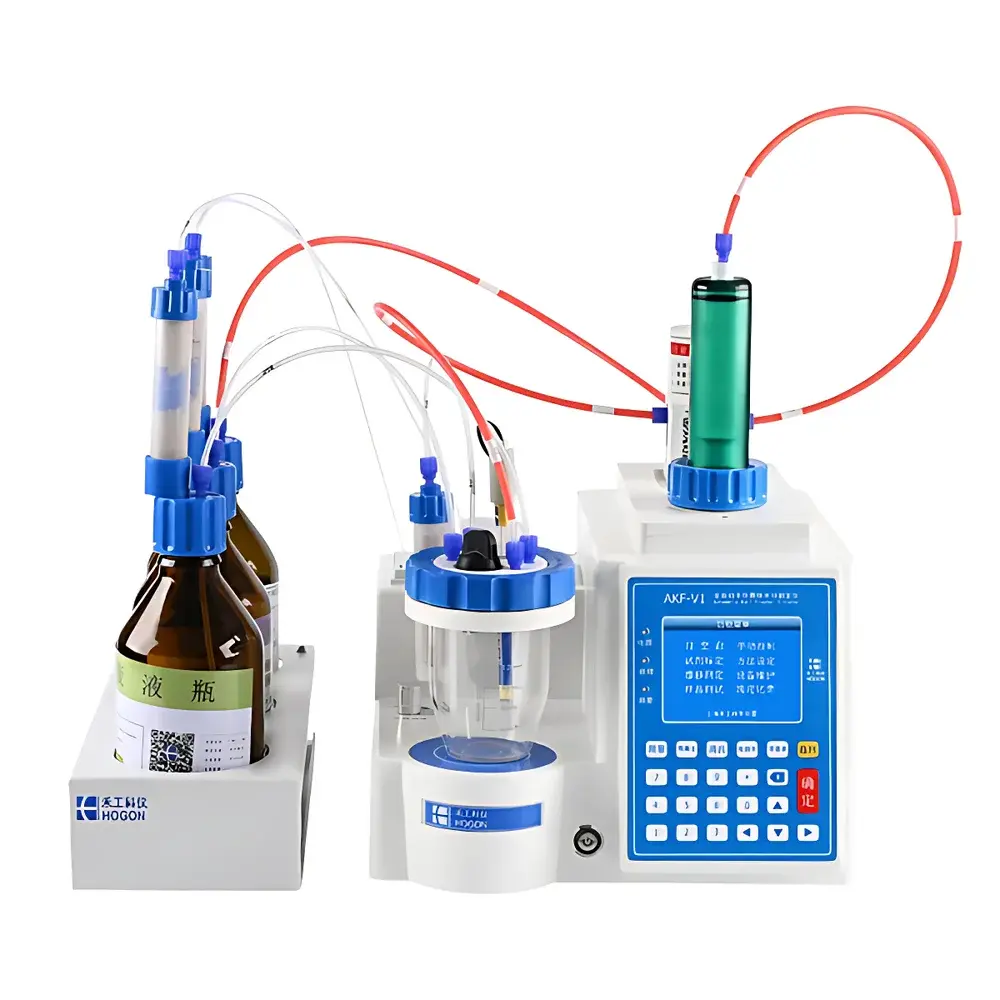
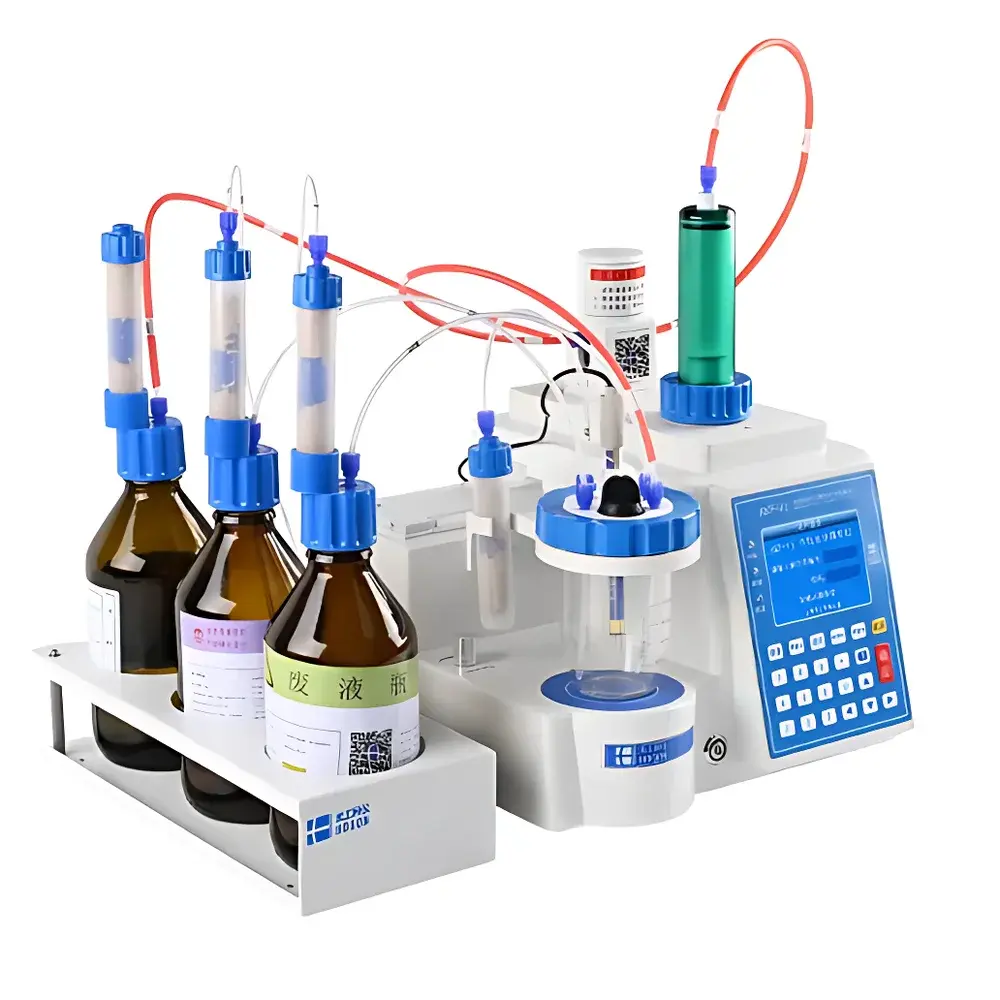
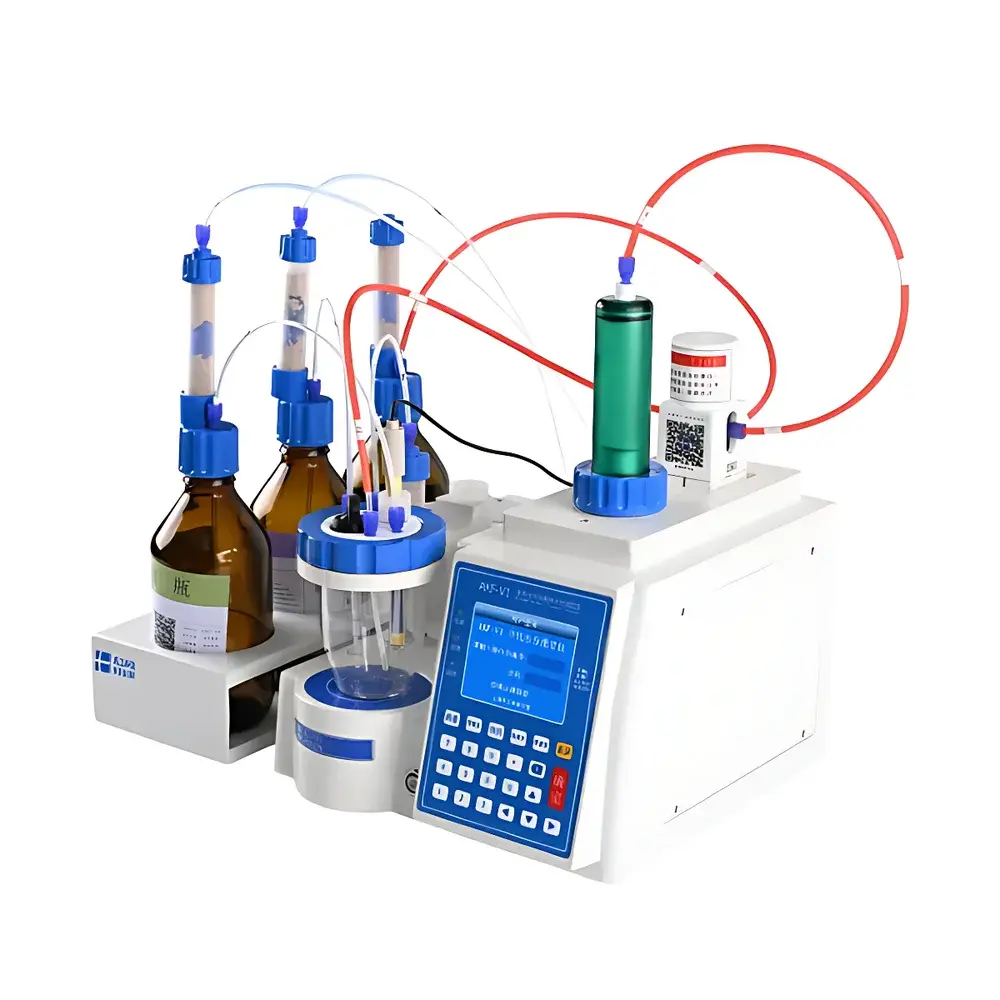
HOGON AKF-V1 Karl Fischer Moisture Analyzer for Aluminum Hypophosphite Flame Retardants
| Brand | HOGON |
|---|---|
| Origin | Shanghai, China |
| Manufacturer Type | Direct Manufacturer |
| Instrument Type | Volumetric Karl Fischer Titrator |
| Moisture Range | 0.001–100.00% (10 ppm – 100% w/w) |
| Resolution | 1 ppm |
| Measurement Precision | ±1 mV (endpoint detection) |
| Minimum Dispensing Volume | 1 µL |
| Repeatability | RSD ≤ 0.5% (at 20 mg H₂O) |
| Linearity of Titration Response | ≥ 0.998 |
| Polarization Voltage Adjustment Range | 0–120 mV |
| Burette | 20 mL Long-Life Automatic Burette |
| Burette Accuracy | ±0.001 mL |
| Power Supply | 110–240 V AC, 50–60 Hz |
| Data Storage Capacity | 100 test records |
Overview
The HOGON AKF-V1 Karl Fischer Moisture Analyzer is a dedicated volumetric titration system engineered for precise and reproducible water content determination in thermally sensitive, low-solubility, and hygroscopic materials—particularly aluminum hypophosphite (AHP) flame retardants. These inorganic phosphorus-based additives are widely adopted in engineering plastics, elastomers, and cable compounds due to their halogen-free formulation, high thermal stability, and excellent char-forming capability. However, residual moisture in AHP significantly compromises its dispersion behavior during compounding, catalyzes premature decomposition during extrusion, and reduces flame-retardant efficiency by interfering with phosphoric acid condensation pathways. The AKF-V1 addresses this critical quality control requirement through coulometric-validated volumetric KF titration, operating on the stoichiometric reaction between iodine, sulfur dioxide, methanol, and water (I₂ + SO₂ + CH₃OH + H₂O → 2HI + CH₃OSO₃H). Its optimized electrode geometry, sealed titration cell design, and adaptive endpoint detection ensure robust performance even with heterogeneous AHP powders that exhibit slow dissolution kinetics and surface adsorption effects.
Key Features
- Optimized for aluminum hypophosphite: Pre-configured method templates and solvent conditioning protocols specifically validated for AHP’s low solubility in standard KF reagents.
- Volumetric precision: 20 mL high-stability burette with ±0.001 mL dispensing accuracy and 1 µL minimum step resolution, enabling trace-level quantification down to 10 ppm.
- Stable endpoint detection: Dual-platinum electrode system with adjustable polarization voltage (0–120 mV) to suppress false endpoints caused by redox-active impurities common in metal phosphinates.
- Automated workflow: Integrated sequences for solvent purging, blank titration, reagent standardization (using certified 1.00 mg H₂O/mL standard), and sample analysis—all executed without manual intervention.
- Hermetic titration cell: Fully enclosed glass cell with magnetic stirring platform and desiccant-sealed reagent reservoirs to prevent ambient moisture ingress during extended runs.
- Thermal drift compensation: Real-time ambient temperature monitoring and algorithmic correction of titrant activity drift, ensuring measurement consistency across laboratory environments (15–30 °C, 30–70% RH).
Sample Compatibility & Compliance
The AKF-V1 supports direct analysis of solid AHP powders (particle size < 100 µm), as well as related flame retardant formulations containing melamine polyphosphate, ammonium polyphosphate, or synergistic metal oxides. Sample introduction is performed via pre-weighed vials using an analytical balance (0.01 mg readability recommended). The instrument complies with ASTM E203–22 and ISO 8533:2021 for volumetric KF titration methodology. All measurement data—including timestamps, operator ID, reagent batch numbers, titration curves, and raw mV readings—are stored with immutable audit trails, satisfying GLP documentation requirements and supporting FDA 21 CFR Part 11 readiness when paired with networked LIMS integration.
Software & Data Management
The embedded firmware provides intuitive touchscreen navigation with multilingual UI (English, German, Japanese, Chinese). Each test record includes full metadata: sample ID, weight, solvent volume, titrant consumption, calculated water %, RSD against triplicate blanks, and linear regression statistics from calibration. Up to 100 results are retained onboard with automatic overwrite protection. Data export is supported via USB 2.0 (CSV/Excel-compatible format) or optional Ethernet interface for centralized QC database synchronization. Software validation documentation (IQ/OQ protocols) and electronic signature support modules are available upon request for regulated pharmaceutical or automotive material certification workflows.
Applications
Beyond aluminum hypophosphite, the AKF-V1 delivers reliable moisture quantification for:
- Phosphorus-nitrogen synergists (e.g., guanidine phosphate, melamine cyanurate)
- Surface-modified metal hydroxides (Al(OH)₃, Mg(OH)₂) used in wire & cable compounds
- Reactive flame retardant monomers (e.g., DOPO derivatives, phosphonates)
- Pharmaceutical excipients (microcrystalline cellulose, lactose monohydrate)
- Electrolyte salts for lithium-ion batteries (LiPF₆, LiFSI)
Its ability to resolve moisture contributions from both surface-adsorbed and lattice-bound water—without thermal decomposition—is essential for release testing of AHP prior to masterbatch production.
FAQ
What solvent system is recommended for aluminum hypophosphite analysis?
Methanol-based KF reagents (e.g., Hydranal-Composite 5) are standard; for improved solubility, up to 10% chloroform co-solvent may be added under method validation.
Can the AKF-V1 handle samples with high salt content?
Yes—the dual-platinum electrode and adjustable polarization voltage mitigate passivation effects from ionic residues common in precipitated AHP synthesis batches.
Is method transfer possible from other KF instruments?
All calibration parameters, titrant factors, and endpoint thresholds are user-exportable and compatible with HOGON’s cross-platform software suite (AKF-Expert Suite v3.2+).
How often must the burette be recalibrated?
Burette linearity verification is required every 6 months per ISO/IEC 17025; daily blank checks and weekly standardization with certified reference material are recommended.
Does the system support multi-point calibration curves?
Yes—up to five concentration points can be defined to validate linearity across the full 10 ppm–100% range, with automatic R² calculation and outlier rejection.





