
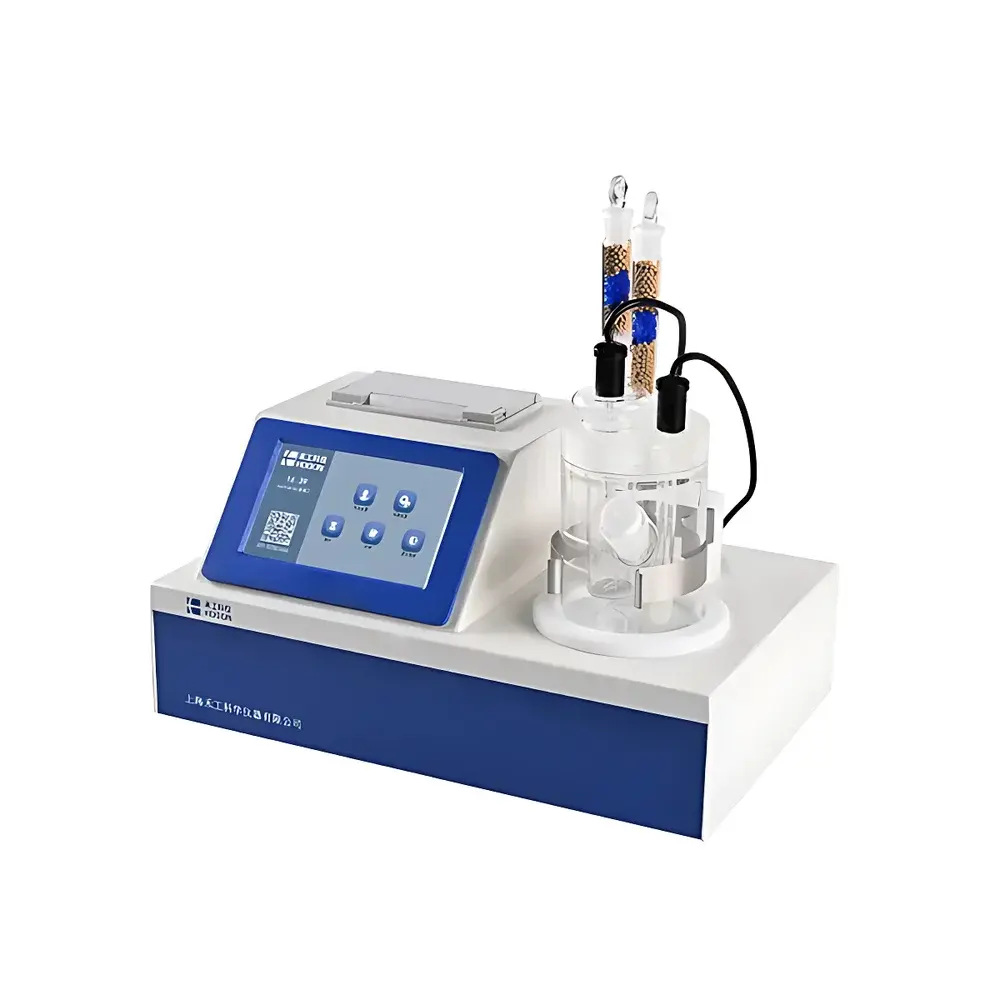
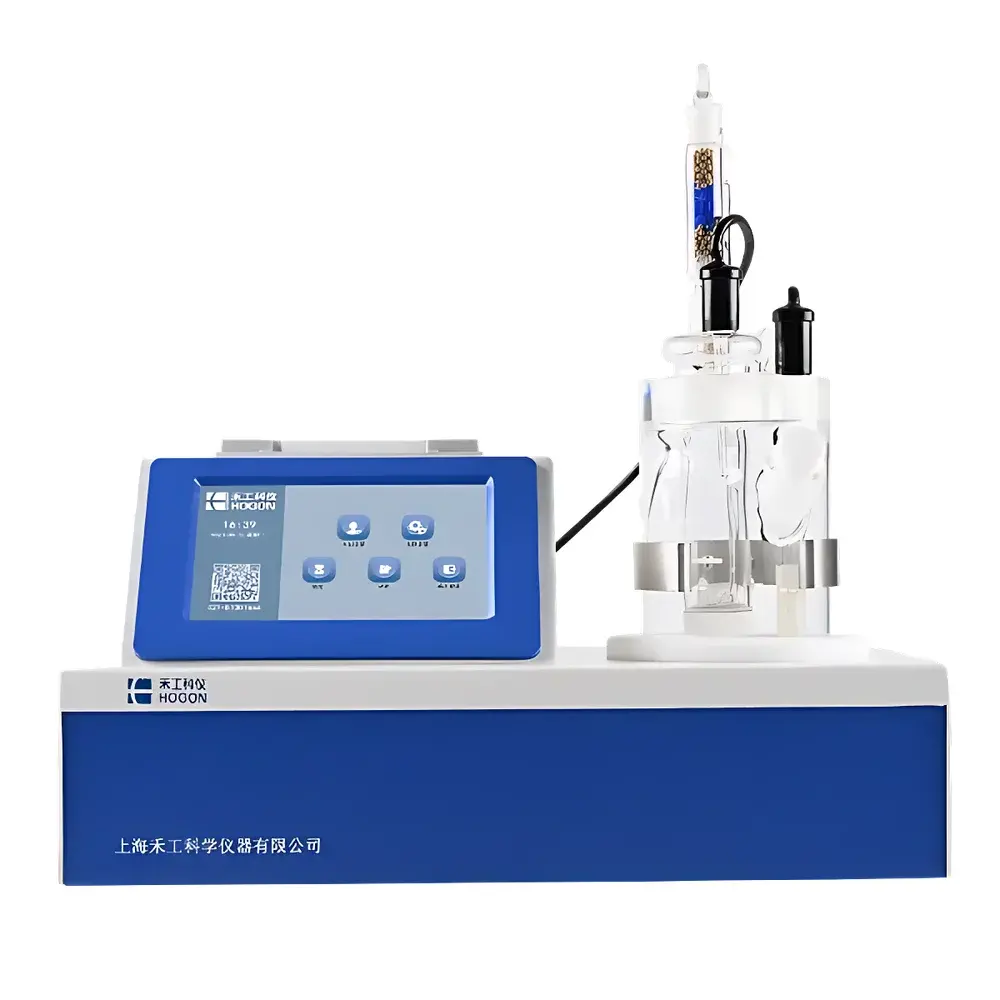
HOGON AKF-3N Coulometric Karl Fischer Moisture Titrator for Dichloromethane Solvent Analysis
| Brand | HOGON |
|---|---|
| Origin | Shanghai, China |
| Manufacturer Type | Direct Manufacturer |
| Instrument Type | Coulometric Moisture Analyzer |
| Model | AKF-3N |
| Measurement Principle | Coulometric Karl Fischer Titration |
| Detection Range | 1 µg – 200 mg H₂O |
| Sensitivity | ≤ 0.1 µg H₂O |
| Compliance | ASTM D6304, ISO 760, USP <921>, GB/T 4117–2022 |
| Data Interface | USB 2.0 |
| Electrode Configuration | Dual-platinum indicator electrodes + membrane-separated generator electrode |
| Stirring System | Integrated variable-speed magnetic stirrer |
| Cell Design | Hermetically sealed titration cell with desiccant airlock |
| Software Features | GLP-compliant audit trail, user-level access control, automatic calibration logging, CSV export |
Overview
The HOGON AKF-3N is a precision-engineered coulometric Karl Fischer moisture titrator specifically optimized for trace water quantification in low-polarity, volatile organic solvents—most notably dichloromethane (DCM). Unlike volumetric KF systems, the AKF-3N employs a generator-anode/cathode electrochemical cell to produce iodine *in situ* via controlled electrolysis of iodide-containing reagent. Water content is determined stoichiometrically using Faraday’s law: each mole of water consumes one mole of iodine, corresponding to 2 × 96,485 C/mol of charge. This enables absolute quantification without volumetric calibration drift, delivering sub-microgram detection limits (≤0.1 µg H₂O) and exceptional reproducibility (RSD < 0.3% at 10–100 µg level). Its design addresses critical challenges in DCM analysis—including solvent volatility, low dielectric constant (~8.9), and susceptibility to ambient moisture ingress—through a fully sealed, desiccated titration environment and real-time electrolytic balance stabilization.
Key Features
- Hermetically sealed titration cell with integrated desiccant airlock and dual-platinum indicator electrodes—eliminates atmospheric moisture interference and ensures operator safety during handling of toxic, volatile solvents.
- Auto-balancing electrolytic circuit that establishes stable baseline current (<50 nA) within 90 seconds post-startup, minimizing preconditioning time and maximizing measurement consistency across batch runs.
- Variable-speed magnetic stirring system (100–800 rpm) with torque-sensing feedback—ensures homogeneous mixing without splashing or emulsion formation in low-surface-tension solvents like DCM.
- Intuitive 7-inch capacitive touchscreen interface with preloaded method templates for halogenated solvents, including dedicated DCM moisture assay protocols compliant with GB/T 4117–2022 and ASTM D6304 Annex A3.
- Onboard data storage (≥10,000 test records) with timestamped metadata (operator ID, sample ID, reagent lot, ambient T/RH), supporting full traceability under GLP/GMP environments.
Sample Compatibility & Compliance
The AKF-3N is validated for direct injection analysis of neat dichloromethane (without co-solvent dilution), as well as other chlorinated, ether-based, and hydrocarbon solvents commonly used in pharmaceutical synthesis (e.g., chloroform, THF, toluene, hexane). Its coulometric architecture avoids reagent consumption variability inherent in volumetric systems, making it suitable for regulatory submissions requiring strict adherence to ICH Q5C stability guidelines. The instrument meets ISO/IEC 17025 documentation requirements for method validation, and its firmware supports 21 CFR Part 11-compliant electronic signatures when paired with HOGON’s optional LabManager Pro software. All electrical components conform to IEC 61010-1 safety standards for laboratory equipment operating in Class II explosion-proof zones.
Software & Data Management
HOGON LabManager Pro (v4.2+) provides comprehensive data governance for the AKF-3N: automated generation of calibration curves (using certified water standards from Merck or Sigma-Aldrich), dynamic endpoint detection algorithms (dV/dt thresholding), and customizable report templates aligned with FDA EMA submission formats. Audit trails record every parameter modification, reagent replacement event, and result export action with immutable timestamps and user attribution. Raw current-vs.-time datasets are exportable in .CSV format for third-party statistical analysis (e.g., JMP, Minitab), while PDF reports include embedded chromatogram-like titration curves, residual current profiles, and uncertainty budgets per GUM (JCGM 100:2008) principles.
Applications
- Pharmaceutical API manufacturing: Quantifying residual moisture in DCM used for crystallization, extraction, or reaction quenching—critical for controlling polymorphic form, residual solvent limits (ICH Q3C), and hydrolytic degradation pathways.
- Electronic chemical purification: Monitoring water levels in semiconductor-grade DCM prior to spin-coating or etching processes where ppm-level H₂O induces film delamination or particle generation.
- Contract research organization (CRO) QC labs: High-throughput screening of solvent batches against pharmacopeial monographs (USP , EP 2.5.12) with automated pass/fail flagging based on predefined acceptance criteria.
- Chemical raw material certification: Supporting ISO 9001:2015 clause 8.5.2 by providing documented evidence of moisture compliance for incoming DCM shipments.
FAQ
What is the minimum detectable water mass for dichloromethane using the AKF-3N?
The system achieves reliable detection down to 0.1 µg H₂O in 1–5 g DCM samples, translating to quantitation limits of 20–50 ppb depending on injection precision and environmental humidity control.
Can the AKF-3N be used with non-aqueous solvents other than DCM?
Yes—validated methods exist for acetone, acetonitrile, DMF, DMSO, and ethyl acetate; however, solvents with active hydrogen (e.g., alcohols, amines) require specialized anhydrous reagents and modified endpoint settings.
How often must the generator electrode be cleaned or replaced?
Under routine DCM analysis (≤20 injections/day), the membrane-separated generator electrode requires cleaning with dry nitrogen every 72 hours and full replacement after 6 months or 500 analyses—whichever occurs first.
Does the instrument support remote diagnostics or network integration?
Via optional Ethernet module and LabManager Pro server deployment, enabling centralized monitoring of up to 16 AKF-3N units across multiple sites with SNMP alerting for reagent depletion or cell contamination events.
Is method transfer possible from volumetric KF instruments to the AKF-3N?
Yes—HOGON provides documented equivalence studies demonstrating correlation (r² > 0.999) between volumetric and coulometric results for DCM, with protocol conversion guides included in the IQ/OQ/PQ validation package.






