
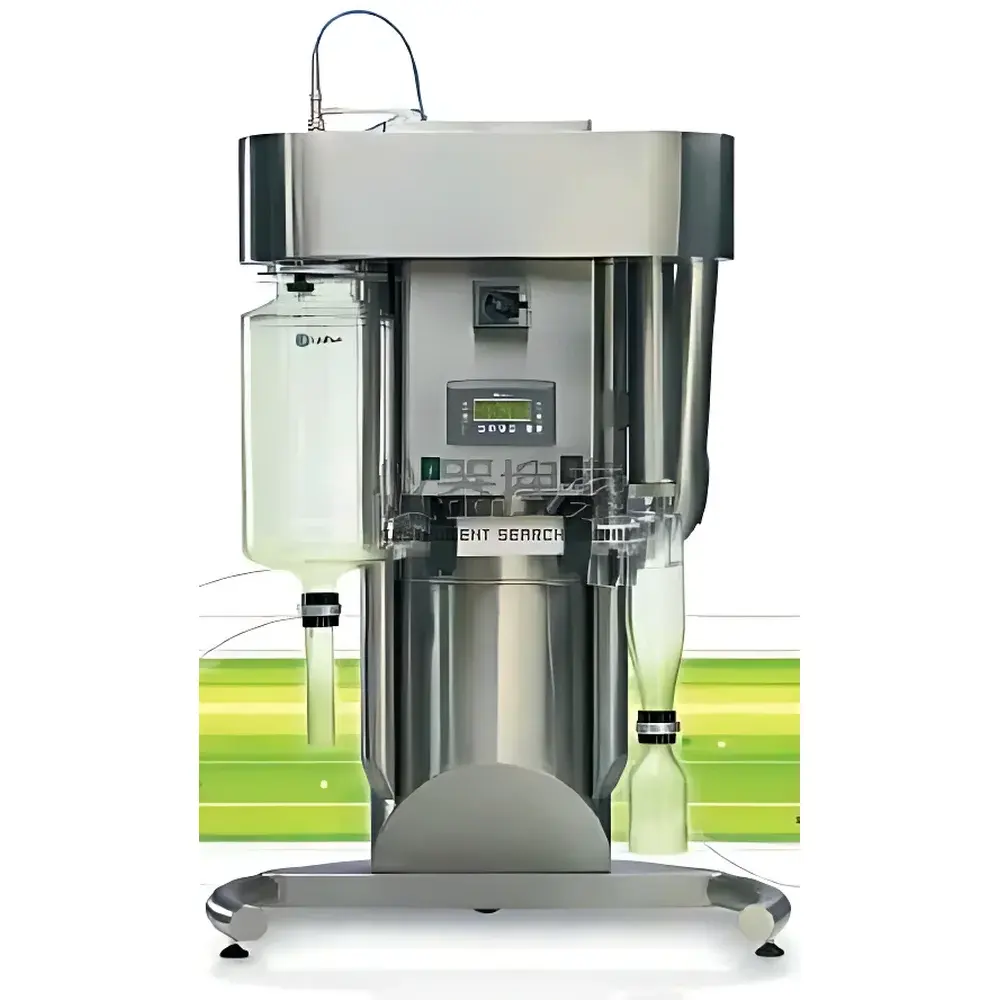
Labplant SD-06 Benchtop Spray Dryer for Organic Solvents
| Origin | UK |
|---|---|
| Manufacturer Type | Authorized Distributor |
| Origin Category | Imported |
| Model | SD-06 |
| Pricing | Upon Request |
| Max Evaporation Capacity | 1.5 L H₂O/h |
| Inlet Air Temperature Range | 40–250 °C |
| Drying Air Flow Rate | 100–300 m³/h |
| Heating Power | 3 kW |
| Compressor Capacity | 1.7 m³/h at 4 bar |
| Feed Rate | Up to 32 mL/min |
| Automatic Nozzle Cleaning Pressure | 2.3 bar (adjustable frequency) |
| Standard Nozzle Orifice | 0.5 mm |
| Anti-Clogging Mode Selection | High/Medium/Low |
| Dimensions (H×W×D) | 1110 × 825 × 600 mm |
| Weight | 80 kg |
| Electrical Supply | 220 V / 50 Hz, 13 A |
Overview
The Labplant SD-06 is a compact, fully integrated benchtop spray dryer engineered for laboratory-scale development of thermally sensitive and solvent-based formulations. It operates on the principle of concurrent-flow spray drying: liquid feed is atomized via a dual-fluid nozzle into fine droplets, which are rapidly dried by controlled hot air in a stainless-steel drying chamber. The resulting powder is separated from exhaust air using a cyclonic separator and collected in a tempered glass or stainless-steel sample cup. Unlike freeze-drying or rotary evaporation—processes that yield solid cakes requiring post-processing milling—the SD-06 delivers free-flowing, spherical microparticles directly from solution or suspension, preserving morphology, crystallinity, and active ingredient integrity. Its design supports routine use with aqueous and organic solvents (e.g., ethanol, acetone, dichloromethane), provided appropriate explosion-proof modifications and solvent recovery accessories are implemented per local safety regulations.
Key Features
- Integrated 316L stainless-steel chassis housing all critical components—including heater, air blower, compressor, controller, and cyclone—eliminating external piping and reducing footprint to ≤0.5 m².
- IP65-rated LCD touchscreen interface enabling real-time adjustment of inlet temperature, drying air flow, peristaltic pump speed, and anti-clogging pulse frequency.
- Dual-fluid stainless-steel nozzle (0.5 mm orifice) with precision-machined concentric capillary geometry; enables stable atomization across variable viscosities (up to 500 cP) and suspended solids content (≤20% w/v).
- Automated nozzle clearance system (2.3 bar compressed air pulses) with three programmable frequency settings to prevent nozzle occlusion during extended runs with viscous or particulate-laden feeds.
- High-efficiency inlet air filtration (99.99% particle removal ≥0.3 µm) located at rear panel, ensuring particulate-free drying environment compliant with ISO 14644-1 Class 5 cleanroom prerequisites for pharmaceutical process development.
- RS232 serial interface supporting bidirectional communication with third-party data loggers or SCADA systems for audit-trail-capable process recording (aligned with FDA 21 CFR Part 11 requirements when paired with validated software).
Sample Compatibility & Compliance
The SD-06 accommodates a broad range of feedstocks including polymer solutions (PLGA, PVP), protein suspensions, nanoparticle colloids, and small-molecule APIs dissolved in water, methanol, ethanol, or ethyl acetate. Its 316L construction ensures resistance to corrosion from halogenated and acidic solvents. When operated with flammable solvents, users must install optional inert gas purging (N₂ or Ar), explosion-proof electrical components (ATEX Zone 2 certified variants available), and condensate recovery traps. The system meets CE Machinery Directive 2006/42/EC and complies with ISO 9001 quality management standards. For GMP-aligned workflows, optional validation packages support IQ/OQ/PQ documentation per ASTM E2500 and ICH Q5C guidelines.
Software & Data Management
While the SD-06 features an embedded microprocessor controller with non-volatile parameter memory, its RS232 port enables integration with LabVIEW™, MATLAB®, or custom Python-based acquisition scripts. All setpoints and real-time sensor outputs—including inlet/outlet temperatures, airflow, and pump RPM—are timestamped and exportable as CSV files. Optional Labplant DataLogger Pro software provides trend visualization, alarm thresholds, and electronic signature functionality for GLP/GMP environments. Audit trails include operator ID, parameter changes, and system status logs—fully traceable for regulatory submissions.
Applications
- Early-stage formulation screening of inhalable dry powders (DPIs) and amorphous solid dispersions (ASDs).
- Rapid production of excipient-free nanocarriers for preclinical biodistribution studies.
- Stabilization of labile biologics (e.g., monoclonal antibodies, mRNA-LNPs) via solvent-compatible spray drying protocols.
- Process parameter mapping (DoE) to establish critical quality attributes (CQAs) such as residual solvent, moisture content (<2%), and particle size distribution (Dv50: 2–15 µm).
- Scale-down modeling for tech transfer to pilot-scale Niro or Buchi spray dryers—validated correlation exists between SD-06 output and 5–20 kg/h industrial units under matched dimensionless numbers (Weber, Reynolds, and dimensionless drying rate).
FAQ
Can the SD-06 handle chlorinated solvents such as chloroform or DCM?
Yes—provided the optional solvent-resistant seals, explosion-proof motor upgrade, and condensate trap are installed. Residual solvent analysis (GC-FID) confirms typical levels <500 ppm in final powder.
Is the system compatible with sterile processing?
The SD-06 is not autoclavable, but all wetted parts (nozzle, cyclone base, collection cup) are removable and compatible with SIP (steam-in-place) up to 121 °C using validated procedures.
What is the minimum sample volume required for method development?
As low as 50 mL of feed solution yields statistically representative powder batches (≥1 g), minimizing API consumption during formulation optimization.
Does Labplant offer validation support for regulated environments?
Yes—comprehensive IQ/OQ documentation, calibration certificates traceable to NIST standards, and FAT/SAT protocols are available upon request for pharmaceutical and medical device clients.
How does the SD-06 compare to lyophilization for protein stability?
Spray drying achieves 10–100× faster throughput than freeze-drying and avoids ice crystal-induced denaturation; however, thermal exposure requires excipient screening (e.g., trehalose, HES) to maintain conformational integrity—validated case studies are available in the Labplant Technical Library.



