
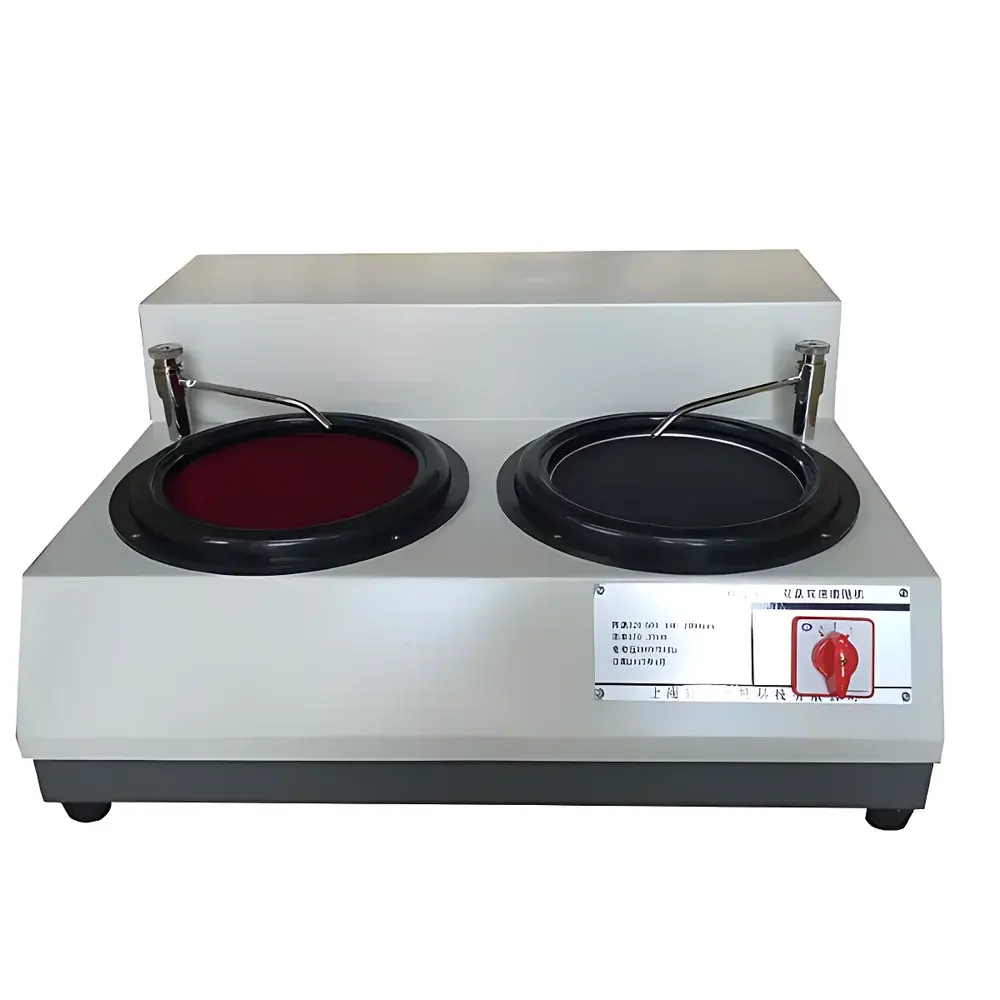
YANRUN MPD-2 Dual-Station Metallographic Grinding and Polishing Machine
| Brand | YANRUN |
|---|---|
| Origin | Shanghai, China |
| Manufacturer Type | Direct Manufacturer |
| Country of Origin | China |
| Model | MPD-2 |
| Speed Settings | 320 rpm, 500 rpm, 660 rpm, 1000 rpm |
| Grinding/Polishing Plate Diameter | φ230 mm |
| Number of Plates | 2 |
| Dimensions (L×W×D) | 730 × 650 × 300 mm |
| Power Rating | 370 W |
| Voltage Supply | 380 V AC |
| Control Mode | Independent Dual-Plate Control |
| Rotation Direction | Unidirectional |
Overview
The YANRUN MPD-2 is a benchtop dual-station metallographic grinding and polishing machine engineered for precision sample preparation in metallurgical, materials science, and failure analysis laboratories. It operates on the principle of controlled mechanical abrasion—utilizing sequential abrasive media (silicon carbide papers, diamond suspensions, and cloth-based polishing cloths) under regulated rotational speed and consistent pressure—to produce planar, scratch-free, and deformation-free surfaces suitable for optical microscopy, SEM imaging, and quantitative microstructural analysis. Designed for reproducible surface finish across diverse specimen types—including ferrous and non-ferrous alloys, sintered ceramics, geological thin sections, and semiconductor wafers—the MPD-2 supports standardized workflows aligned with ASTM E3, ISO 14489, and GB/T 13298–2015 for metallographic specimen preparation.
Key Features
- Benchtop dual-plate architecture with independent speed control per station—enabling simultaneous grinding and polishing or parallel processing of two distinct specimens.
- Four fixed-speed settings (320 rpm, 500 rpm, 660 rpm, and 1000 rpm), optimized to match industry-standard abrasive stages: coarse grinding (320 rpm), intermediate grinding (500 rpm), pre-polishing (660 rpm), and final polishing (1000 rpm).
- φ230 mm aluminum alloy grinding/polishing plates with concentric grooving for uniform slurry distribution and enhanced cooling efficiency during extended operation.
- Robust metal enclosure with integrated water inlet/outlet ports—supporting continuous coolant flow to suppress heat generation, minimize thermal artifact formation, and extend abrasive media life.
- Unidirectional rotation ensures mechanical stability and predictable wear patterns across abrasive surfaces, critical for maintaining geometric fidelity in cross-sectional analysis.
- 370 W industrial-grade induction motor delivers consistent torque across all speed ranges, minimizing speed drift under variable load conditions typical of hard or heterogeneous samples.
Sample Compatibility & Compliance
The MPD-2 accommodates specimens up to 40 mm in diameter (standard metallographic mounts) and is compatible with standard ISO/ASTM-compliant consumables—including 230 mm backing plates, self-adhesive silicon carbide papers (P80–P2500), diamond-impregnated discs (3–1 µm), and woven/non-woven polishing cloths (e.g., synthetic napped cloth, velvet, or chemically resistant polyester). Its design conforms to general laboratory safety requirements per IEC 61010-1 and supports GLP-aligned documentation practices via traceable operational parameters (speed selection, runtime, coolant usage). While not certified for FDA 21 CFR Part 11 compliance out-of-the-box, its manual control interface allows integration into validated SOPs where electronic audit trails are maintained externally.
Software & Data Management
The MPD-2 operates via tactile push-button controls without embedded firmware or digital display—reflecting its role as a dedicated, low-maintenance mechanical tool within regulated environments where simplicity, reliability, and serviceability are prioritized over automation. All operational parameters (selected speed, plate assignment, duration) are recorded manually in lab notebooks or LIMS-integrated log sheets. This analog interface eliminates validation overhead associated with software-driven instruments and aligns with ISO/IEC 17025 Clause 7.7 (Control of Equipment) for instruments used in accredited testing laboratories.
Applications
- Routine metallographic specimen preparation for quality control in foundries, aerospace component manufacturers, and automotive casting facilities.
- Microstructural evaluation of additive-manufactured alloys, where minimization of subsurface deformation is essential prior to EBSD or TEM lamella extraction.
- Preparation of ceramic matrix composites and refractory materials for pore-size distribution analysis using image analysis software (e.g., ImageJ with ASTM E112-compliant protocols).
- Geological thin-section polishing for petrographic microscopy, particularly in applications requiring flatness tolerance ≤0.5 µm over 20 mm span.
- Failure analysis labs preparing fracture surfaces for SEM-EDS mapping, where edge retention and relief preservation are critical.
FAQ
What voltage requirement does the MPD-2 support?
The MPD-2 is configured for 380 V AC three-phase power supply, commonly deployed in industrial and research laboratory infrastructure across mainland China and other regions adopting IEC 60038 standards.
Can the MPD-2 accommodate plates larger than φ230 mm?
No—the mechanical drive system, plate clamping mechanism, and motor torque profile are specifically calibrated for φ230 mm plates; use of non-standard diameters may compromise rotational balance, safety interlock function, and surface finish consistency.
Is automatic speed ramping or programmable timing available?
No—the MPD-2 features discrete fixed-speed selection only, with no built-in timer or acceleration/deceleration profiles. Timing is managed externally using laboratory timers or process logs.
Does the unit include consumables beyond initial setup?
Standard delivery includes two sheets of metallographic abrasive paper and one polishing cloth; ongoing consumables (diamond suspensions, lubricants, replacement cloths, and adhesive-backed papers) must be sourced separately based on application-specific requirements.
How is maintenance performed on the MPD-2?
Routine maintenance consists of periodic cleaning of the water channel system, inspection of plate mounting screws for torque retention, and verification of motor belt tension (if belt-driven variant); full service documentation and spare parts lists are provided in the technical manual included with shipment.



