
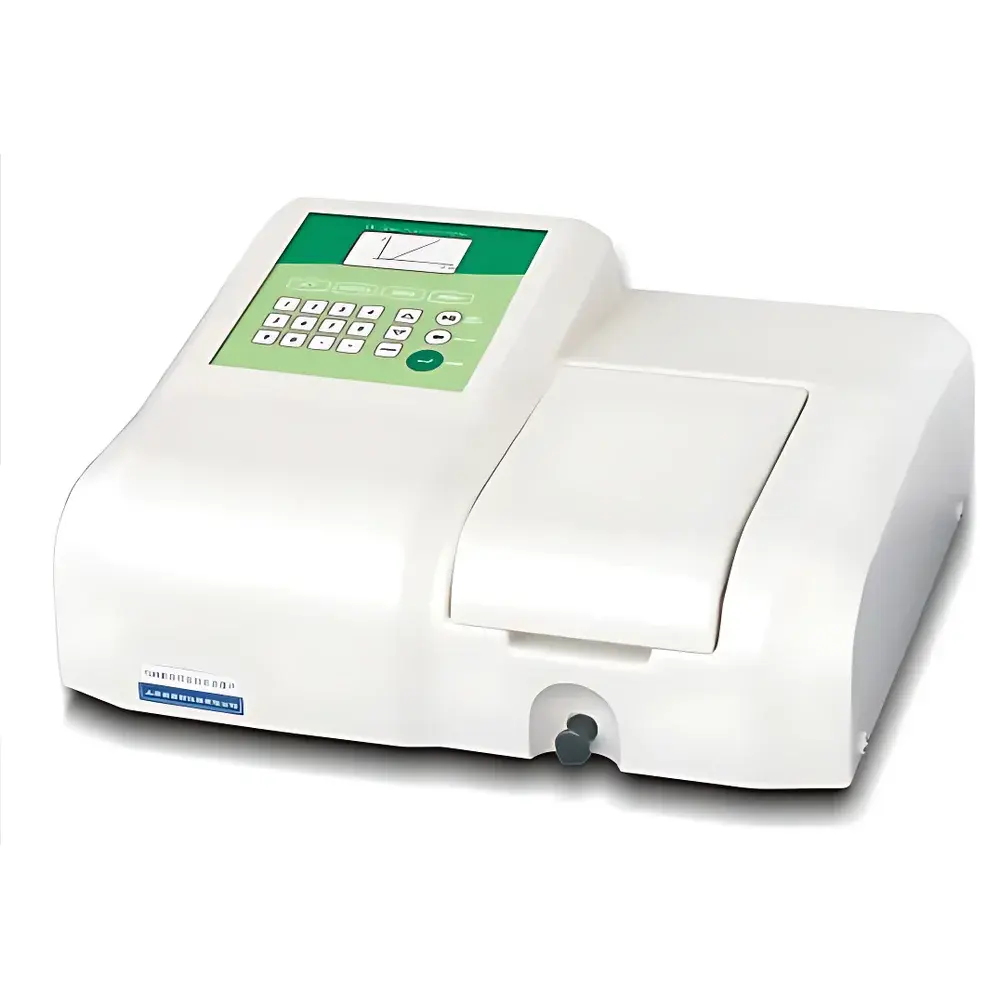
Shanghai INESA UV-754N Dual-Beam Ultraviolet-Visible Spectrophotometer
| Origin | Shanghai, China |
|---|---|
| Manufacturer Type | Authorized Distributor |
| Origin Category | Domestic (PRC) |
| Model | UV-754N |
| Price | USD 1,950 (FOB Shanghai) |
| Optical Architecture | Dual-Beam |
| Detector | Photomultiplier Tube (PMT) |
| Wavelength Range | 190–1100 nm |
| Wavelength Scanning | Motorized Auto-Scan |
| Spectral Bandwidth | 4 nm |
| Wavelength Accuracy | ±0.5 nm |
| Stray Light | ≤0.05%T at 220 nm and 360 nm |
| Wavelength Repeatability | ≤0.2 nm |
| Photometric Accuracy | ±0.002 A (0–0.5 A), ±0.003 A (0.5–1.0 A), ±0.3%T (0–100%T) |
| Photometric Repeatability | ≤0.001 A (0–0.5 A), ≤0.002 A (0.5–1.0 A), ≤0.15%T (0–100%T) |
| Photometric Range | 0–200%T, −0.301–3.000 A, 0–9999 C |
| Baseline Drift | ≤0.001 A/h at 500 nm |
| Baseline Linearity | ±0.002 A |
| Noise | ≤0.15%T (100%T), ≤0.1%T (0%T) |
Overview
The Shanghai INESA UV-754N is a dual-beam ultraviolet-visible (UV-Vis) spectrophotometer engineered for precision absorbance, transmittance, and concentration measurements across the full spectral range of 190–1100 nm. Its optical design employs a Czerny-Turner monochromator with a high-efficiency 1200 lines/mm holographic grating, ensuring optimal resolution and signal-to-noise performance. The instrument utilizes a photomultiplier tube (PMT) detector—selected for its superior sensitivity in the UV region and low dark current—enabling reliable quantification of dilute analytes and low-absorbance samples. As a true dual-beam system, the UV-754N continuously compares sample and reference beam intensities in real time, effectively compensating for lamp intensity drift, solvent absorption, and cuvette imperfections. This architecture delivers high reproducibility in routine QC testing and supports compliance-critical workflows in pharmaceutical, environmental, and academic laboratories.
Key Features
- Dual-beam optical path with real-time reference compensation for enhanced baseline stability and measurement robustness
- Motorized wavelength scanning with automatic zeroing and auto-calibration routines for operator-independent operation
- Czerny-Turner monochromator with 1200 L/mm holographic grating optimized for spectral purity and throughput
- Photomultiplier tube (PMT) detector offering high quantum efficiency from 190 nm through visible wavelengths
- Narrow 4 nm spectral bandwidth enabling adequate resolution for most standard UV-Vis applications without excessive noise penalty
- Wavelength accuracy of ±0.5 nm and repeatability of ≤0.2 nm—validated per ISO 8579 and ASTM E275 guidelines
- Low stray light performance (≤0.05%T at 220 nm and 360 nm) critical for accurate high-absorbance measurements and DNA/protein quantitation
- Photometric linearity maintained within ±0.002 A over extended baseline scans, supporting multi-point calibration protocols
Sample Compatibility & Compliance
The UV-754N accommodates standard 10 mm square quartz, glass, or plastic cuvettes (pathlengths 1–50 mm with optional holders). It supports both transmission and reflectance modes via accessory ports. All photometric calibrations are traceable to NIST-certified neutral density filters and holmium oxide reference standards. The instrument meets essential requirements for GLP-compliant environments: baseline drift ≤0.001 A/h satisfies long-duration kinetic assays; photometric repeatability ≤0.002 A aligns with USP and EP 2.2.25 specifications for spectrophotometric assay validation. While not natively 21 CFR Part 11 compliant, audit trails and user access logs can be implemented via external LIMS integration or third-party data acquisition software validated under GxP frameworks.
Software & Data Management
Bundled PC-based control software provides intuitive method setup, spectral scanning, kinetic profiling, multi-wavelength quantitation, and derivative spectroscopy. Raw absorbance/time/wavelength data export is supported in CSV and ASCII formats for downstream analysis in MATLAB, Python (NumPy/Pandas), or statistical packages. Calibration curves include linear, quadratic, and cubic regression with residual plotting and R² reporting. Software enforces user-defined pass/fail criteria for acceptance testing and supports batch processing of up to 99 samples with auto-printing of compliance-ready reports. Audit-ready metadata—including date/time stamps, operator ID, lamp hours, and wavelength verification results—is embedded in each exported file.
Applications
- Pharmaceutical QC: Active pharmaceutical ingredient (API) assay per USP/EP monographs; excipient compatibility studies; dissolution testing
- Environmental analysis: Nitrate, phosphate, and heavy metal (e.g., Cr(VI), Fe(II)) quantification in water per EPA Methods 353.2 and 365.1
- Life sciences: Nucleic acid (A260) and protein (A280/A260 ratio) concentration and purity assessment; enzyme kinetics (e.g., LDH, ALP)
- Academic research: Ligand-binding studies, equilibrium constant determination, and thermodynamic parameter derivation via temperature-controlled cell holders
- Industrial chemistry: Dye concentration monitoring, polymer degradation analysis, and catalyst activity screening
FAQ
Is the UV-754N suitable for GMP-regulated environments?
Yes—when operated with documented procedures, calibrated references, and controlled software configurations, it fulfills core instrumental qualification (IQ/OQ) requirements for Class II analytical instruments under EU Annex 11 and FDA guidance.
What maintenance is required to sustain wavelength accuracy?
Annual verification using holmium oxide (241, 279, 287, 333, 360, 418, 460, 485, 536 nm peaks) and didymium filters is recommended; lamp replacement every 1,000–1,500 hours ensures stable output.
Can the instrument measure absorbance beyond 3.000 A?
No—the photometric range is capped at 3.000 A (0.1%T); for higher absorbances, users must employ reduced pathlength cells or sample dilution per ICH Q2(R2) principles.
Is USB or RS-232 connectivity included?
Standard configuration includes RS-232 serial interface; USB-to-serial adapters are compatible but require driver validation for regulated use.
Does the system support temperature-controlled measurements?
Not natively—but it accepts standard Peltier or circulating water jacketed cuvette holders (accessory sold separately) compatible with industry-standard thermal controllers.




