
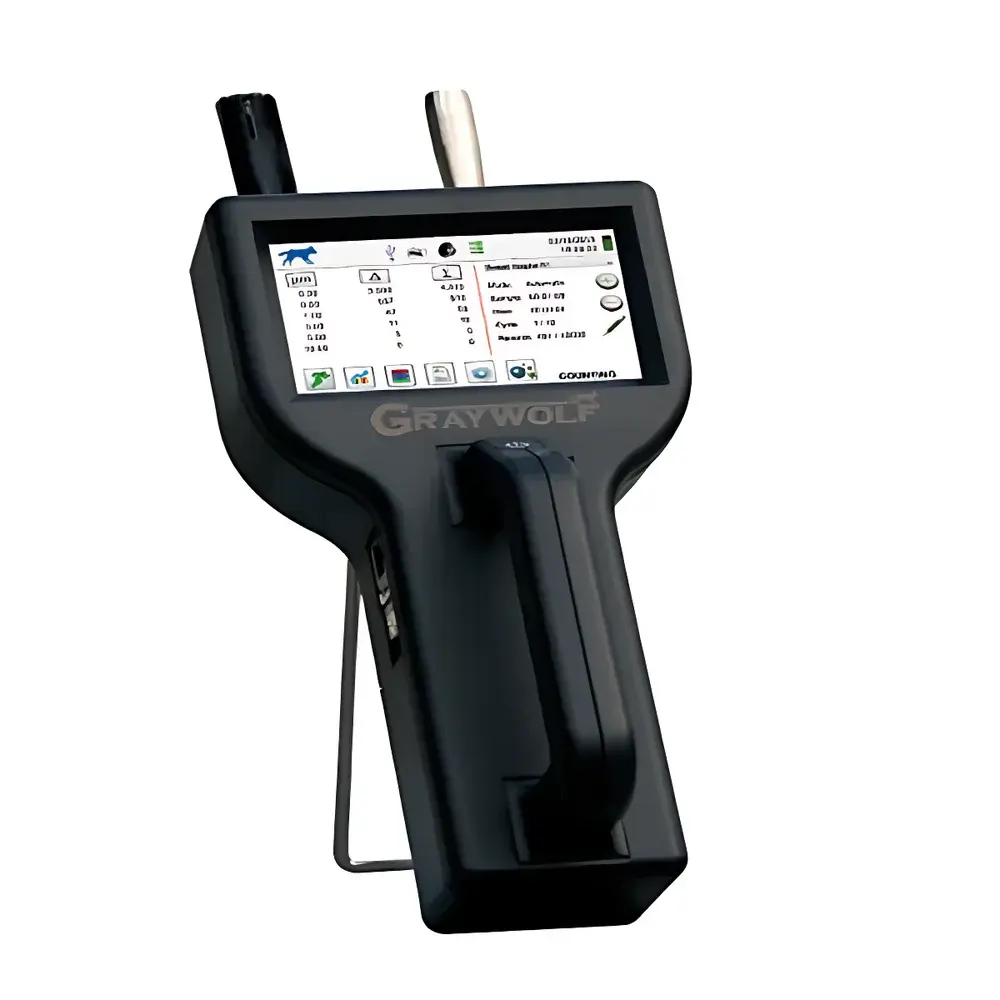
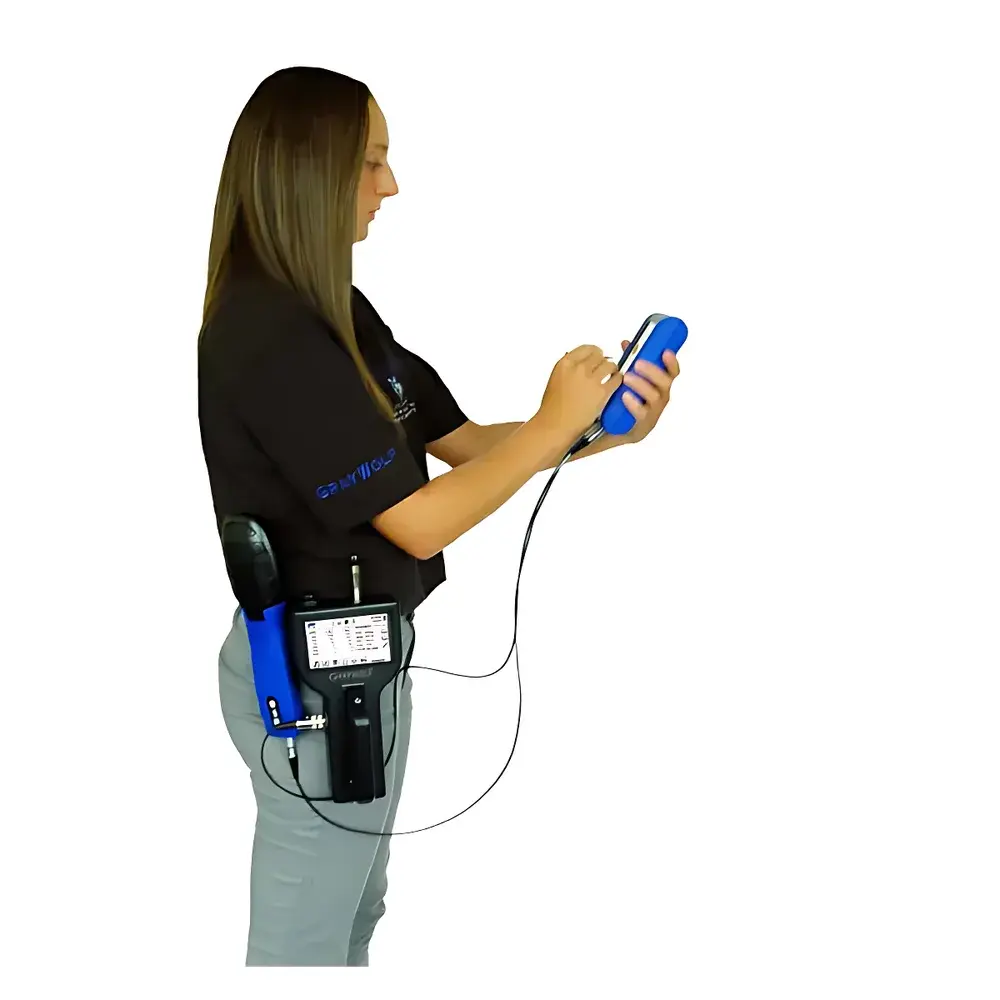
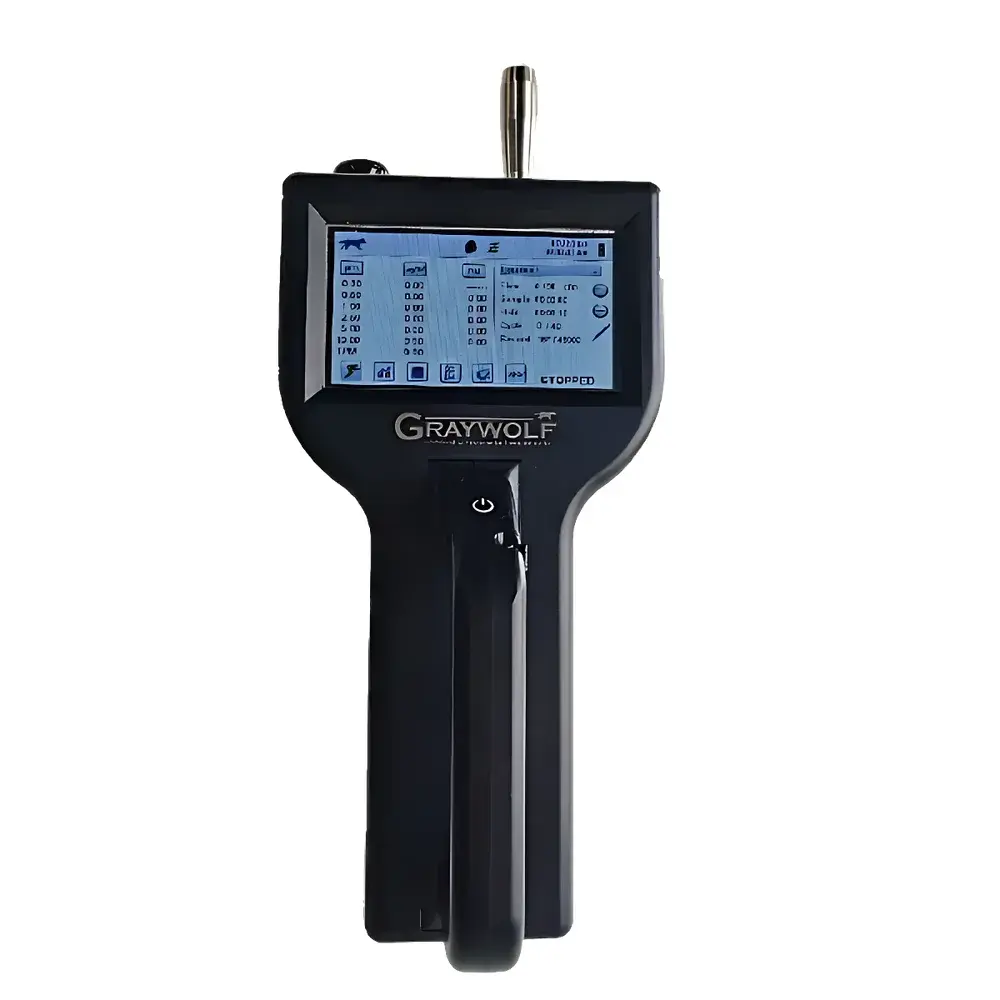
Graywolf PC-3500 Portable Laser-Based Atmospheric Particulate Matter Monitor
| Brand | Graywolf |
|---|---|
| Model | PC-3500 |
| Measurement Principle | Light Scattering (Laser Nephelometry) |
| Measured Parameters | TSP, PM₁₀, PM₂.₅, PM₁, PM₀.₃ |
| Particle Size Range | 0.3–25 µm |
| Sampling Flow Rate | 2.83 L/min |
| Measurement Interval | 1 s – 99 h (user-configurable) |
| Channel Configuration | 6 independent size channels |
| Built-in PHA | Yes (compliant with ISO 21501-4) |
| Laser Pulse Rate | 250,000 pulses/sec |
| Max. Particle Concentration | 15,000,000 particles/ft³ |
| Operating Temperature | 5–40 °C |
| Relative Humidity | 20–95 % RH (non-condensing) |
| Battery Life | >10 h continuous operation |
| Dimensions | 25.4 × 12.9 × 11.4 cm (incl. handle) |
| Weight | 1.0 kg |
Overview
The Graywolf PC-3500 is a research-grade, portable laser nephelometer engineered for high-fidelity atmospheric particulate matter monitoring. It operates on the principle of Mie scattering—where monochromatic laser light interacts with airborne particles, generating scattered intensity signals proportional to particle size and refractive index. Unlike fixed-channel consumer-grade sensors, the PC-3500 implements real-time pulse-height analysis (PHA) to resolve individual particle events across a continuous 0.3–25 µm aerodynamic diameter range. Its 250,000-pulse-per-second diode laser enables statistically robust counting even at ultra-low concentrations (<1 particle/cm³) and high-density environments (up to 15 million particles/ft³), making it suitable for both cleanroom qualification per ISO 14644-1 and ambient aerosol characterization under EPA and EU PM monitoring protocols.
Key Features
- Six fully configurable size channels: Users define arbitrary lower/upper cutoff diameters per channel (e.g., 0.3–0.5 µm, 1.0–2.5 µm), supporting custom binning aligned with regulatory or research-specific aerosol classification schemes.
- Adjustable optical parameters: Density and refractive index inputs allow correction for non-spherical or compositionally heterogeneous aerosols—critical for accurate mass concentration derivation (µg/m³) from number-based scattering data.
- Multi-threaded embedded processor: Enables concurrent sampling, real-time data streaming via USB/WiFi, on-device annotation, and background calibration—all without interrupting acquisition continuity.
- Integrated PHA module compliant with ISO 21501-4: Ensures traceable pulse amplitude discrimination, minimizing coincidence error and enabling NIST-traceable particle sizing in field-deployable form factor.
- Intelligent flow control architecture: Internal vacuum pump maintains constant 2.83 L/min volumetric flow across variable filter loading and pressure differentials, meeting ISO 21501-4 and EN 13725 sampling requirements.
- Advanced power management: Sleep mode reduces standby current to <10 µA; battery runtime exceeds 10 hours at standard 1-min logging intervals, validated per IEC 62368-1 safety standards.
Sample Compatibility & Compliance
The PC-3500 is validated for use with ambient air, indoor environments, HVAC ducts, cleanrooms (Class 1–ISO 5), and occupational health settings. Its HEPA-filtered exhaust prevents cross-contamination during sequential sampling. The instrument complies with ISO 21501-4 (calibration and performance of light-scattering airborne particle counters), ASTM D6625 (standard practice for measuring airborne particles), and supports GLP/GMP-aligned workflows through timestamped audit trails, user-access controls, and optional 21 CFR Part 11-compliant software modules. All factory calibrations are performed using NIST-traceable PSL (polystyrene latex) reference standards at six primary sizes (0.3, 0.5, 1.0, 2.5, 5.0, and 10.0 µm).
Software & Data Management
Graywolf’s proprietary Insight™ Desktop Software (v4.2+) provides full configuration, real-time visualization, and post-acquisition analysis—including mass concentration back-calculation using user-defined density/refractive index tables, size distribution histogramming, and time-series overlay. Data export supports CSV, Excel, and netCDF formats for integration into LIMS or statistical platforms (e.g., R, Python pandas). Firmware updates and remote diagnostics are supported over secure TLS-encrypted WiFi or USB-C, with version-controlled firmware signing ensuring integrity during field deployments.
Applications
- Ambient air quality monitoring for PM₁, PM₂.₅, PM₁₀, and TSP compliance reporting (EU Directive 2008/50/EC, US EPA NAAQS)
- Cleanroom environmental monitoring per ISO 14644-1 and FDA Annex 1 (sterile manufacturing)
- Indoor air quality assessment in schools, hospitals, and office buildings per ASHRAE Standard 62.1
- Source apportionment studies requiring multi-size-resolved aerosol dynamics
- Filter efficiency testing (e.g., HEPA, ULPA) using upstream/downstream differential counting
- Occupational exposure assessment in construction, mining, and pharmaceutical powder handling
FAQ
Does the PC-3500 provide mass concentration (µg/m³) directly?
Yes—when density and refractive index are specified, the instrument applies Mie theory-based conversion algorithms to derive mass concentration from raw scattering counts, traceable to gravimetric reference methods.
Is external calibration required after purchase?
No—factory calibration against NIST-traceable PSL standards is valid for 12 months under normal operating conditions. Optional annual recalibration services include full PHA linearity verification and flow rate validation.
Can the device operate unattended for extended periods?
Yes—programmable sampling intervals (1 second to 99 hours), internal data logging (≥10,000 records), and low-power sleep mode support autonomous deployment in remote or mobile applications.
What accessories enable duct or isokinetic sampling?
The optional isokinetic sampling probe kit includes a thermocouple-integrated pitot tube, flow controller, and mounting hardware—fully compatible with ASME MFC-3M and ISO 10780 sampling standards.
Is the firmware upgradable in the field?
Yes—over-the-air (OTA) updates via WiFi or local USB-C connection maintain alignment with evolving regulatory requirements and add new analytical features without hardware modification.







