
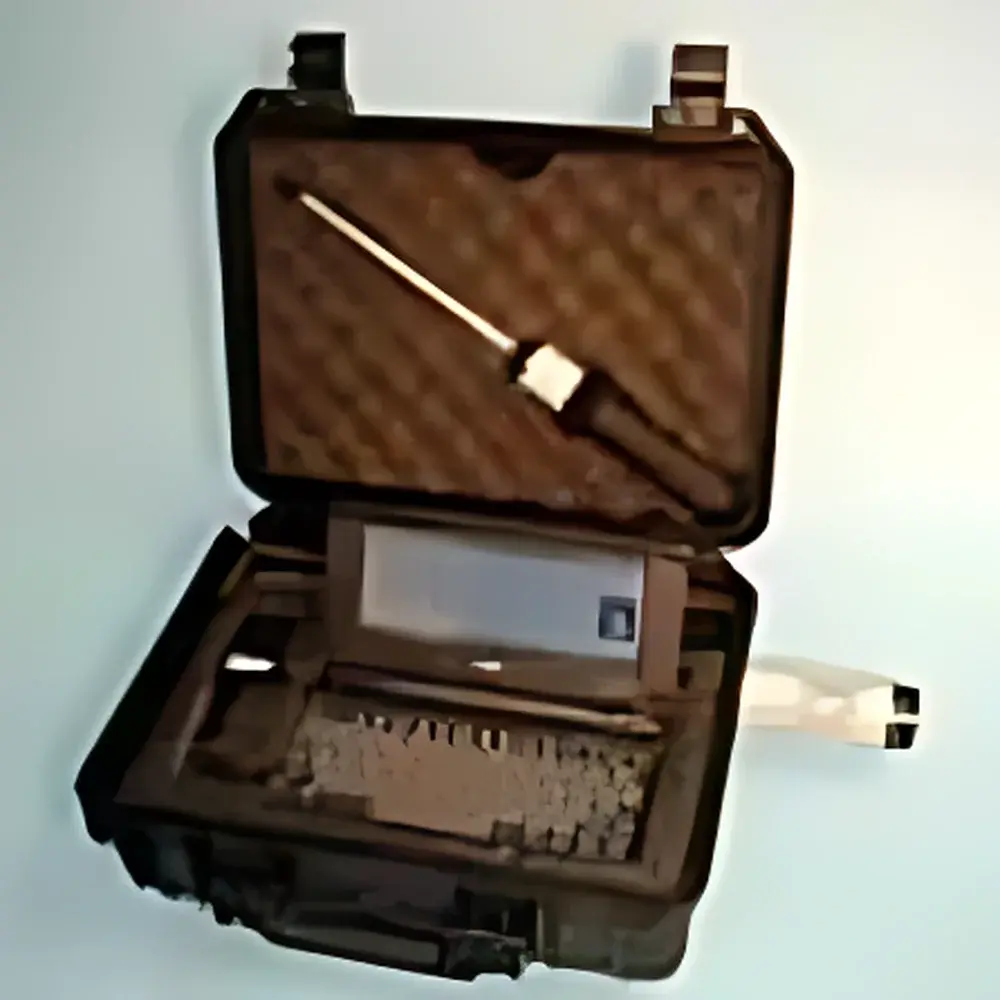
Graywolf Cleanroom Monitoring System
| Origin | USA |
|---|---|
| Supplier Type | Authorized Distributor |
| Import Status | Imported |
| Model | Graywolf |
| Pricing | Available Upon Request |
Overview
The Graywolf Cleanroom Monitoring System is a modular, handheld environmental verification platform engineered for comprehensive ISO 14644-1, EU GMP Annex 1, and USP / compliant cleanroom qualification and routine monitoring. Unlike conventional single-parameter instruments, this system integrates a ruggedized Windows-based PDA host with six interchangeable, calibrated sensor modules—each designed to meet traceable metrological requirements for pharmaceutical, biotech, semiconductor, and medical device manufacturing environments. Its core architecture leverages real-time data fusion: the host unit executes embedded algorithms that convert raw sensor outputs into regulatory-grade metrics—including particle concentration (per ISO 21501-4), differential pressure (per ISO 14644-3), face velocity uniformity (per IEST-RP-CC006.3), and airborne microbial recovery (per ISO 14698-1). All measurements are timestamped, geotagged (optional), and stored with full audit trail capability—ensuring alignment with FDA 21 CFR Part 11 and EU Annex 11 electronic record integrity standards.
Key Features
- Modular sensor architecture: Six dedicated probes—particle counter (0.3–20.0 µm, 0.1 CFM flow), differential pressure transducer (IP54-rated, auto-zeroing), thermal anemometer (0.00–30.00 m/s, ±0.015 m/s accuracy), active air sampler (30–120 L/min, autoclavable 90 mm head), Class 2 sound level meter (35–130 dB(A)), and lux meter (20–20,000 lux)—all hot-swappable and independently calibrated.
- Embedded Cleanroom OS: Real-time calculation of ISO Class (e.g., ISO 5/Class 100), velocity uniformity (% deviation), static pressure differentials (Pa or inH₂O), RH/T profiles, and noise spectra—all displayed concurrently on the PDA’s high-contrast touchscreen.
- Regulatory-ready data management: On-device storage of ≥500 particle records with metadata (date/time, RH, temp, volume, alarm flags, user-defined labels); voice, sketch, and text annotations embed directly into measurement files.
- Report generation engine: Preloaded templates compliant with ISO 14644-2 surveillance reporting; customizable Word/Excel-compatible templates support site-specific SOPs and client deliverables.
- Power resilience: Dual power options per probe—rechargeable Li-ion or alkaline batteries—with >130 hours operational life for pressure and sound modules; AC adapter included for extended benchtop use.
Sample Compatibility & Compliance
The system supports direct integration with standard cleanroom validation protocols. Particle counting adheres to JIS B9921:1997 efficiency calibration (50% @ 0.3 µm, 100% >0.45 µm) and meets ISO 21501-4 optical equivalence requirements. The active air sampler complies with ISO 14698-1 for viable particle recovery using 380-hole, 0.1 mm orifice aluminum plates—validated for steam sterilization at 121°C. Differential pressure measurements satisfy ISO 14644-3 uncertainty budgets (<±0.5 Pa) when used with certified reference manometers. All probes carry NIST-traceable calibration certificates (valid 12 months), and firmware updates maintain alignment with evolving ASTM E2954-22 (cleanroom airflow mapping) and IEST-G-CC1002 (microbial sampling) guidelines.
Software & Data Management
The PDA hosts native Windows Mobile applications—including DuctCal™ for duct traverse calculations and HoodCal™ for unidirectional airflow mapping—enabling on-site derivation of volumetric flow rates (m³/h) and capture velocity assessments. Data export supports CSV, XML, and PDF formats; encrypted USB transfer ensures HIPAA/FDA Part 11 compliance. Audit trails log every user action (login, parameter change, report generation, file deletion) with immutable timestamps. Optional cloud sync via secure TLS 1.2 enables centralized review by QA teams across multiple facilities—fully compatible with LIMS integration through ODBC drivers.
Applications
This system is deployed for: ISO 14644-1 classification of Grade A/B/C/D environments; EU GMP Annex 1 periodic requalification; USP sterile compounding area certification; HVAC commissioning and balancing; containment validation (e.g., isolators, RABS); and continuous environmental monitoring (CEM) gap analysis. It is routinely used by third-party auditors during FDA pre-approval inspections and by internal QA units performing root cause analysis of particle excursions or airflow deviations.
FAQ
Is the particle counter compliant with ISO 21501-4?
Yes—the optical design, counting efficiency curve, and flow rate stability meet all mandatory clauses of ISO 21501-4:2018.
Can calibration certificates be issued with accredited laboratory traceability?
Yes—certificates include NIST-traceable references and uncertainty budgets per ISO/IEC 17025 requirements.
Does the system support 21 CFR Part 11 electronic signatures?
The host OS supports role-based login, electronic signature capture, and audit trail export—fully configurable for Part 11 enforcement scenarios.
What is the maximum storage capacity for particle count data?
Each probe stores up to 500 records locally; the PDA host retains ≥10,000 measurement sets with full annotation history.
Are replacement probes available with factory recalibration?
All probes ship with 12-month calibration validity; certified recalibration services are offered globally through Graywolf-authorized service centers.







