
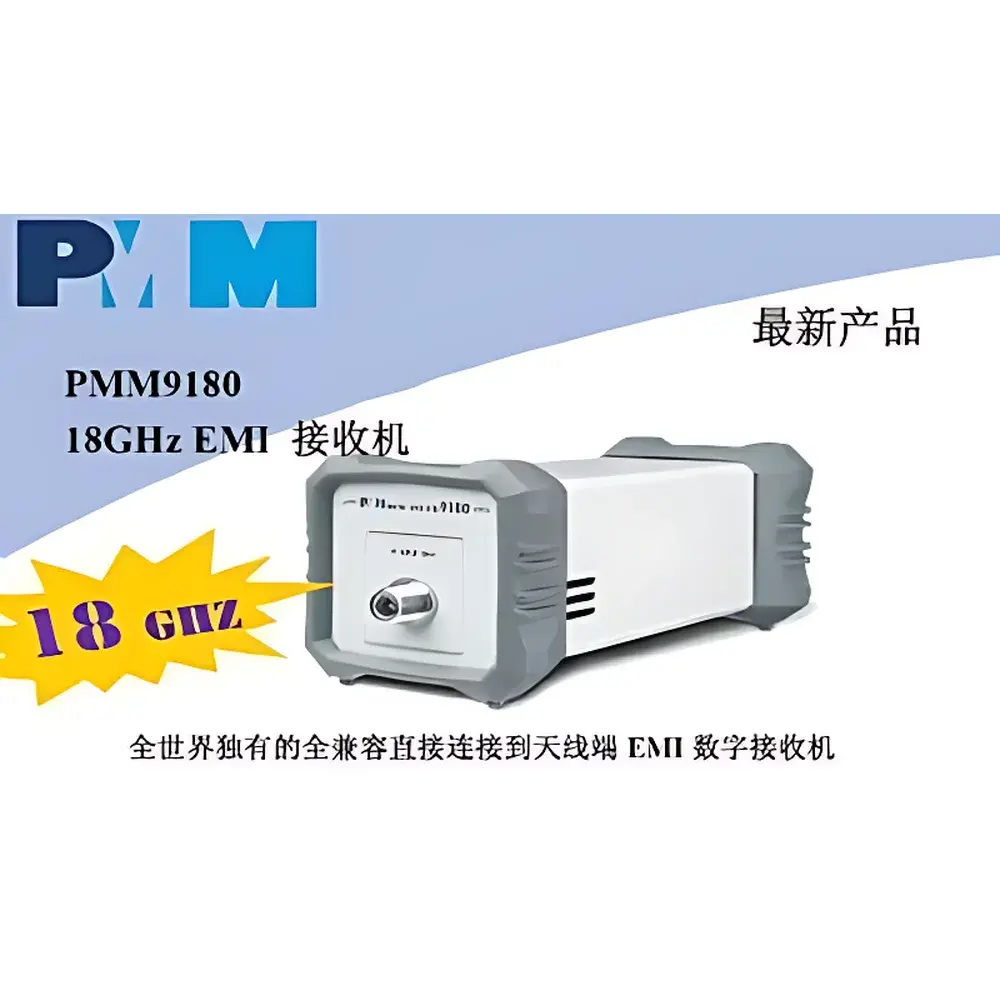
PMM 9180 18 GHz Digital EMI Receiver
| Brand | PMM |
|---|---|
| Origin | Italy |
| Model | PMM 9180 |
| Frequency Range | 6–18 GHz |
| Resolution | 100 Hz |
| Reference Frequency Accuracy | < 2 ppm |
| RF Input | 50 Ω, N-type female (SMA compatible) |
| VSWR (10 dB attenuation) | < 2 |
| VSWR (0 dB attenuation) | < 3 |
| Attenuator Range | 0–45 dB (5 dB steps) |
| Preamp Gain | 20 dB |
| Max Input (Sinusoidal AC) | 137 dBμV (1 W, non-damaging) |
| Preselector Bands | 6–9 GHz, 9–12 GHz, 12–15 GHz, 15–18 GHz |
| IF Bandwidths | 3/10/30/100/300 kHz (–6 dB) |
| Displayed Average Noise Level (DANL), RBW = 1 MHz, preselector ON, preamp ON | PK < 8 dBμV (typ. 6 dBμV) |
| DANL, RBW = 1 MHz, preselector ON, preamp OFF | PK < 28 dBμV (typ. 26 dBμV) |
| DANL, RBW = 10 kHz, preselector ON, preamp ON | PK < –12 dBμV (typ. –14 dBμV) |
| Spurious Response | < 20 dBμV |
| Measurement Accuracy (S/N > 20 dB) | ±2.0 dB (6–18 GHz) |
| Interface | High-speed optical fiber |
| Operating Temperature | –5 °C to +45 °C |
| Power Supply | 10–15 VDC, 2.5 A |
| Rechargeable Li-ion Battery | 4 h continuous operation |
| Dimensions | 235 × 105 × 105 mm (L × W × H) |
| Weight | 2.2 kg |
Overview
The PMM 9180 is a high-frequency digital EMI receiver engineered for precision electromagnetic interference (EMI) measurement in the millimeter-wave spectrum. Operating from 6 GHz to 18 GHz, it implements real-time digital signal processing (DSP) architecture with direct antenna-coupled acquisition—eliminating traditional coaxial cabling and its associated phase instability, insertion loss variability, and impedance mismatch uncertainties. Unlike conventional swept-tuned receivers, the PMM 9180 employs an all-digital front-end with integrated preselection filtering and high-stability local oscillator synthesis (<2 ppm reference accuracy), enabling repeatable CISPR-compliant measurements without external calibration references between scheduled maintenance intervals. Its design adheres strictly to CISPR 16-1-1:2023 Edition 4.1 and MIL-STD-461G requirements for radiated emissions testing, making it suitable for pre-compliance screening, military platform certification, and R&D-level spectral analysis in 5G FR2, satellite communication, radar harmonics, and automotive ADAS radar bands.
Key Features
- Direct antenna interface via optical fiber link—no RF cable dependency, minimizing measurement uncertainty from cable flexure, temperature drift, or connector repeatability
- Integrated lithium-ion battery mounted on antenna mast—enables up to 4 hours of uninterrupted field operation without tethering to external power
- Four-band mechanical preselector (6–9 / 9–12 / 12–15 / 15–18 GHz) with automatic band switching synchronized to frequency sweep
- Programmable resolution bandwidths: standard EMI filters (9/120 kHz/1 MHz per CISPR) plus high-resolution options (3–300 kHz at –6 dB)
- Onboard 20 dB low-noise preamplifier with bypass capability; eliminates need for external LNAs while maintaining dynamic range integrity
- Full suite of EMI detectors: Peak (PK), Quasi-Peak (QP), Average (AV), RMS, and CISPR-Average—all compliant with CISPR 16-1-1 Annex D algorithms
- Optical isolation between receiver unit and control PC—ensures immunity from ground loops and common-mode noise in high-EMI test environments
Sample Compatibility & Compliance
The PMM 9180 is designed for use with calibrated broadband antennas (e.g., double-ridged horn, pyramidal absorber-lined horns) and active near-field probes across its full operational bandwidth. It supports standardized test configurations per ANSI C63.4, EN 55032, EN 55022, MIL-STD-461G RS103, and IEC 61000-4-3. All detector responses—including QP weighting curves and IF filter shape factors—are validated against traceable national metrology institute (NMI) standards. The instrument’s firmware implements audit-ready logging per ISO/IEC 17025:2017 clause 7.7 and supports GLP/GMP-aligned data integrity workflows when paired with PMM’s optional EMITEST software suite.
Software & Data Management
Controlled via PMM EMITEST v5.x software (Windows 10/11, 64-bit), the receiver supports automated test sequencing, multi-limit line overlay, margin analysis, and report generation compliant with ISO/IEC 17025 and FDA 21 CFR Part 11 (with optional electronic signature module). Raw IQ data export (IEEE 32-bit float, .bin format) enables post-processing in MATLAB, Python (SciPy), or Keysight PathWave. All measurement metadata—including calibration date, antenna factor, cable loss, distance, and detector mode—is embedded in each exported file. Firmware updates are delivered via signed binary packages with SHA-256 verification to ensure system integrity and regulatory traceability.
Applications
- Radiated emissions pre-compliance testing for 5G NR FR2 base stations and user equipment
- Military avionics and vehicle-mounted radar system EMC validation (MIL-STD-461G RS103)
- Millimeter-wave IoT sensor and automotive radar coexistence analysis (77–81 GHz harmonic monitoring)
- EMC troubleshooting of high-speed digital interfaces (PCIe 6.0, USB4 Gen 3×2) using near-field scanning
- Satellite payload susceptibility assessment in RF anechoic chambers
- Research-grade spectral occupancy studies in unlicensed 60 GHz and V-band (40–75 GHz) allocations
FAQ
Does the PMM 9180 require periodic recalibration by an accredited lab?
Yes—while its internal stability reduces recalibration frequency, PMM recommends annual traceable calibration per ISO/IEC 17025 by an ILAC-MRA signatory laboratory. Factory calibration certificates include measurement uncertainty budgets for all key parameters.
Can the PMM 9180 be used with existing CISPR-compliant antennas?
Yes—provided antenna calibration data (including AF, correction factors, and phase center offset) is imported into EMITEST software. Antenna factor interpolation is supported across the 6–18 GHz range.
Is optical fiber interface compatible with third-party DAQ systems?
No—the high-speed optical interface uses a proprietary PMM protocol optimized for low-latency streaming and deterministic timing. Integration with external systems requires PMM’s SDK or EMITEST API.
What is the maximum permissible ambient temperature during extended measurements?
The unit is rated for continuous operation at +45 °C; however, for measurements requiring ±1.0 dB amplitude accuracy, ambient temperature must remain within ±5 °C of the last calibration ambient condition.
How does the preselector improve measurement validity above 6 GHz?
It suppresses out-of-band mixing products and image frequencies inherent in superheterodyne architectures, ensuring compliance with CISPR 16-1-1 Annex B requirements for spurious response rejection (>60 dB typical suppression across all bands).







