
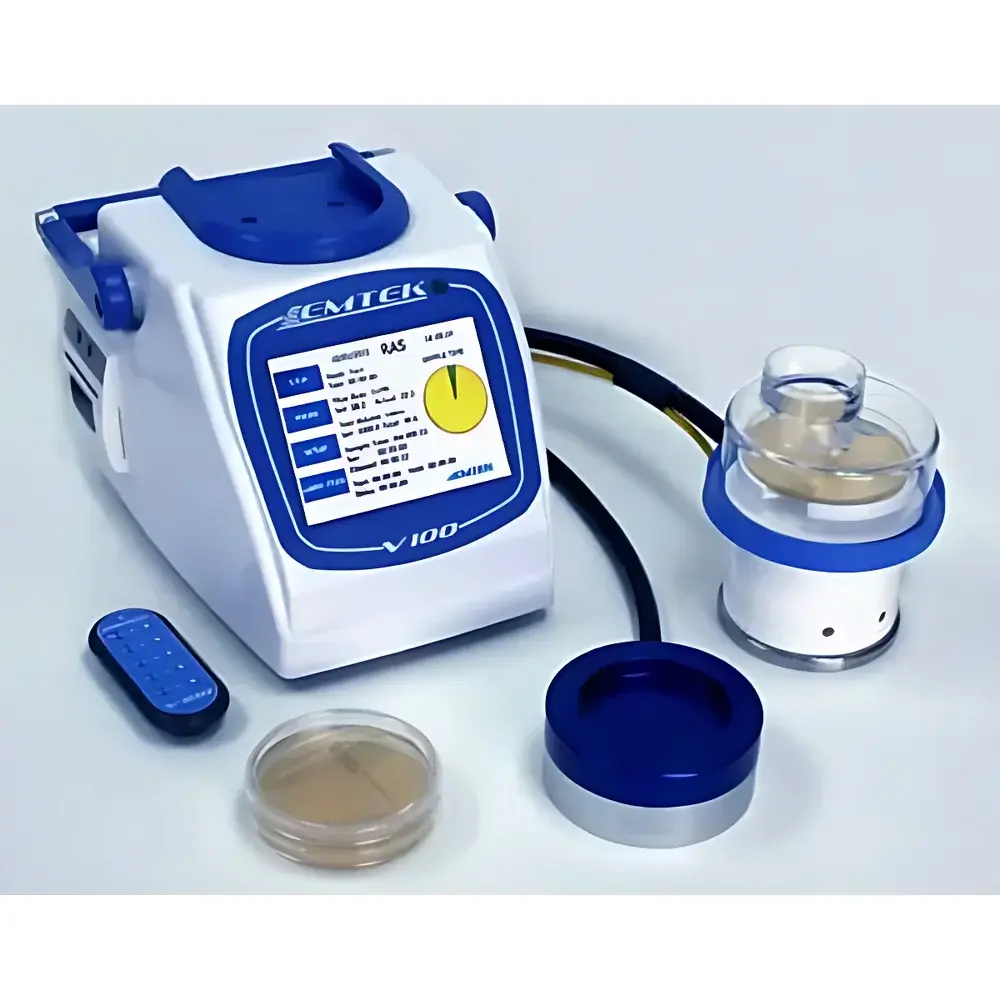
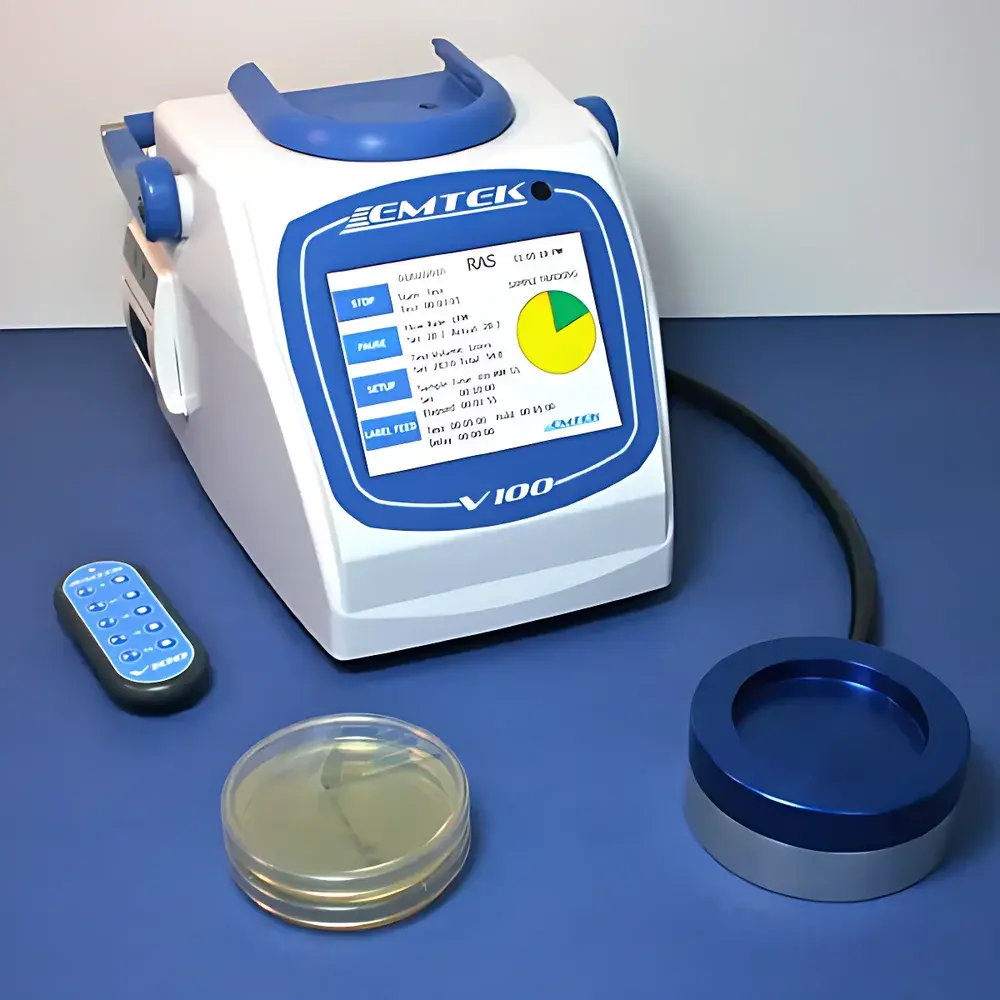
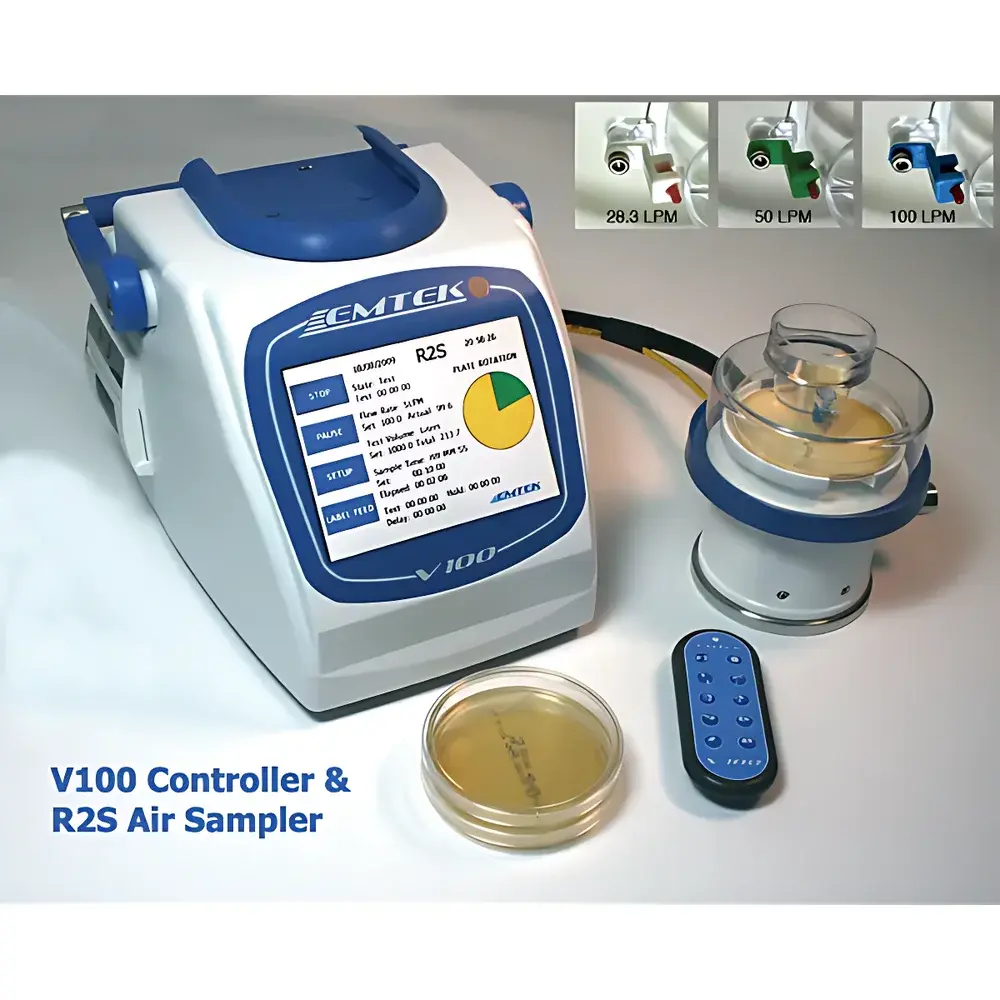
EMTEK V100 Compressed Air and Ambient Air Microbial Sampler
| Brand | EMTEK |
|---|---|
| Origin | USA |
| Model | EMTEK-V100 |
| Sampling Principle | Slit-to-Agar Rotation & Andersen-Style Impaction |
| Flow Rates | 28.3, 50, or 100 L/min (user-selectable) |
| Dimensions | 25.4 × 20.3 × 17.8 cm (L×W×H) |
| Weight | 2.45 kg |
| Power Input | 100–115 V / 60 Hz or 220 V / 50 Hz |
| Data Storage Capacity | >500 test records |
| Sampling Duration per Cycle | 0–120 min |
| Maximum Sample Volume per Cycle | >300 L |
| Exhaust Filter | 0.2 µm sterilizing-grade hydrophobic PTFE |
| Housing & Sampling Heads | Microban®-infused Kydex® and 316 stainless steel |
| Remote Control | Infrared (Start/Stop/Pause/Resume) |
| Display | Full-color touchscreen LCD |
| Optional Output | Thermal printer (label + receipt modes), USB data export |
Overview
The EMTEK V100 is a dual-mode, high-integrity microbial air sampler engineered for simultaneous monitoring of compressed air systems and ambient indoor/outdoor environments. It operates on two validated physical collection principles: slit-to-agar rotational sampling (patented RAS and R2S heads) and calibrated Andersen-style inertial impaction (R2S head), enabling quantitative recovery of viable airborne microorganisms ≥0.1 µm in aerodynamic diameter. Unlike single-principle samplers, the V100’s dual-head capability allows concurrent sampling at two independent locations—critical for spatial contamination mapping in ISO Class 5–8 cleanrooms, compressed air distribution networks per ISO 8573-7, and GMP-compliant manufacturing suites. Its architecture complies with core requirements of ISO 14698-1 (biocontamination control), EU GMP Annex 1 (2022), and USP , supporting both routine environmental monitoring (EM) and root-cause investigations.
Key Features
- Dual-sampling operation: One host unit supports two independently controlled sampling heads—enabling parallel acquisition from distinct zones (e.g., compressed air line outlet + adjacent ambient workspace).
- Modular head system: Interchangeable sampling heads include the R2S (standard impactor, 28.3/50/100 L/min), RAS (slit-to-agar rotation, 28.3/50/100 L/min), and RCG (high-pressure compressed air–optimized, 28.3 L/min only), all constructed from 316 stainless steel and Microban®-treated Kydex® to eliminate instrument-mediated bioburden.
- Precision flow control: Mass-flow calibrated at factory; selectable rates of 28.3 L/min (ISO 14698-1 reference), 50 L/min (enhanced throughput), or 100 L/min (rapid screening)—each verified traceable to NIST standards.
- Intelligent timing logic: Programmable multi-stage sampling sequences—including delay start, cycle count, inter-cycle pause, and total duration—ensuring alignment with facility shift schedules or process validation protocols.
- Agar depth calibration: Adjustable agar plate height mechanism minimizes variability in nutrient layer thickness across runs, directly improving colony isolation fidelity and CFU quantification reproducibility.
- Integrated sterilizing exhaust: 0.2 µm hydrophobic PTFE filter prevents cross-contamination between samples and safeguards operator safety during high-bioburden sampling.
Sample Compatibility & Compliance
The V100 accommodates standard 90 mm Petri dishes (non-vented or vented) and custom agar formulations including TSA, SDA, and selective media for Gram-negative or spore-forming organisms. All sampling heads meet ISO 8573-7 requirements for compressed air microbiological testing and are validated per ASTM E2994–21 (Standard Practice for Validation of Air Samplers). The device supports GLP/GMP audit readiness through timestamped, user-logged test records (including operator ID, location tag, flow rate, duration, and head type), with optional 21 CFR Part 11–compliant software add-ons for electronic signature and audit trail management.
Software & Data Management
Onboard memory stores >500 complete sampling sessions with full parameter metadata. Data export is supported via USB 2.0 to CSV or XML formats for integration into LIMS or statistical process control (SPC) platforms. The thermal printer provides dual-output capability: adhesive labels for immediate sample tube or dish identification, and continuous thermal receipts for lab notebook correlation. The color touchscreen interface displays real-time flow stability, elapsed time, and error diagnostics (e.g., pressure drop across exhaust filter, door-open alerts), reducing operator interpretation variance.
Applications
The EMTEK V100 serves critical roles in regulated and research-intensive settings: compressed air quality verification in pharmaceutical filling lines (per ISO 8573-1 Class 2/3); environmental monitoring of aseptic processing isolators; bioburden assessment in medical device packaging cleanrooms; fermentation facility airshed characterization; and HVAC system validation in hospital surgical suites. Its ability to resolve temporal contamination events—via synchronized agar exposure and programmable multi-interval sampling—makes it especially valuable for investigating sporadic microbial excursions linked to maintenance activities, personnel movement, or equipment cycling.
FAQ
Is the EMTEK V100 compliant with ISO 8573-7 for compressed air testing?
Yes—the RCG sampling head and associated flow calibration are specifically designed and validated for compressed air applications per ISO 8573-7:2019, including pressure compensation and oil-free sampling pathway integrity.
Can the same sampling head be used for both ambient and compressed air?
No—ambient and compressed air require physically distinct head designs. The RCG head is rated for pressures up to 10 bar and includes integrated pressure regulation; R2S and RAS heads are rated for atmospheric pressure only.
Does the device support automated calibration logging?
The V100 does not perform self-calibration, but it retains calibration certificate metadata (date, technician, flow verification values) within each stored test record when manually entered prior to use.
What is the maximum allowable particulate loading before filter replacement?
The 0.2 µm exhaust filter should be replaced after 50 sampling cycles or upon observed pressure drop exceeding 25% of baseline—whichever occurs first—as documented in the maintenance log.
Is remote operation possible without line-of-sight?
The infrared remote requires direct line-of-sight; for non-line-of-sight control, users may integrate the V100 into building management systems (BMS) via optional RS-485 or Modbus RTU interface modules.







