
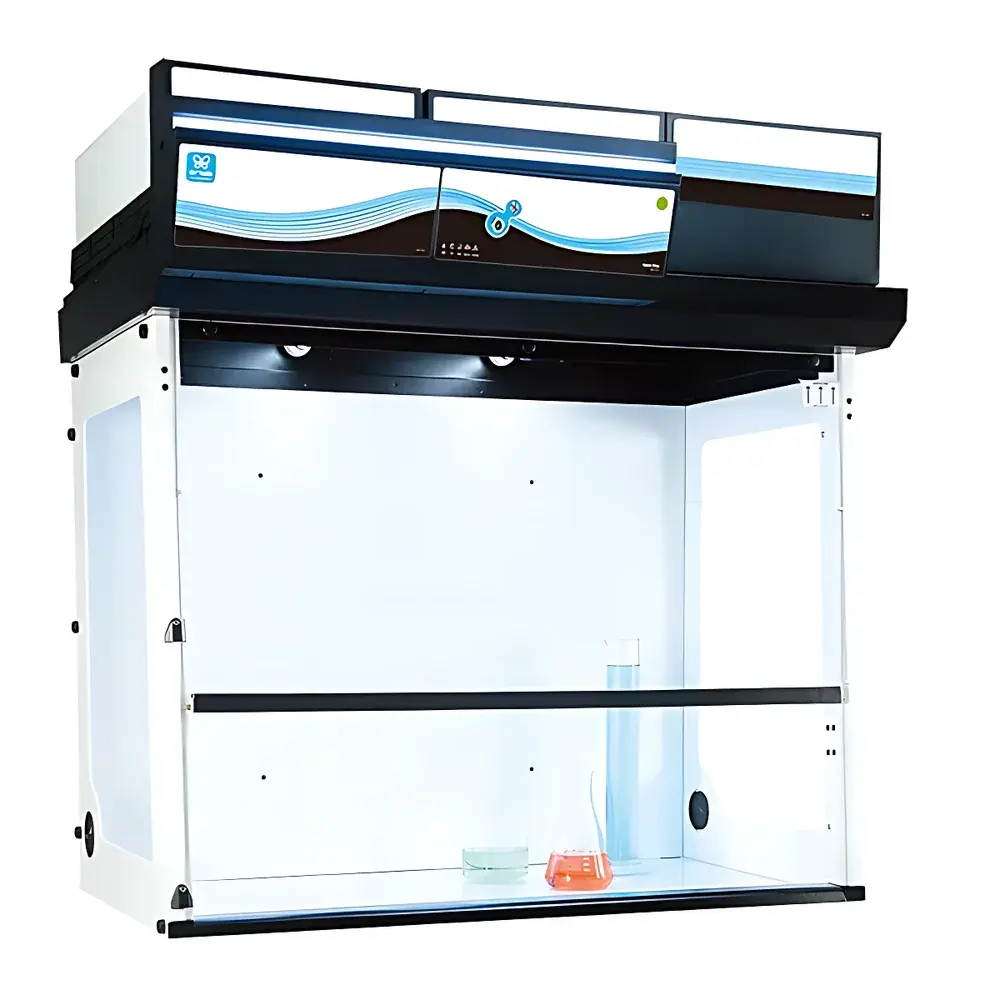
English Product Name
| Brand | Erlab |
|---|---|
| Origin | Jiangsu, China |
| Model | Smart 483 |
| Construction | All-Steel Enclosure |
| Type | Ductless (Recirculating) Fume Hood |
| Dimensions (W×D×H) | 1298 mm × 751 mm × 1333–1515 mm |
| Average Face Velocity | 0.4–0.6 m/s |
| Airflow Volume | 660 m³/h |
| Lighting | LED Tube |
| Rated Power | 160 W |
| Net Weight | 60.4 kg |
| Compliance | JG/T 385–2012, ANSI Z9.5–2012, AFNOR NFX 15-211 (Class 1 & 2 Filtration Requirements) |
Overview
The Erlab Smart 483 is a high-performance ductless purifying fume hood engineered for precision containment and energy-efficient operation in modern laboratories. Unlike conventional ducted hoods that exhaust conditioned air outdoors—resulting in significant HVAC load and infrastructure complexity—the Smart 483 recirculates filtered air back into the laboratory environment. It employs a dual-stage filtration architecture based on activated carbon impregnated with chemisorbents and particulate filters, enabling safe removal of volatile organic compounds (VOCs), inorganic acids, aldehydes (including formaldehyde), and fine particulates. Its design adheres to internationally recognized safety standards—including ANSI Z9.5–2012 (USA), JG/T 385–2012 (China), and AFNOR NFX 15-211 (France)—ensuring validated capture efficiency and operator protection under Class 1 and Class 2 chemical exposure scenarios. The unit operates at a controlled face velocity range of 0.4–0.6 m/s, dynamically monitored via integrated electronic anemometry, and maintains consistent airflow performance across its full height adjustment range (1333–1515 mm).
Key Features
- Modular, field-replaceable filter cartridges: Configurable combinations for VOCs, acids, aldehydes, or mixed-phase contaminants—enabling application-specific optimization without hardware modification.
- Real-time filter saturation monitoring: Integrated sensors detect breakthrough for organic solvents, inorganic acids, and formaldehyde; visual (ring-light indicator) and audible alarms trigger before saturation thresholds are exceeded.
- Redundant safety filtration: A secondary “safety filter” remains active after primary filter exhaustion, providing continued containment during scheduled maintenance windows.
- Erlab Safety Process (ESP) integration: Supports traceable safety documentation including applicability assessment, user certification, and usage logging—facilitating GLP/GMP-aligned audit readiness.
- Remote diagnostics and alerting: Connects via Ethernet or Wi-Fi to Erlab’s cloud-based platform for real-time access to airflow status, filter life metrics, alarm history, and operational logs.
- Energy-efficient operation: 160 W nominal power draw and zero external ductwork eliminate HVAC compensation losses—reducing total cost of ownership by up to 70% compared to equivalent ducted systems over a 5-year lifecycle.
Sample Compatibility & Compliance
The Smart 483 is validated for routine use with low-to-moderate volatility chemicals commonly encountered in environmental testing, quality control, and academic research labs—including acetone, ethanol, hydrochloric acid (dilute), nitric acid (dilute), formaldehyde solutions (<1%), and silica dust. It is not intended for perchloric acid, hydrogen fluoride, radioactive materials, or highly polymerizing monomers. All filtration configurations undergo independent verification per ISO 10121-1 (gas-phase filter testing) and EN 1822-1 (particulate filter classification). Documentation includes test reports aligned with ISO/IEC 17025 requirements for accredited calibration and performance validation. The unit supports compliance with institutional biosafety level (BSL-1/BSL-2) chemical handling protocols and contributes to LEED v4.1 Energy & Atmosphere credit achievement through reduced building energy demand.
Software & Data Management
The Smart 483 integrates with Erlab’s SmartLink™ software suite, offering role-based web interface access for lab managers, EHS officers, and end users. Key capabilities include: configurable alarm thresholds, automated filter replacement scheduling, exportable CSV logs for regulatory submission (e.g., OSHA 1910.1200, EU REACH), and timestamped event tracking (e.g., door position changes, airflow deviations, filter swaps). Audit trails comply with FDA 21 CFR Part 11 requirements for electronic records and signatures when deployed with appropriate IT governance controls. Data retention is configurable up to 36 months; all communications are encrypted via TLS 1.2+.
Applications
This ductless fume hood serves laboratories requiring flexible, low-infrastructure chemical containment—particularly in environmental analysis (e.g., EPA Method 8260B sample prep), pharmaceutical QC (USP compliant instrument qualification support), university teaching labs, and field-deployable mobile labs. Its compact footprint (1298 mm width) and caster-mounted base allow rapid repositioning within shared lab spaces without structural modifications. The absence of roof penetrations or dedicated exhaust shafts enables installation in historic buildings, leased facilities, or modular lab units where ducting is prohibited or cost-prohibitive.
FAQ
What types of chemicals can be safely handled in the Smart 483?
It is certified for use with common organic solvents (e.g., methanol, toluene), dilute inorganic acids (≤10% HCl, HNO₃), and formaldehyde solutions below 1% concentration. Consult the Chemical Compatibility Matrix before use with halogenated solvents or strong oxidizers.
How often must filters be replaced?
Replacement frequency depends on usage intensity and chemical profile—typically every 6–12 months under standard academic lab conditions. The system calculates remaining service life based on real-time sensor data and cumulative exposure metrics.
Does the Smart 483 require external ventilation or make-up air?
No. It operates as a closed-loop recirculation system and imposes no demand on building HVAC infrastructure.
Can it be integrated into a centralized lab monitoring network?
Yes—via standard Modbus TCP or HTTP API, enabling interoperability with BMS platforms (e.g., Siemens Desigo, Honeywell Enterprise Buildings Integrator).
Is third-party validation available for regulatory submissions?
Erlab provides ISO/IEC 17025-accredited test reports upon request, including face velocity uniformity mapping, tracer gas containment efficiency (SF₆), and filter breakthrough testing per ASTM D5208.



