
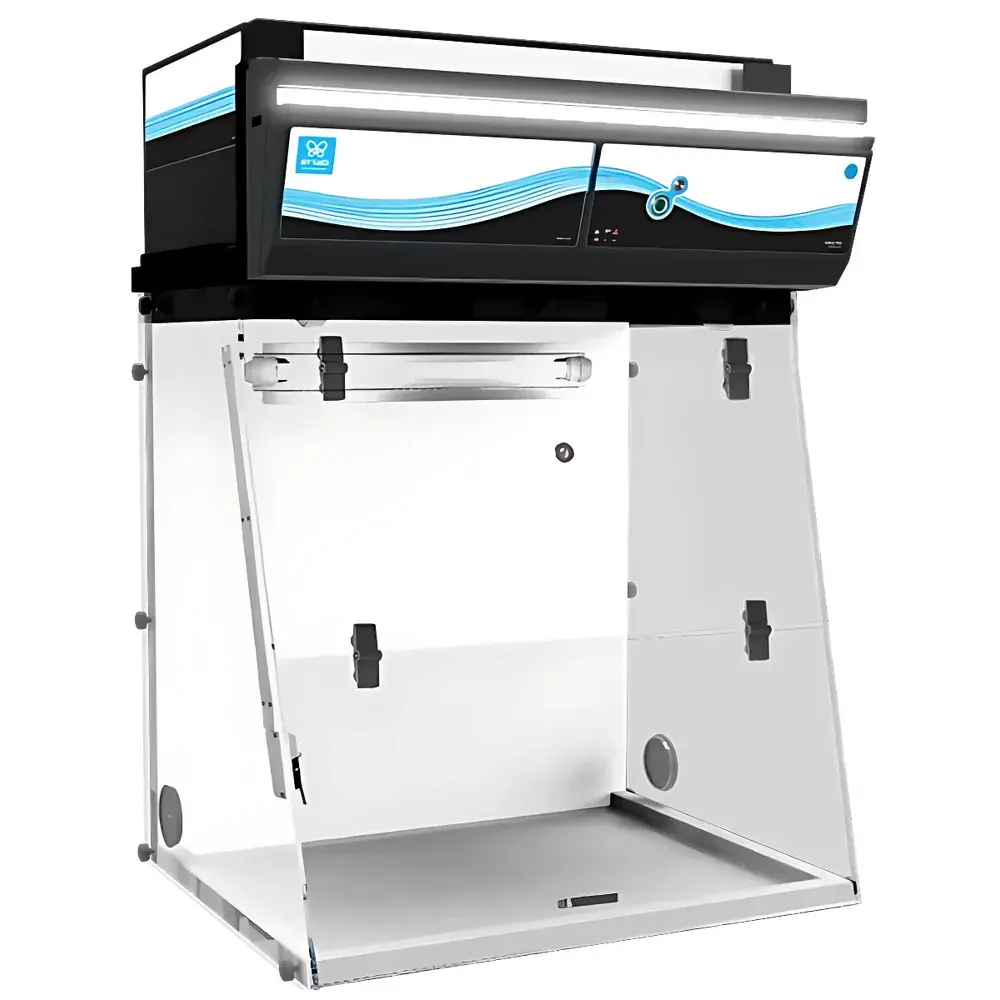
Erlab Flow Vertical Laminar Flow Clean Bench
| Brand | Erlab |
|---|---|
| Origin | Jiangsu, China |
| Manufacturer Type | Authorized Distributor |
| Product Category | Domestic |
| Model | Clean Air Enclosures 321 |
| Price Range | USD 14,000 – 42,000 (FOB) |
| Cabinet Material | Fully Stainless Steel |
| Ventilation Type | Ductless (Recirculating) |
| Filtration | HEPA H14 (99.995% @ 0.3 µm) or ULPA U17 (99.999995% @ 0.12 µm) |
| Cleanroom Classification | ISO Class 5 (EN ISO 14644-1:2015) |
| Optional Add-on | Molecular Filter (Activated Carbon + Impregnated Media) for VOC Removal |
| Safety Monitoring | Real-time 360° airflow & filter integrity sensing via SmartLight™ optical interface |
| Compliance | EN 12464-1, EN 14175-5, IEC 61000-6-3, CE-marked |
Overview
The Erlab Flow Vertical Laminar Flow Clean Bench (Model: Clean Air Enclosures 321) is a ductless, recirculating clean air workstation engineered for particle-sensitive applications in research, quality control, and precision manufacturing environments. Unlike traditional fume hoods or horizontal laminar flow cabinets, this unit employs a vertical unidirectional airflow system—generated by a low-turbulence centrifugal blower and conditioned through certified HEPA H14 or ULPA U17 filters—to deliver ISO Class 5 (≤3,520 particles/m³ ≥0.5 µm) air across the work surface. The laminar flow principle ensures consistent velocity (0.3–0.5 m/s), minimal turbulence, and uniform particle removal from the operator-to-sample path. Designed for laboratories where structural ducting is impractical or cost-prohibitive, the Flow Clean Bench operates as a self-contained, plug-and-play enclosure—eliminating reliance on building exhaust infrastructure while maintaining full compliance with EN 14175-5 (laboratory fume cupboard standards) and EN 12464-1 (lighting and indoor air quality for workplaces).
Key Features
- Vertical laminar airflow architecture with pre-filter + main HEPA H14 (or ULPA U17) filtration—achieving ≥99.995% (H14) or ≥99.999995% (U17) particle capture efficiency at the most penetrating particle size (MPPS)
- SmartLight™ optical user interface: real-time visual feedback via color-coded LED bands indicating operational status, filter saturation level, and airflow integrity—no touchscreen required, minimizing contamination risk and cleaning complexity
- Ductless recirculation design: >70% of supply air is filtered and returned to the work area; only ~30% is exhausted externally (if optional external discharge kit installed), reducing HVAC load and energy consumption
- Fully welded 304 stainless steel chassis and work surface—resistant to corrosion, static discharge, and routine decontamination with ethanol, isopropanol, or 10% bleach solutions
- Integrated molecular filtration option: dual-stage activated carbon + chemisorbent media for adsorption of volatile organic compounds (VOCs), aldehydes, and acidic/basic vapors—critical for cell culture, semiconductor handling, and analytical sample prep
- 360° environmental monitoring: embedded sensors continuously track static pressure differential across filters, motor RPM, ambient temperature/humidity, and cabinet sash position (where applicable)
Sample Compatibility & Compliance
The Clean Air Enclosures 321 supports non-hazardous, non-volatile, and low-risk biological or particulate-sensitive procedures—including sterile microbiological transfers, PCB assembly, optical component alignment, microfluidic device fabrication, and pharmaceutical weighing. It is not intended for use with flammable solvents, radioactive materials, or human pathogens requiring BSL-2 containment. The unit conforms to EN ISO 14644-1:2015 (cleanroom classification), EN 14175-5:2021 (performance testing of laboratory enclosures), and IEC 61000-6-3:2018 (EMC emissions). All electrical components carry CE marking; filter certification follows EN 1822-1:2019. Documentation includes factory-assembled test reports, filter integrity certificates (DOP/PAO scan data), and traceable calibration records—supporting GLP/GMP audit readiness.
Software & Data Management
The Flow Clean Bench operates without proprietary software or cloud dependency. All operational parameters are managed via the embedded SmartLight™ controller, which logs timestamped events—including filter runtime, alarm triggers (e.g., low airflow, high ΔP), and maintenance prompts—into non-volatile memory. Logged data can be exported via USB-C port in CSV format for integration into laboratory information management systems (LIMS) or electronic lab notebooks (ELN). The system supports 21 CFR Part 11-compliant audit trails when paired with validated third-party LIMS platforms; user access levels (operator, technician, administrator) are configurable via physical key switch or PIN code.
Applications
- Microelectronics: wafer probing, die bonding, and photomask handling under particle-free conditions
- Life sciences: aseptic transfer of primary cells, stem cell expansion, and CRISPR reagent preparation
- Materials science: nanomaterial dispersion, thin-film deposition setup, and AFM/SEM sample mounting
- Quality assurance: reference standard weighing, tablet coating inspection, and optical lens cleaning
- Educational labs: hands-on training in clean technique, filter validation, and airflow visualization using smoke wire tests
FAQ
Is this unit suitable for handling hazardous chemicals or biohazards?
No. The Clean Air Enclosures 321 is designed exclusively for particle control—not chemical or biological containment. It does not meet NFPA 45, ANSI Z9.5, or BSL-2 requirements.
Can the HEPA filter be replaced in-house?
Yes. Filter replacement requires no tools and takes <5 minutes; all filters are pre-certified and shipped with EN 1822-3 test reports. Replacement intervals are determined by cumulative runtime and ΔP monitoring—not fixed calendar schedules.
Does the unit require external ductwork or make-up air compensation?
No. As a ductless system, it operates independently of building HVAC. Optional external discharge kits allow connection to roof vents but are not mandatory for safe operation.
What validation documentation is provided upon delivery?
Each unit ships with a Factory Acceptance Test (FAT) report, filter certification dossier (including MPPS efficiency, leakage scan results), airflow uniformity map, and CE Declaration of Conformity.
How is compliance with ISO Class 5 verified post-installation?
Users must perform periodic airborne particle counting per ISO 14644-1 Annex B using calibrated 0.5 µm and 5.0 µm channel particle counters; Erlab provides a certified IQ/OQ protocol template aligned with EU GMP Annex 1 and USP <797>.



