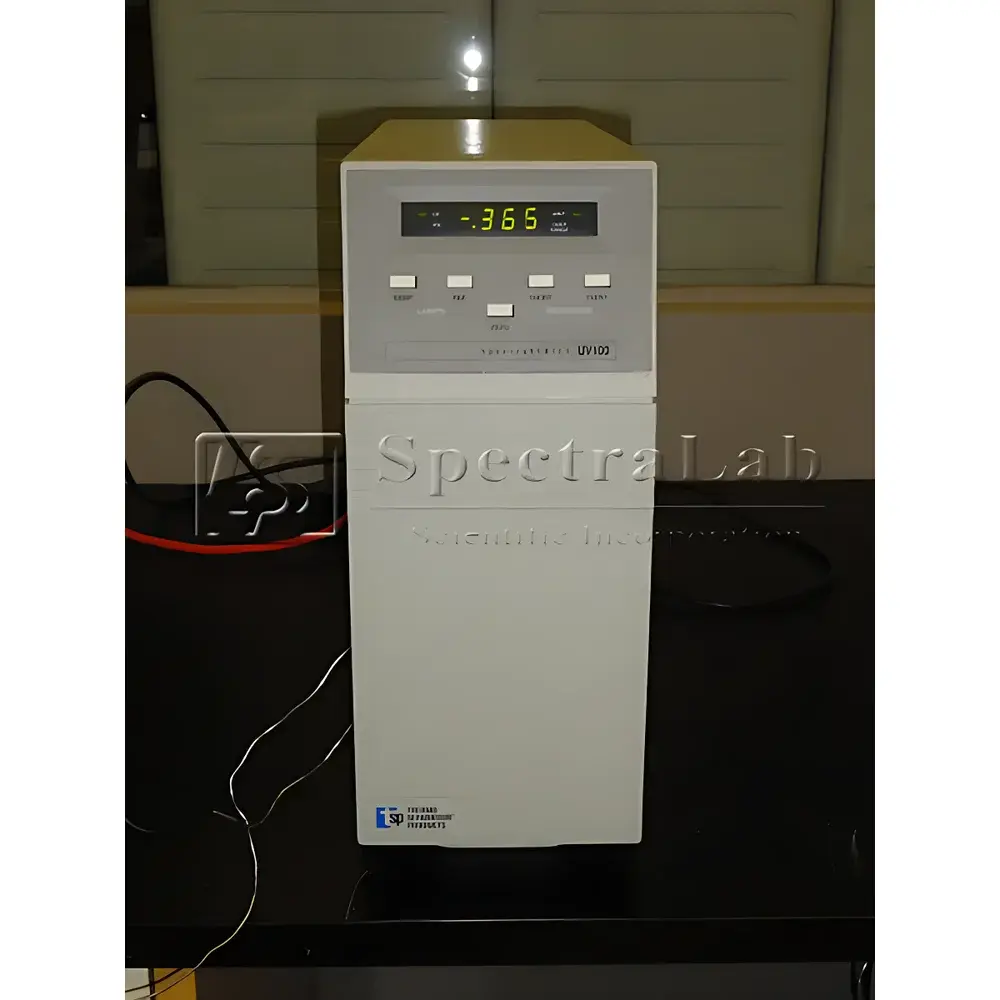
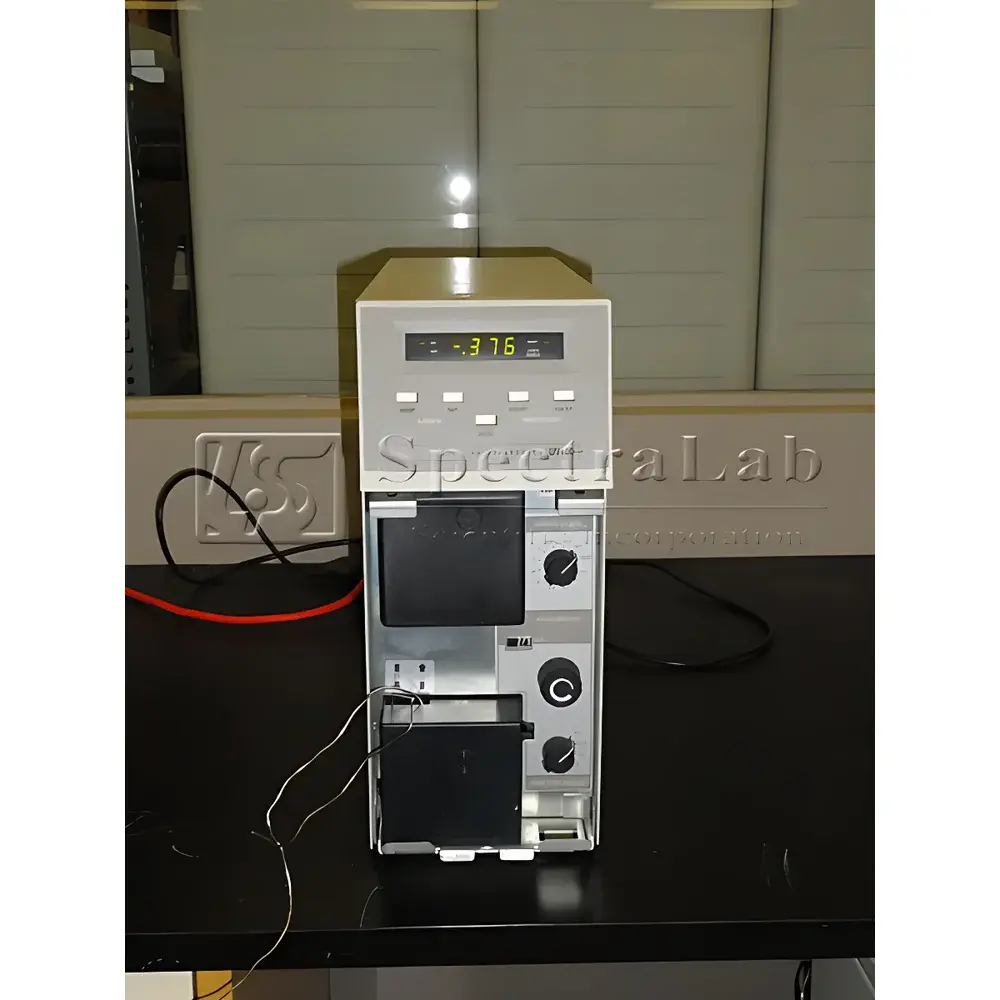
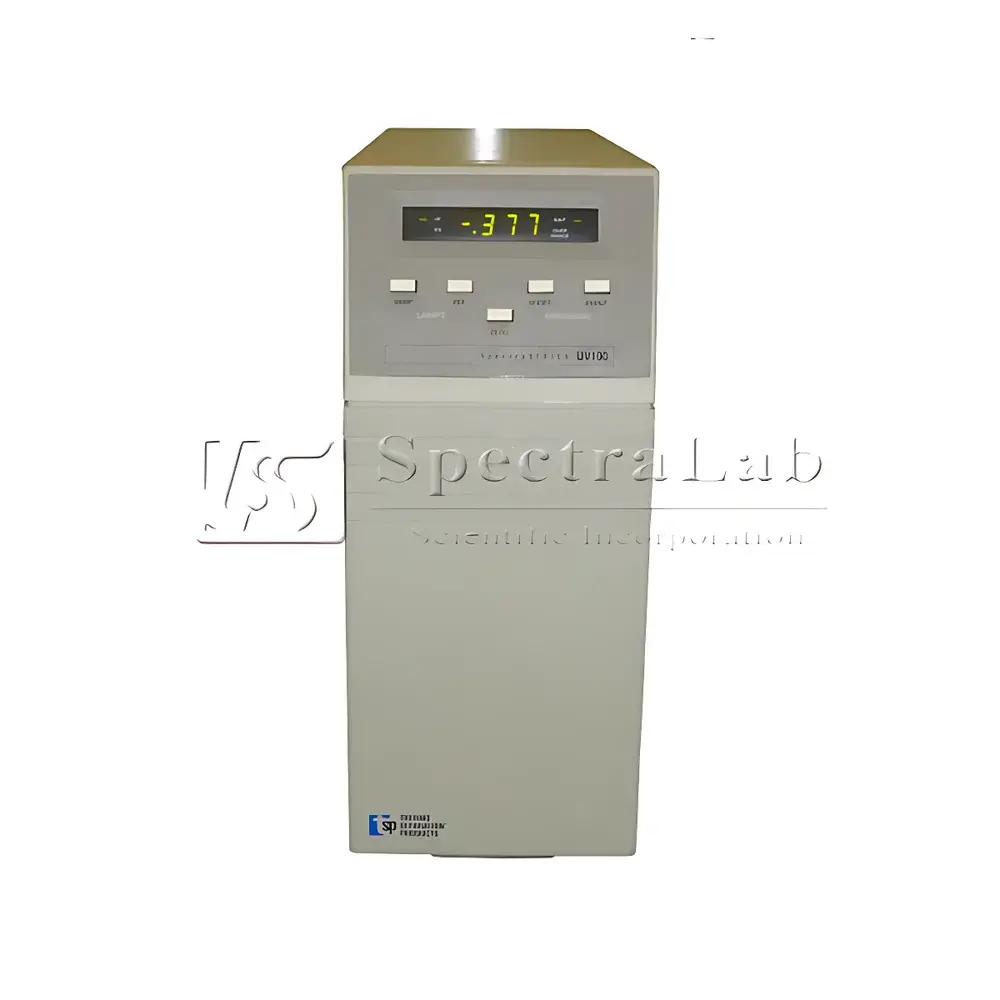
Thermo Fisher TSP UV100 UV-Vis Detector
| Brand | Thermo Fisher |
|---|---|
| Origin | Canada |
| Model | UV100 |
| Product Category | Chromatography Detector |
| Usage Duration | 4–5 years |
| Warranty | 6 months |
| Condition | Refurbished & Fully Tested |
Overview
The Thermo Fisher TSP UV100 is a high-stability, dual-beam ultraviolet-visible (UV-Vis) absorbance detector designed for integration into legacy and modern high-performance liquid chromatography (HPLC) systems. Engineered on the foundational optical architecture of the Thermospectra series, it employs a deuterium lamp source (190–370 nm) and a tungsten-halogen lamp (350–800 nm), enabling broad-spectrum detection across standard analytical UV-Vis windows. The detector operates on fixed-wavelength or programmable wavelength scanning modes, with analog output (0–1 V) compatible with analog integrators and legacy data acquisition systems. Its optical path features a 10 mm flow cell with 8 µL internal volume, optimized for standard 4.6 mm ID analytical columns and delivering reproducible baseline stability (< ±1 × 10⁻⁵ AU/hr) under controlled ambient conditions.
Key Features
- Dual-lamp optical system (deuterium + tungsten-halogen) ensuring continuous spectral coverage from 190 nm to 800 nm
- Fixed-wavelength operation with manual wavelength selection via front-panel rotary dial; no software dependency required
- High-sensitivity photodiode array design supporting absorbance detection down to 0.0001 AU full scale
- Robust mechanical construction with stainless-steel fluidic housing and chemically resistant wetted materials (e.g., sapphire windows, PEEK flow cell body)
- Integrated analog output (BNC) and TTL-compatible event trigger for synchronization with fraction collectors or external timers
- Refurbishment includes full optical alignment verification, lamp intensity calibration, flow cell leak testing, and electronic signal integrity validation per Thermo Fisher service protocols
Sample Compatibility & Compliance
The TSP UV100 is compatible with common HPLC mobile phases—including aqueous buffers (e.g., phosphate, acetate), organic modifiers (acetonitrile, methanol), and low-concentration acids/bases—provided pH remains within 2.0–7.5 to preserve flow cell integrity. It meets mechanical and electrical safety requirements per CSA C22.2 No. 61010-1 (Canada) and conforms to IEC 61010-1:2010 for laboratory equipment. While not natively 21 CFR Part 11 compliant due to its analog architecture, the detector supports GLP/GMP workflows when paired with validated analog-to-digital conversion hardware and audit-trail-enabled data systems. It is routinely deployed in QC laboratories performing USP , EP 2.2.46, and ASTM D5502-compliant assays for pharmaceutical impurity profiling and excipient quantitation.
Software & Data Management
As a standalone analog detector, the UV100 does not include embedded firmware or digital communication interfaces (e.g., RS-232, USB, or Ethernet). Data acquisition relies on external analog integrators (e.g., Shimadzu C-R7A, Waters 746 Integrator) or modern DAQ systems equipped with calibrated 16-bit ADC inputs. SpectraLab Scientific provides optional configuration documentation—including gain/offset tables, voltage-to-absorbance conversion coefficients, and timing diagrams for peak width validation—to facilitate method transfer and system qualification. All refurbished units ship with a traceable calibration report referencing NIST-traceable holmium oxide and neutral density filters.
Applications
- Stability-indicating assay development for small-molecule APIs under ICH Q1/Q2 guidelines
- Residual solvent analysis in polymer-grade monomers using isocratic reversed-phase methods
- Educational HPLC training platforms where deterministic, low-maintenance detection is prioritized over spectral flexibility
- Environmental water testing for nitrate, nitrite, and aromatic hydrocarbons via EPA Method 300.0 and 8081B
- Food additive quantification (e.g., benzoic acid, sorbic acid) in acidic matrices using simple isocratic elution
FAQ
Is the UV100 compatible with modern HPLC systems featuring digital controllers?
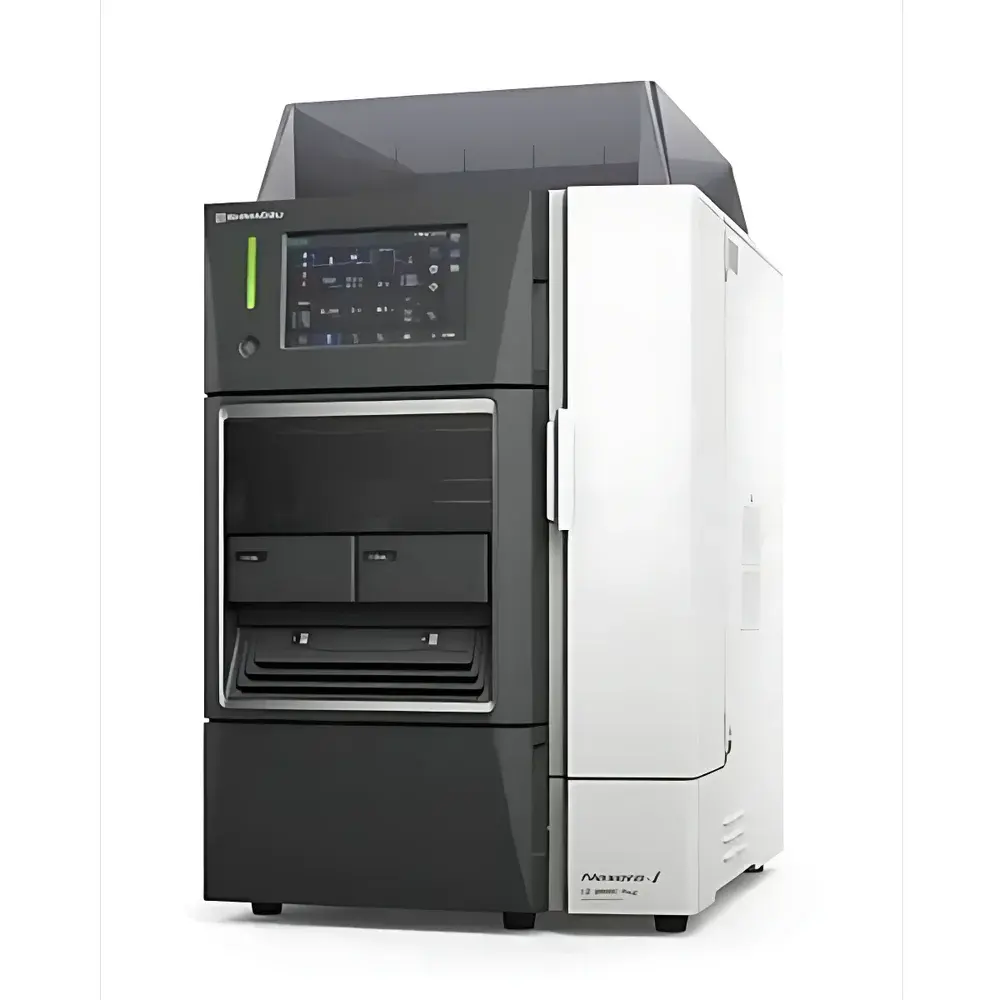
Yes—when interfaced via an analog input module or external A/D converter, it functions reliably with Agilent 1260, Waters e2695, and Shimadzu Nexera systems.
Does the refurbishment include lamp replacement?
All units ship with newly installed, factory-tested deuterium and tungsten-halogen lamps, each with documented initial intensity readings.
Can the detector be used for gradient methods?
Yes—the dual-beam design minimizes baseline drift during solvent gradient transitions; however, optimal performance requires stable column oven temperature and pulse-dampened pump output.
What documentation accompanies the unit?
Each detector includes a Certificate of Refurbishment, optical alignment verification record, flow cell pressure test log, and lamp calibration summary—all signed and dated by SpectraLab’s ISO 9001-certified technical staff.
Related Products