
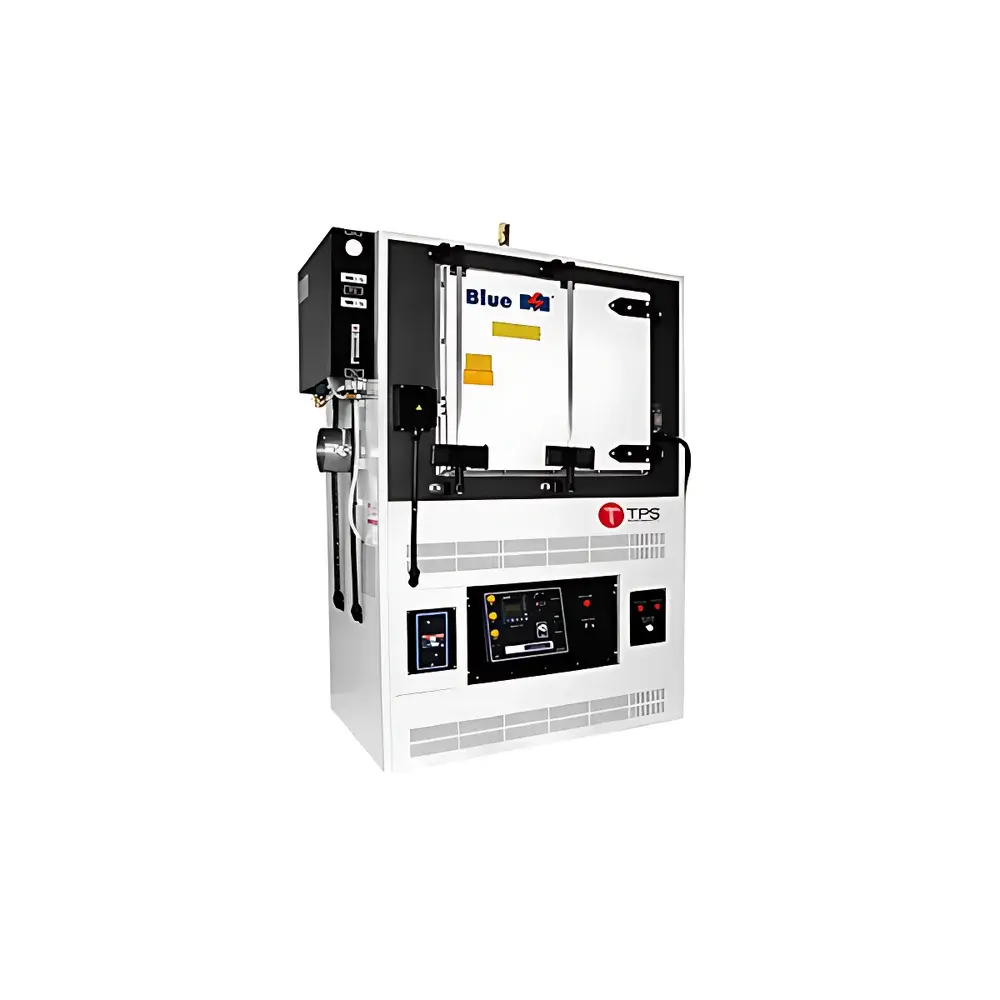
Blue M IGF-7780 Semiconductor Wafer Curing Oven
| Brand | Blue M |
|---|---|
| Origin | USA |
| Model | IGF-7780 |
| Temperature Range | Ambient +15°C to 593°C (1099°F) |
| Max Operating Temperature | 400°C |
| Uniformity | ±2% of setpoint |
| Temperature Stability | ±2% of setpoint |
| Temperature Deviation | ±0.5°C |
| Chamber Dimensions (W×H×D) | 25 × 20 × 20 cm |
| Internal Volume | 5.8 ft³ (0.164 m³) |
| Gas Compatibility | N₂, Ar, He, CO₂, and forming gas (4% H₂ in N₂) |
| Safety Certifications | NFPA 86 Class B |
| Heating System | Open-wire NiCr elements |
| Insulation | 6-inch mineral wool |
| Door Seal | High-temp fiberglass gasket |
| Cooling | Air-cooled door (IGF-7780) |
| Control Resolution | ±0.1°C |
| Exhaust | Adjustable damper with purge timer |
| Interlocks | Door switch (heater/fan shutdown), gas leak detection alarm, pressure monitoring |
Overview
The Blue M IGF-7780 Semiconductor Wafer Curing Oven is an NFPA 86 Class B-certified inert-atmosphere high-temperature aging chamber engineered for precision thermal processing of silicon wafers, photomasks, thin-film substrates, and microelectromechanical systems (MEMS) during post-lithography bake, die attach curing, underfill polymerization, and metallization annealing. It operates on the principle of forced convection heating within a sealed, gas-tight cavity, where uniform temperature distribution is maintained via a high-capacity horizontal airflow system and optimized baffle geometry. Unlike standard ambient-air ovens, the IGF-7780 integrates real-time inert gas management—supporting nitrogen, argon, helium, carbon dioxide, and low-concentration forming gas (4% H₂ in N₂)—to suppress oxidation, prevent intermetallic diffusion, and eliminate moisture-induced defects during critical semiconductor packaging and front-end-of-line (FEOL) processes. Its welded stainless steel inner chamber eliminates insulation contamination pathways, ensuring long-term process integrity and minimizing particle generation in cleanroom-compatible environments.
Key Features
- Gas-tight welded stainless steel inner chamber with double-wall construction for inert gas containment and thermal isolation
- Open-wire nickel-chromium (NiCr) heating elements mounted externally to minimize particulate shedding and enable rapid thermal response
- Horizontal laminar airflow system with adjustable baffles ensures ±2% temperature uniformity across the full 25 × 20 × 20 cm workspace
- Integrated gas flow meter, chamber pressure transducer, and digital purge timer for programmable inert gas purging sequences
- Dual-stage safety interlock system: door switch disables heater and blower upon opening; gas leak detection triggers audible/visual alarm and automatic heater cutoff
- 6-inch (152 mm) mineral wool insulation combined with a high-temperature fiberglass door gasket maintains thermal efficiency and surface temperature compliance per NFPA 86
- Front-panel digital controller with ±0.1°C resolution, ramp-soak programming, and real-time deviation logging
- Exhaust damper with manual adjustment and optional automated vent control for volatile byproduct management
Sample Compatibility & Compliance
The IGF-7780 accommodates standard 100–300 mm semiconductor wafers on quartz or ceramic carriers, as well as multi-layer ceramic packages, leadframes, and wafer-level chip-scale packages (WLCSP). Its inert atmosphere capability supports processes requiring oxygen levels below 10 ppm—critical for silver sintering, low-temperature co-fired ceramic (LTCC) densification, and copper pillar reflow. The oven complies with NFPA 86 Standard for Ovens and Furnaces (Class B for inert and flammable gas atmospheres), and its design aligns with ISO 14644-1 Class 5 cleanroom operational expectations when integrated with HEPA-filtered gas supply lines. While not inherently 21 CFR Part 11 compliant, the controller supports external data acquisition systems that can be configured for GLP/GMP audit trails when paired with validated software platforms.
Software & Data Management
The IGF-7780 utilizes a standalone microprocessor-based controller with non-volatile memory for up to 16 user-defined ramp-soak profiles. Temperature setpoints, actual readings, deviations, and alarm events are logged internally at 1-second intervals and exportable via RS-485 or analog 4–20 mA output. Optional Ethernet or USB interface modules enable integration into centralized MES or SCADA environments for SPC charting, batch record generation, and remote parameter verification. All thermal profiles meet ASTM E220 and ISO/IEC 17025 traceability requirements when calibrated using NIST-traceable reference thermocouples placed at designated sensor ports (standard on IGF-7780 and higher models).
Applications
- Post-exposure bake (PEB) and post-apply bake (PAB) of photoresists on silicon and compound semiconductor substrates
- Curing of epoxy mold compounds (EMC), silicone gels, and polyimide passivation layers
- Thermal stabilization of MEMS inertial sensors and RF filter assemblies
- Oxidation-free annealing of aluminum and titanium nitride metallization stacks
- Low-temperature glass frit bonding and anodic bonding qualification
- Reliability stress testing per JEDEC JESD22-A108 (high-temperature operating life) and JESD22-A110 (highly accelerated temperature-humidity stress test)
FAQ
What inert gases are compatible with the IGF-7780?
Nitrogen (N₂), argon (Ar), helium (He), carbon dioxide (CO₂), and forming gas (4% H₂ in N₂) are fully supported. Hydrogen concentrations exceeding 4% require consultation with Blue M engineering for modified safety interlocks.
Is the IGF-7780 suitable for cleanroom installation?
Yes—when supplied with filtered inert gas and installed with appropriate exhaust ducting, it meets ISO 14644-1 Class 5 particulate limits during steady-state operation. Optional HEPA-filtered recirculation kits are available.
Does the oven support automated data logging for quality audits?
The base controller logs temperature data internally; for FDA 21 CFR Part 11-compliant electronic records, integration with third-party validated data acquisition software is required.
What is the maximum recommended wafer load for thermal uniformity?
For optimal ±2% uniformity, loading should not exceed 75% of chamber volume. A typical configuration supports up to four 200-mm wafers on low-mass quartz carriers.
How does the gas leak detection system function?
A pressure decay test initiates automatically after chamber sealing; if pressure drops beyond a user-defined threshold within a preset interval, the system triggers an alarm and de-energizes the heater circuit while maintaining purge flow.



