
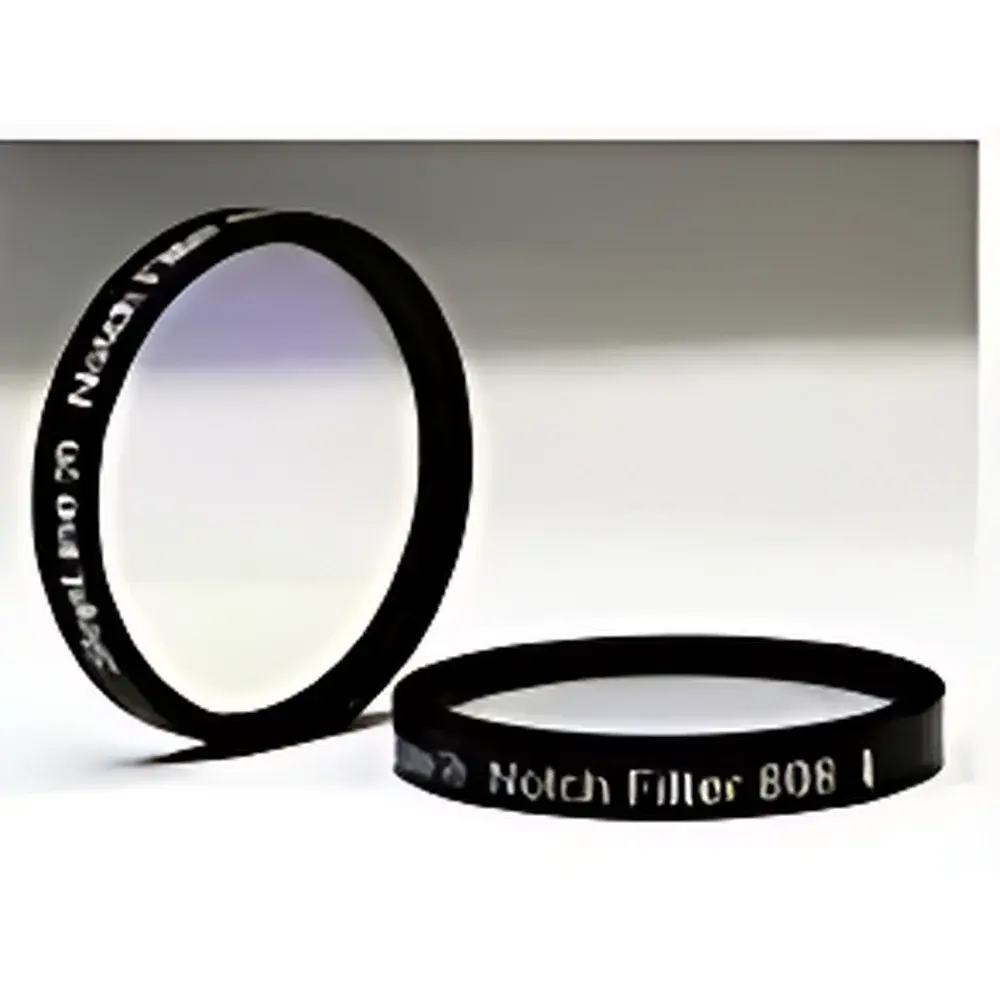
Semrock StopLine® Notch Filter Series
| Brand | Semrock |
|---|---|
| Origin | USA |
| Model | NF03-405E-25, NF03-488E-25, NF03-514E-25, NF03-532E-25, NF01-532U-25, NF03-561E-25, NF03-594E-25, NF03-633E-25, NF03-658E-25, NF03-785E-25, NF03-808E-25 (Single-Notch) |
| Coating Type | Hard Ion Beam Sputtered (IBS) Dielectric |
| Notch Depth | OD > 6 (typical), OD > 7 (select models) |
| Transmission Band | >90% average across passbands |
| Blocking Range | Typically ±1–5 nm from notch center (FWHM varies by model) |
| Substrate | Fused silica (UV-grade) |
| Surface Quality | 10–5 scratch-dig |
| Flatness | λ/4 @ 633 nm |
| Operating Temperature | –40 °C to +70 °C |
| Damage Threshold | >5 J/cm² @ 10 ns, 20 Hz, 1064 nm (pulsed) |
Overview
Semrock StopLine® Notch Filters are high-performance, ultra-narrowband optical interference filters engineered for precise laser line rejection in demanding spectroscopic and imaging applications. Based on advanced ion-beam sputtered (IBS) dielectric thin-film technology, these filters deliver deep spectral blocking (optical density >6–7) at defined laser wavelengths while maintaining high transmission (>90% avg.) across broad adjacent passbands. Unlike soft-coated or epoxy-bonded alternatives, StopLine® filters utilize monolithic hard-coating architecture directly deposited onto UV-grade fused silica substrates—eliminating thermal drift, delamination risk, and humidity-induced degradation. This robust construction ensures long-term stability under continuous illumination, making them ideal for integration into Raman spectrometers, fluorescence lifetime imaging (FLIM), confocal microscopes, and laser-based diagnostic platforms where signal-to-noise ratio and spectral fidelity are critical.
Key Features
- Deep, stable optical density (OD >6 typical; OD >7 available) centered precisely at common laser emission lines (e.g., 405 nm, 488 nm, 532 nm, 633 nm, 785 nm, 808 nm)
- Multi-notch variants support simultaneous rejection of two or more laser lines—enabling compact multi-laser excitation systems without cascaded filtering
- Hard IBS coating provides exceptional environmental durability: resistant to temperature cycling (–40 °C to +70 °C), high-power irradiation, and mechanical cleaning
- Low wavefront distortion (λ/4 @ 633 nm) and tight surface quality (10–5 scratch-dig) ensure minimal beam aberration in collimated or focused optical paths
- Standard 25 mm diameter format with 2 mm thickness; custom sizes, shapes, and mounting options available within 7 business days
- Compliant with ISO 9001 manufacturing controls; certified conformance documentation supplied with each filter batch
Sample Compatibility & Compliance
StopLine® Notch Filters are routinely deployed in regulated analytical environments requiring traceable performance validation. Their consistent spectral response supports compliance with ASTM E275 (spectrophotometer calibration), ISO 17025 (testing laboratory competence), and FDA 21 CFR Part 11 when integrated into instrument control software with audit-trail capability. Each filter is individually tested using NIST-traceable spectrophotometry and accompanied by a full spectral transmittance report (200–1100 nm). For GMP/GLP workflows, optional IQ/OQ documentation packages—including installation qualification protocols and operational verification data—are available upon request. The fused silica substrate meets USP requirements for optical clarity and low autofluorescence, supporting use in clinical cytometry and in vitro diagnostic (IVD) devices.
Software & Data Management
While StopLine® filters are passive optical components, their performance parameters are fully compatible with industry-standard optical design and system modeling tools including Zemax OpticStudio, CODE V, and FRED. Spectral data files (.csv, .txt) conforming to the ISO 15382 standard are provided for seamless import into spectral simulation pipelines. For instrument OEMs integrating these filters into automated platforms, Semrock supplies machine-readable metadata (XML schema) containing lot-specific center wavelength, FWHM, OD profile, and coating uniformity metrics—enabling real-time spectral calibration traceability and predictive maintenance scheduling. All spectral reports include timestamps, operator IDs, and instrument calibration certificates aligned with ISO/IEC 17025 requirements.
Applications
- Raman spectroscopy: Effective suppression of Rayleigh scatter in backscattering configurations, enabling detection of weak Stokes/anti-Stokes bands with improved signal fidelity
- Fluorescence microscopy: Integration into dichroic cubes or emission pathways to eliminate laser bleed-through in multi-color labeling experiments
- Laser safety & beam diagnostics: Use as notch elements in power monitoring setups where precise attenuation of specific wavelengths is required without affecting broadband reference signals
- Biophotonics instrumentation: Embedded in flow cytometers and tissue analyzers to isolate narrow emission bands from complex autofluorescence backgrounds
- Quantum optics: Wavelength-selective filtering in single-photon detection modules operating near telecom or visible laser lines
FAQ
What is the typical damage threshold for StopLine® filters under CW and pulsed laser exposure?
Standard StopLine® filters exhibit a pulsed damage threshold of >5 J/cm² (10 ns, 20 Hz, 1064 nm) and a continuous-wave threshold exceeding 1 kW/cm² (532 nm), verified per ISO 21254-1. Custom high-LDT versions are available for ultrafast or high-repetition-rate systems.
Can I integrate a multi-notch filter into an existing fluorescence microscope with dual-laser excitation?
Yes—multi-notch filters such as NF01-488/532-25×5.0 are designed for direct replacement in standard 25 mm filter holders. Their angular insensitivity (<±3° shift tolerance) ensures compatibility with finite-conjugate and infinity-corrected optical paths.
Do you provide spectral verification reports with every shipment?
Yes—each filter ships with a unique serial-numbered spectral transmittance report covering 200–1100 nm, acquired on a calibrated PerkinElmer Lambda 1050+ spectrophotometer, traceable to NIST SRM 2036.
Is custom center wavelength tuning possible?
Yes—custom notch center wavelengths (±0.25 nm resolution) and bandwidth adjustments are supported with lead times of ≤7 business days; minimum order quantity applies.
How does the hard IBS coating compare to traditional evaporated coatings in thermal stability?
IBS coatings demonstrate 0.15 nm/°C for thermal-evaporated equivalents, ensuring sub-pixel registration stability in temperature-fluctuating lab environments.



