
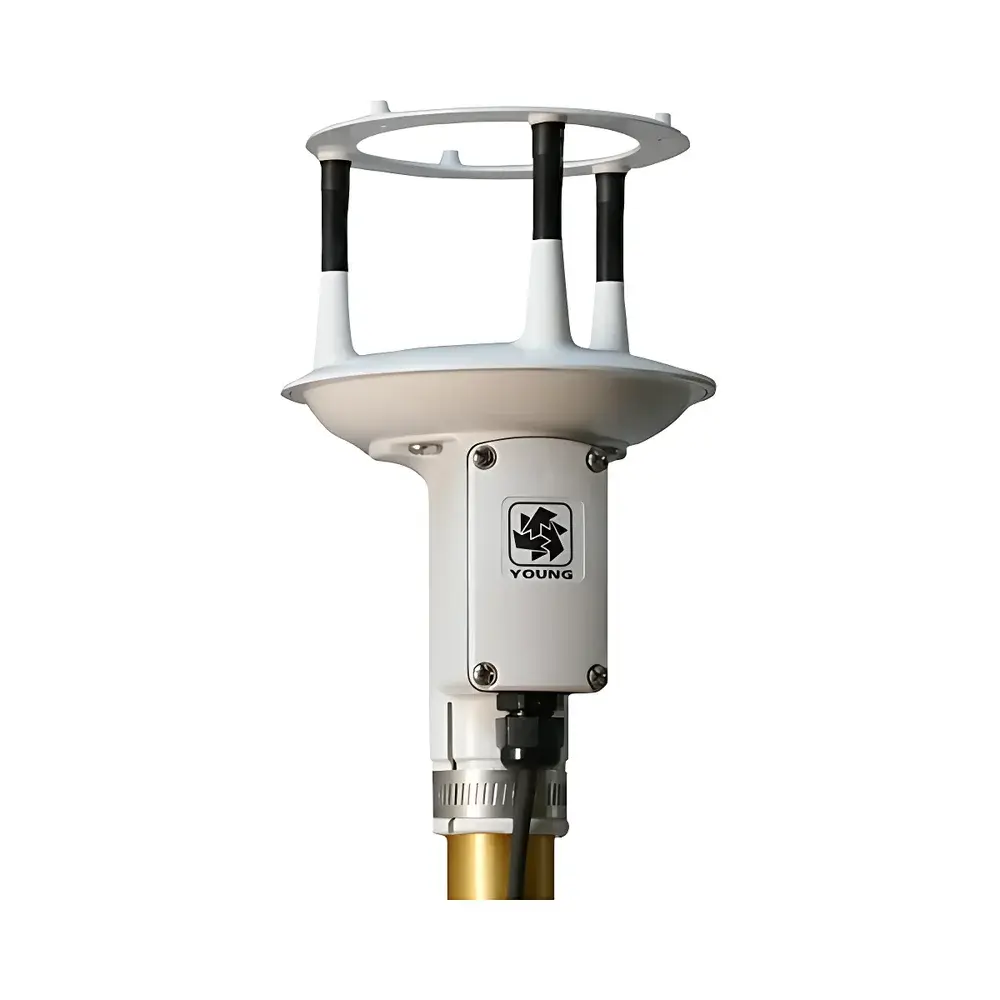
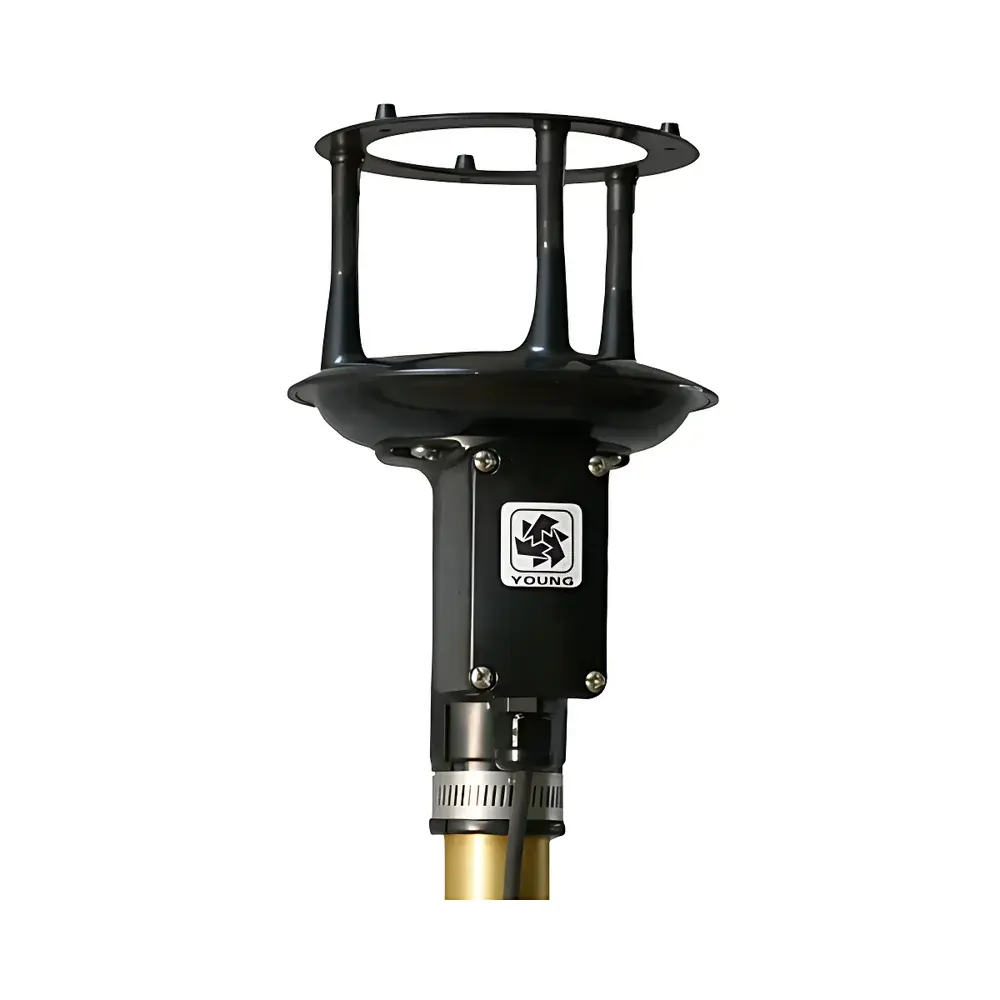
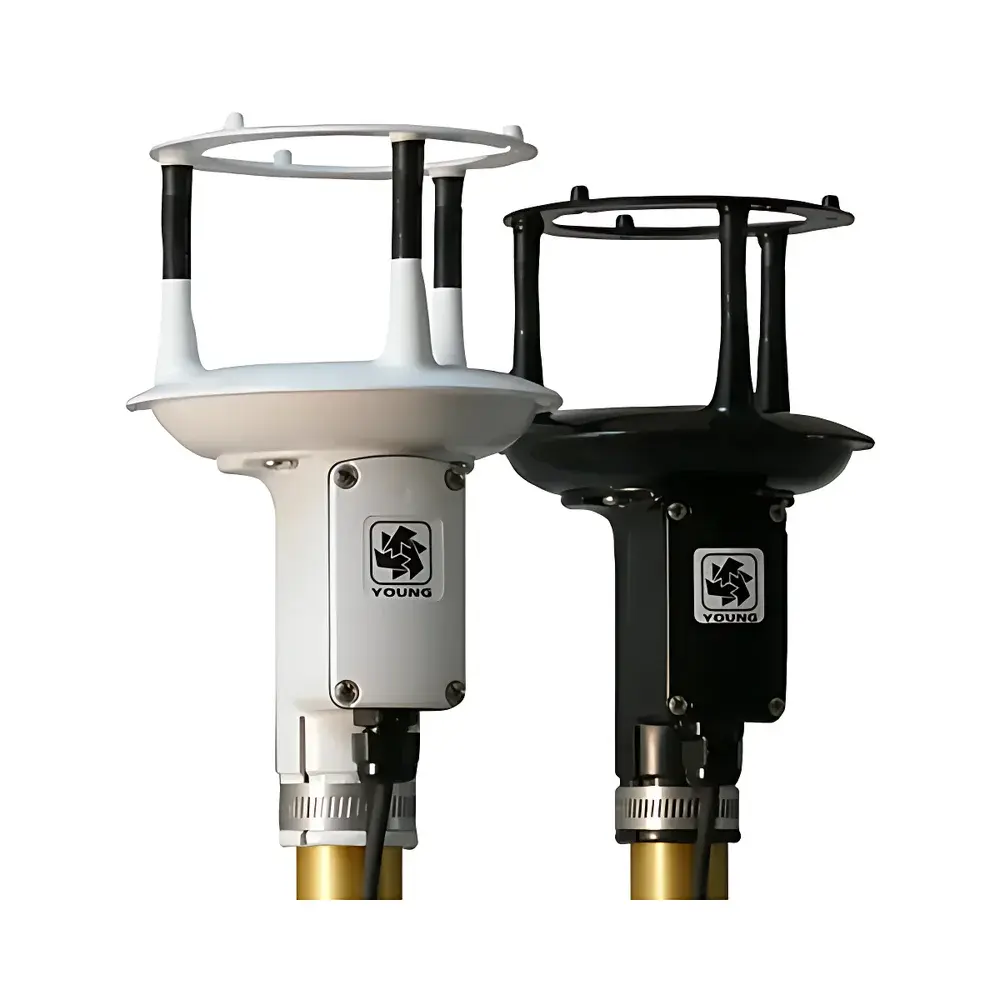
R.M. Young 91000 Ultrasonic Anemometer
| Brand | R.M. Young |
|---|---|
| Origin | USA |
| Model | 91000 |
| Instrument Type | Ultrasonic Anemometer |
| Resolution | 0.01 m/s |
| Measurement Range | 0–75 m/s |
| Accuracy | ±2% |
| Operating Temperature | −50°C to +60°C |
| Operating Humidity | 0–100% RH |
| Ingress Protection | IP66 |
| Sampling Rate | Up to 10 Hz |
| Output Protocols | SDI-12, NMEA 0183, ASCII Serial |
| Mounting | Standard 1-inch IPS pipe thread |
| Housing Material | Corrosion-resistant anodized aluminum |
| Color Options | Black or White |
Overview
The R.M. Young 91000 Ultrasonic Anemometer is a high-reliability, all-weather environmental sensor engineered for precise, contactless measurement of wind speed and wind direction using time-of-flight ultrasonic transit-time principles. Unlike mechanical cup-and-vane anemometers, the 91000 employs four precisely aligned transducer pairs arranged in a tetrahedral configuration to compute orthogonal wind vector components (U, V, W) and derive horizontal wind speed and direction with no moving parts—eliminating mechanical wear, inertia lag, and icing-related failure modes. Each unit undergoes individual wind-tunnel calibration traceable to NIST standards, ensuring metrological consistency across its full operational range of 0–75 m/s. Designed for long-term deployment in harsh climatic conditions—from Arctic research stations to tropical coastal observatories—the instrument maintains stable performance across an extended temperature envelope (−50°C to +60°C) and full humidity range (0–100% RH), making it suitable for unattended operation in remote or mission-critical monitoring networks.
Key Features
- Ultrasonic time-of-flight measurement principle with no rotating components for zero maintenance and high long-term stability
- Factory-calibrated in certified wind tunnel; calibration certificates provided with each unit
- High temporal resolution: configurable sampling rate up to 10 Hz for capturing turbulent gust structures and rapid wind shifts
- Rugged, marine-grade anodized aluminum housing rated IP66 for dust-tight and powerful water jet resistance
- Integrated solid-state magnetic compass (in compatible variants such as 91500/91500B) enabling true north-referenced directional output without external heading sensors
- Standard serial outputs compliant with widely adopted protocols: SDI-12 (for environmental data loggers), NMEA 0183 (for marine navigation systems), and ASCII human-readable strings (for custom integration)
- Simple mechanical mounting via standard 1-inch IPS pipe thread; weatherproof junction box included for field wiring
- Windows-based configuration utility for real-time parameter adjustment—including sampling interval, output format, baud rate, and averaging window settings
Sample Compatibility & Compliance
The 91000 is designed for open-air atmospheric boundary layer measurements and requires unobstructed exposure to ambient airflow. It is not intended for ducted or confined-space applications. Its robust construction meets ASTM D5096-21 (Standard Practice for Field Calibration of Anemometers) and aligns with WMO Guide to Instruments and Methods of Observation (CIMO Guide, Chapter 12) recommendations for Class I wind sensors. While the device itself does not carry formal ISO/IEC 17025 accreditation, its calibration methodology adheres to ISO/IEC 17025 principles through traceable wind-tunnel procedures. The instrument supports GLP-compliant data acquisition when paired with validated data loggers (e.g., Campbell Scientific CR6, Onset HOBO RX3000) that provide audit-trail-enabled timestamping and secure storage.
Software & Data Management
The included Windows configuration application provides bidirectional communication over RS-232 or USB-to-serial adapters. Users can adjust operational parameters, initiate firmware updates, and perform diagnostic self-tests—including transducer health checks and signal-to-noise ratio diagnostics. Raw output streams are ASCII-delimited and fully parseable by third-party platforms including Python (via PySerial), MATLAB, LabVIEW, and SCADA systems. For enterprise-scale deployments, the 91000 integrates natively with R.M. Young’s Y-Link™ telemetry gateway and is supported in major environmental data management ecosystems such as AERIS, SensorUp, and HydroSphere. All output formats include UTC timestamps synchronized to internal quartz oscillator (±1 ppm stability), supporting time-series correlation across multi-sensor networks.
Applications
- Climate and meteorological research stations (including polar and alpine sites)
- Renewable energy site assessment and turbine performance monitoring
- Air quality modeling and dispersion studies requiring high-frequency wind vector inputs
- Coastal and offshore oceanographic buoys and platform installations
- Urban microclimate mapping and building aerodynamics validation
- Federal and state environmental compliance monitoring per EPA Method 40 CFR Part 58 Appendix E
- Educational atmospheric science laboratories requiring NIST-traceable instrumentation
FAQ
Does the 91000 require periodic recalibration?
While the solid-state design ensures long-term drift stability, R.M. Young recommends verification against a reference standard every 24 months for applications requiring ISO/IEC 17025 traceability or regulatory compliance.
Can the 91000 operate on battery power?
Yes—the device draws ≤150 mA at 12 VDC and is compatible with solar-charged battery systems commonly used in remote telemetry applications.
Is the 91000 compatible with Campbell Scientific dataloggers?
Yes—fully supported via SDI-12 protocol; example programs and wiring diagrams are available in Campbell’s Device Configuration Utility library.
What is the minimum detectable wind speed?
The theoretical detection threshold is 0.01 m/s (per resolution specification); however, practical lower limit under turbulent low-wind conditions is ~0.1 m/s due to acoustic noise floor and thermal boundary layer effects.
Does the unit support Modbus or Ethernet output?
No—native communication is RS-232/RS-485 serial only. Protocol conversion to Modbus RTU or TCP/IP requires an external industrial gateway (e.g., Lantronix UDS-10/20 or Red Lion DA Series).
Related Products







