
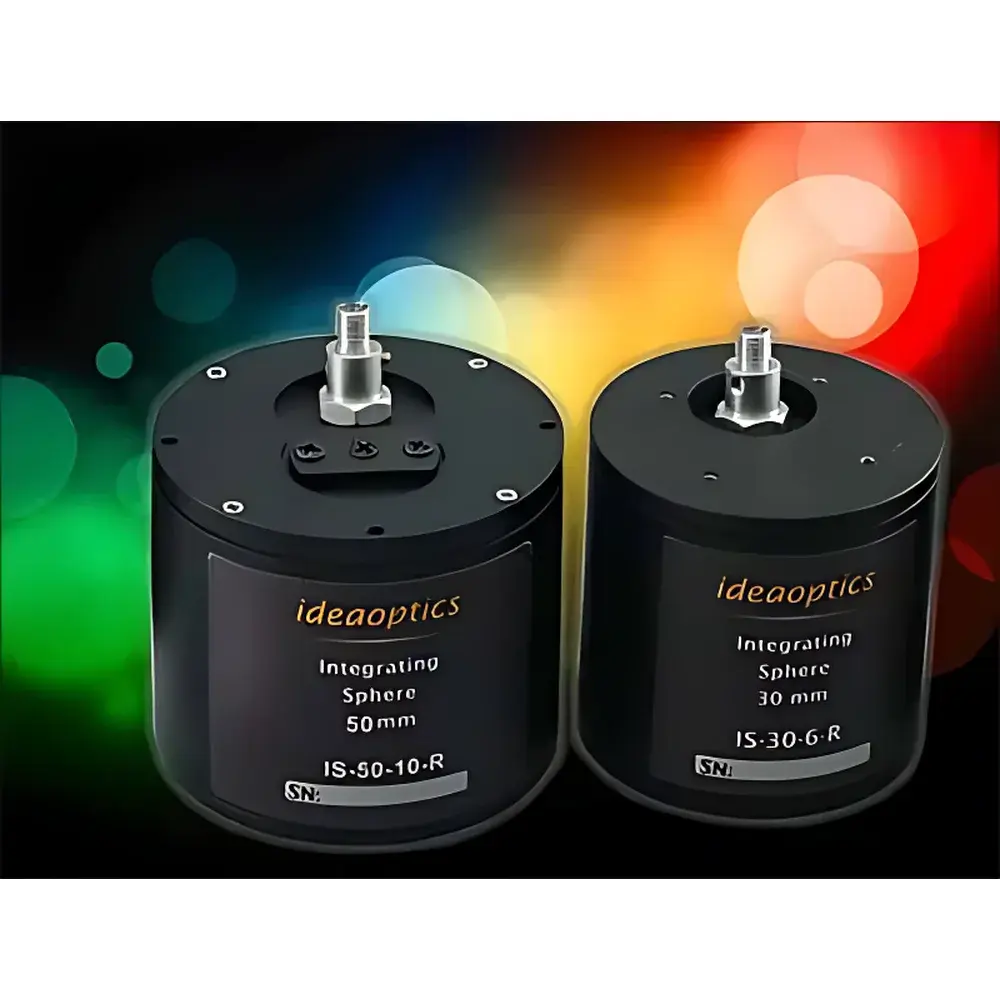
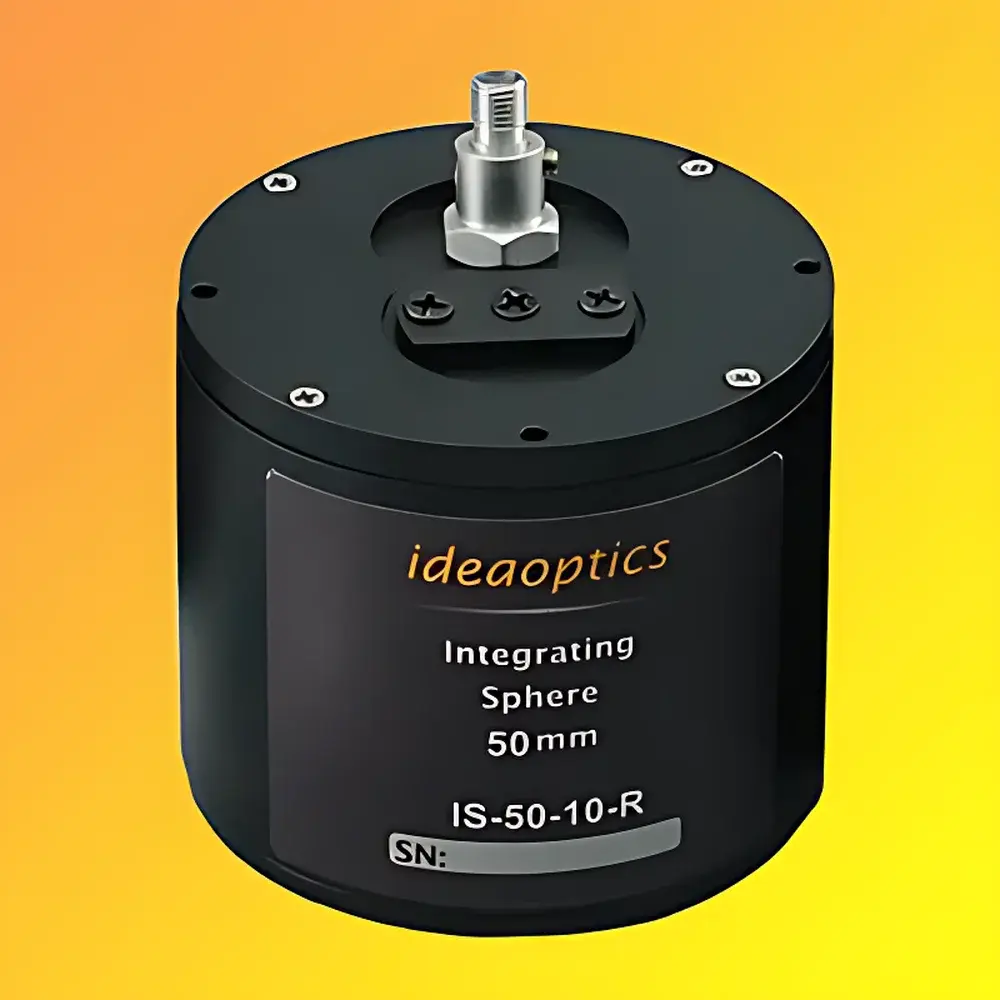
IdeaOptics IS Series High-Performance Integrating Sphere
| Brand | IdeaOptics |
|---|---|
| Model | IS |
| Type | Optical Component |
| Spectral Range | 200–2500 nm |
| Internal Coating | Sintered PTFE (Polytetrafluoroethylene) |
| Input Port | SMA905, 8° off-axis normal incidence (with FIBH collimating lens) |
| Output Port | SMA905, 90° orthogonal to input |
| Compliance | ISO 13697 (diffuse reflectance standards), ASTM E1331 (integrating sphere spectrophotometry), NIST-traceable calibration compatible |
| Regulatory Alignment | Designed for GLP/GMP-compliant optical measurement workflows |
Overview
The IdeaOptics IS Series High-Performance Integrating Sphere is an engineered optical component designed for precision photometric and radiometric measurements across the ultraviolet–visible–near-infrared (UV–Vis–NIR) spectrum (200–2500 nm). Based on the fundamental principle of diffuse multiple-scattering integration, the IS sphere homogenizes incident light through highly Lambertian reflection from its sintered polytetrafluoroethylene (PTFE) internal coating. Unlike conventional BaSO₄-coated spheres—whose reflectance degrades due to oxidation and humidity sensitivity—the IS series utilizes vacuum-sintered PTFE, delivering stable, spectrally uniform reflectance (>98% between 400–1500 nm; >95% at 200 nm and 2500 nm) with negligible aging effects over extended operational lifetimes. Its geometric configuration features an 8° off-axis excitation port optimized for minimal specular artifact interference, coupled with a 90° orthogonal detection port, enabling rigorous separation of incident and collected flux paths in reflectance, transmittance, fluorescence quantum yield, and absolute irradiance applications.
Key Features
- Ultra-broad spectral coverage: validated performance from deep UV (200 nm) to short-wave NIR (2500 nm), supporting multi-modal spectroscopic workflows.
- Sintered PTFE internal surface: engineered for high Lambertian character, low angular dependence, and long-term chemical stability—resistant to ambient oxidation, moisture absorption, and UV-induced yellowing.
- Standardized SMA905 interface geometry across all ports: ensures plug-and-play compatibility with commercial fiber-coupled light sources, spectrometers, and photodetectors.
- Integrated FIBH collimating optics at input port: minimizes divergence and spatial non-uniformity of incident beam, improving measurement reproducibility for directional illumination setups.
- Modular mechanical design: supports optional mounting flanges, vacuum-compatible variants, and custom port configurations (e.g., auxiliary sampling, reference monitoring, or baffle-integrated layouts).
- Traceable calibration readiness: sphere geometry (diameter, port size, area ratio) adheres to ISO 13697 and ASTM E1331 guidelines, facilitating third-party radiometric calibration and uncertainty budgeting per GUM (Guide to the Expression of Uncertainty in Measurement).
Sample Compatibility & Compliance
The IS Series accommodates solid, liquid, and powder samples via standardized sample holders compatible with standard cuvette mounts or custom stage adapters. It supports both absolute and relative measurements—including diffuse reflectance (DRIFTS), total transmittance, fluorescence collection efficiency, and radiant flux quantification—under controlled environmental conditions. All units are manufactured under ISO 9001-certified production protocols. The PTFE coating composition complies with RoHS Directive 2011/65/EU and meets outgassing requirements per ECSS-Q-ST-70-02C for low-contamination optical environments. For regulated laboratories, the sphere’s geometry and material certification documentation support audit readiness for FDA 21 CFR Part 11–aligned data integrity frameworks when integrated with compliant spectrometer control software.
Software & Data Management
While the IS sphere itself is a passive optical component, it is fully interoperable with industry-standard spectroscopy platforms—including Ocean Insight, Avantes, Hamamatsu, and StellarNet spectrometers—as well as LabVIEW, Python (via PyVISA or seabreeze), and MATLAB-based acquisition systems. When deployed in validated instrument configurations, raw spectral data generated using the IS sphere may be logged with full metadata (wavelength, integration time, lamp ID, temperature, port configuration) to satisfy ALCOA+ principles (Attributable, Legible, Contemporaneous, Original, Accurate, Complete, Consistent, Enduring, Available). Optional firmware-enabled auto-calibration routines (e.g., dark-current subtraction, port-efficiency correction) can be implemented via host software to maintain measurement traceability across instrument lifetime.
Applications
- Quantitative diffuse reflectance spectroscopy for pigment analysis, thin-film characterization, and solar absorber evaluation.
- Fluorescence quantum yield determination using comparative integrating sphere methods per ASTM E2758.
- LED and OLED luminous efficacy testing in accordance with CIE S 025/E:2015.
- Material BRDF/BTDF modeling inputs for optical simulation tools (e.g., LightTools, TracePro).
- Calibration transfer between spectroradiometers and reference standards in national metrology institutes.
- Photocatalytic reaction monitoring under polychromatic irradiation where uniform fluence distribution is critical.
FAQ
What spectral range is guaranteed for the PTFE coating’s reflectance performance?
The sintered PTFE coating maintains ≥95% hemispherical reflectance from 200 nm to 2500 nm, with peak reflectance >98% between 400–1500 nm. Full spectral reflectance curves are supplied with each unit upon request.
Can the IS sphere be used under vacuum or inert atmosphere?
Yes—standard models operate at ambient pressure, but vacuum-rated variants (up to 10⁻⁵ mbar) and purge-capable versions (N₂ or Ar) are available upon specification.
Is the 8° input angle configurable for other incidence geometries?
The base model uses fixed 8° off-axis illumination; however, custom port angular positioning (including 0° normal incidence or 45° configurations) is offered as a factory option.
How is port efficiency correction handled during quantitative measurements?
Port efficiency must be determined empirically for each configuration using certified reference standards (e.g., NIST SRM 990c); correction factors are applied during post-processing in accordance with ASTM E1331 Annex A2.
Does IdeaOptics provide NIST-traceable calibration services for the IS sphere?
IdeaOptics partners with accredited calibration laboratories to deliver ISO/IEC 17025-certified reflectance and throughput calibration reports, including uncertainty budgets aligned with EURAMET cg-18 guidelines.



