
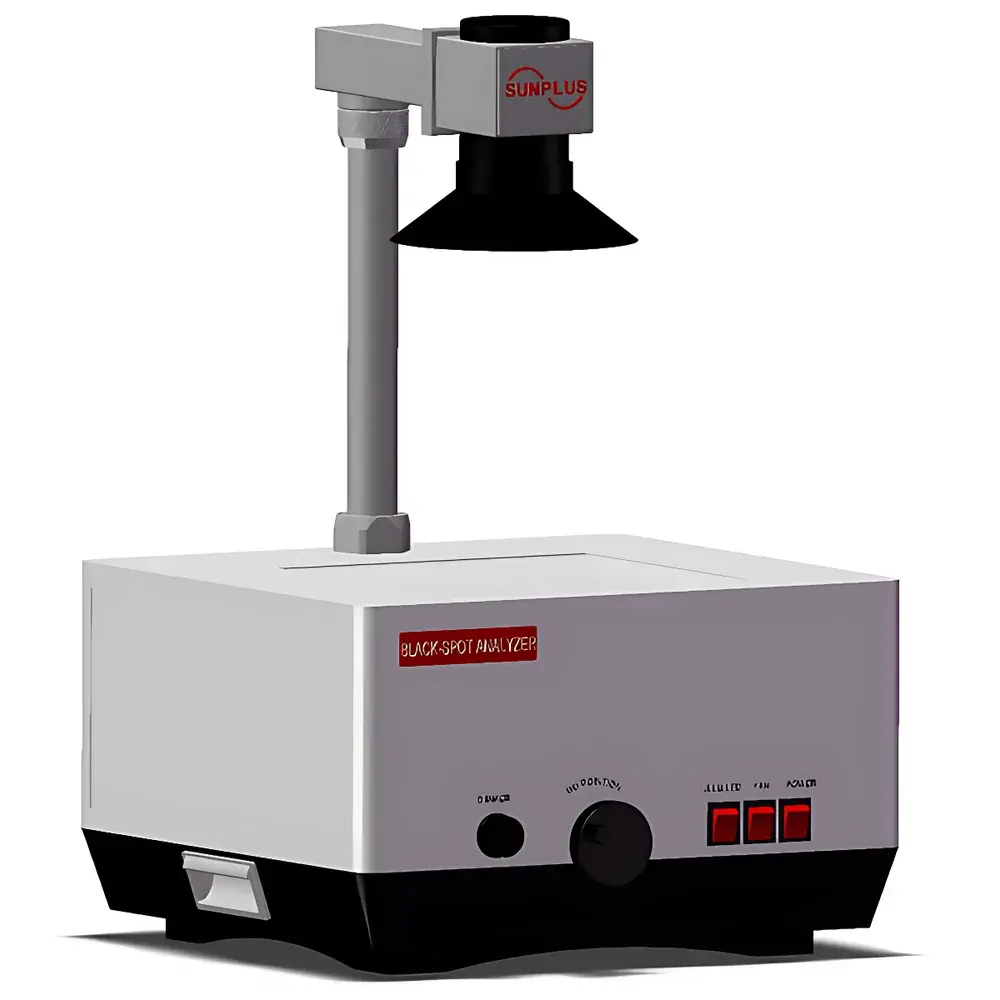
HunterLab SP-BS-1908 Advanced Black Spot & Defect Analyzer for Polymer Pellets and Films
| Brand | HunterLab |
|---|---|
| Origin | Canada |
| Model | SP-BS-1908 |
| Minimum Detectable Size | 0.1 mm |
| Detection Accuracy | < 0.035 mm |
| Inspection Area | ≥ 200 × 200 mm |
| Optical Magnification | >20× |
| Light Output | ≥6000 lm |
| Illumination Source | 24 V / 60 W |
| Power Supply | 220 V, 50 Hz |
| Dimensions | ~459 × 426 × (276 + 380) mm |
Overview
The HunterLab SP-BS-1908 Advanced Black Spot & Defect Analyzer is a high-precision optical inspection system engineered for quantitative assessment of foreign particles, carbonized residues, gel specks, and intrinsic structural defects in thermoplastic polymer materials. Operating on the principle of high-contrast transmitted-light imaging with calibrated monochromatic illumination, the instrument captures digital micrographs of samples placed on a uniformly illuminated stage, enabling pixel-level segmentation and morphometric analysis of dark-field anomalies against controlled background luminance. Designed to comply with ASTM D7252–22 (Standard Test Method for Determining Black Specks in Polyolefin Resins), ISO 18064:2018 (Plastics — Polypropylene — Specification), and relevant sections of USP for pharmaceutical-grade polymer packaging components, the SP-BS-1908 supports both routine QC screening and regulatory-compliant batch release testing across resin pellet, flake, and thin-film formats.
Key Features
- Automated detection and classification of black spots, gels, oxidized specks, and surface contaminants down to 0.1 mm in equivalent circular diameter (ECD), with sub-0.035 mm measurement uncertainty validated per ISO/IEC 17025 traceable calibration protocols.
- Adjustable threshold-based segmentation engine supporting multi-class labeling: e.g., “carbonaceous residue”, “metallic inclusion”, “polymer gel”, or “surface scratch”, configurable per material type and process history.
- Integrated 20× optical magnification path with uniform 6000-lumen cold-white LED backlighting (24 V / 60 W), eliminating thermal drift and ensuring consistent photometric response across extended inspection sessions.
- Large-format inspection stage (≥200 × 200 mm active area) accommodating standard transparent trays for bulk pellet analysis or direct placement of free-hanging films up to 250 µm thickness without masking, pre-treatment, or contrast enhancement.
- Real-time zoom navigation (1×–10× digital zoom) synchronized with sample feed direction, preserving spatial orientation fidelity between physical handling and on-screen visualization for operator ergonomic consistency.
- Batch-mode processing with auto-reset tray positioning logic, enabling unattended analysis of up to 12 standardized trays per session under defined illumination and focus presets.
Sample Compatibility & Compliance
The SP-BS-1908 is validated for use with opaque, translucent, and fully transparent polymeric substrates including polypropylene (PP), polyethylene (PE), polyvinyl chloride (PVC), polyphenylene sulfide (PPS), polycarbonate (PC), and ethylene–vinyl acetate (EVA) copolymers. It meets functional requirements outlined in ASTM D3892 (Standard Guide for Plastics—Sampling), ISO 293:2004 (Plastics—Compression Moulding Test Specimens), and supports GLP/GMP-aligned audit trails when operated with optional 21 CFR Part 11-compliant software modules. All calibration routines utilize NIST-traceable standard plates with certified defect-size reference arrays, and system performance verification is documented per IQ/OQ protocols included in the validation support package.
Software & Data Management
The proprietary VisionScan™ Analysis Suite (v4.2+) provides ISO 13485-aligned data integrity controls, including electronic signatures, role-based access permissions, immutable audit logs, and encrypted local database storage. Users define pass/fail criteria via dynamic rule sets—for example, “≤3 particles ≥0.3 mm per 100 cm²” or “no single particle >1.0 mm”—with automatic report generation in PDF/A-2b or CSV format. All image metadata (timestamp, operator ID, calibration status, illumination intensity, lens focus offset) are embedded and exportable. Raw TIFF sequences and annotated overlays are archived with SHA-256 checksum verification; long-term retention complies with FDA ERES guidelines for electronic records.
Applications
- Resin supplier qualification and incoming raw material inspection for automotive interior trim, medical device housings, and food-contact packaging resins.
- In-process monitoring of extrusion die cleanliness and melt filtration efficiency in compounding lines.
- Root cause analysis of black speck formation linked to screw/barrel degradation, catalyst residue carryover, or regrind contamination.
- Comparative evaluation of antioxidant package efficacy under accelerated thermal aging conditions (e.g., ISO 2578).
- Supporting ISO 9001:2015 Clause 8.6 release documentation for polymer lots destined for Class II medical devices.
- Quantitative correlation studies between black spot density and haze/transmission loss in optical film grades (ASTM D1003).
FAQ
Does the SP-BS-1908 require sample staining or backside coating for film inspection?
No. Its high-luminance transmitted-light architecture enables direct analysis of untreated transparent films without blackening agents, adhesive tapes, or vacuum mounting.
Can the system distinguish between surface scratches and subsurface voids?
Yes—via adjustable focal plane scanning and depth-of-field optimization, allowing operators to isolate anomalies at specific Z-positions within semi-crystalline film matrices.
Is third-party software integration supported?
Yes. The instrument exposes RESTful APIs and OPC UA endpoints for bidirectional data exchange with LIMS (e.g., LabVantage, Thermo Fisher SampleManager) and MES platforms.
What calibration frequency is recommended for GMP environments?
Daily system suitability checks using the supplied standard plate; full recalibration every 6 months by an ISO/IEC 17025-accredited service provider.
How is measurement repeatability verified across operators?
Through built-in inter-operator reproducibility mode, which randomizes sample order and masks identifiers during blinded re-analysis to calculate %RSD per ISO 5725-2.



