
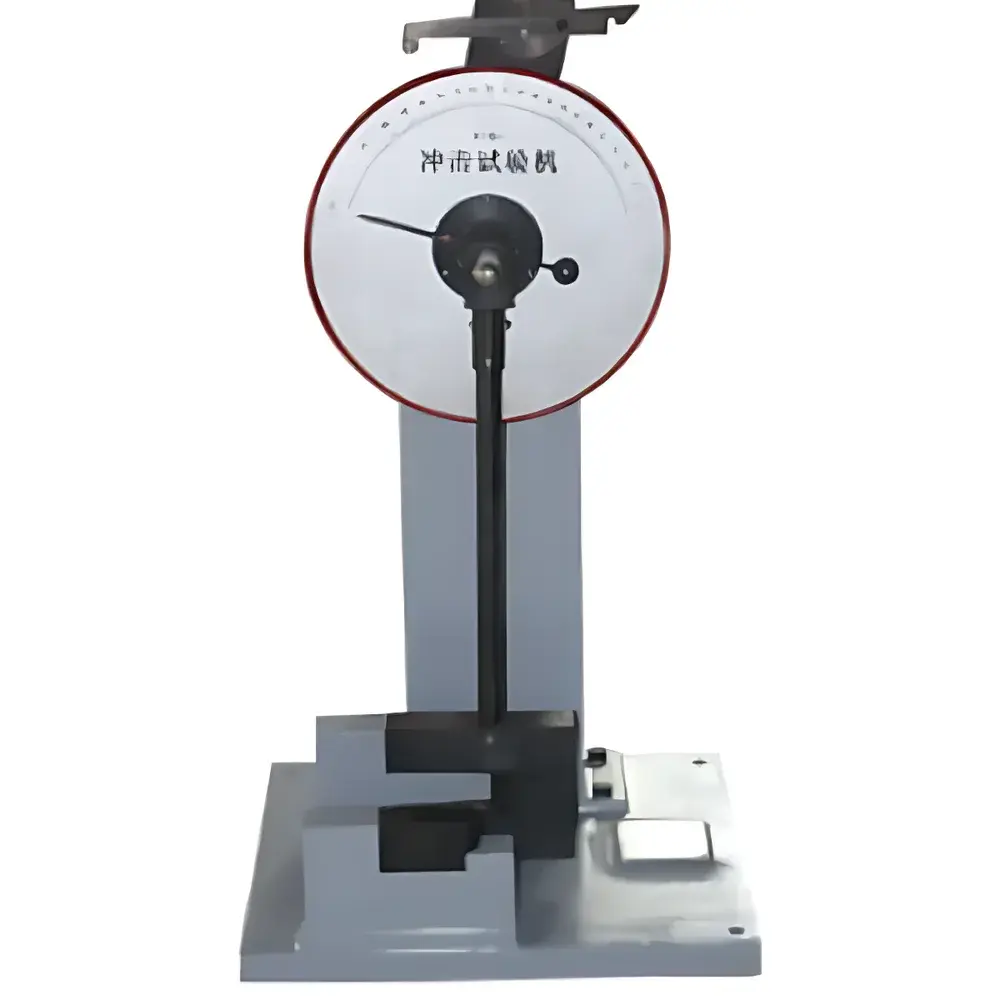
YANRUN MJB-100 Pendulum Impact Tester for Wood-Based Panels
| Brand | YANRUN |
|---|---|
| Model | MJB-100 |
| Type | Pendulum Impact Testing Machine |
| Impact Energy | 100 J (1 J/division) |
| Impact Velocity | 4.45 m/s |
| Pendulum Torque (Impact Constant) | 53.5714 N·m |
| Pendulum Pre-Lift Angle | 150° |
| Distance from Pendulum Axis to Specimen Center | 590 mm |
| Support Span | 240 mm |
| Radius of Anvil Arc | R15 ± 0.05 mm |
| Striking Edge Thickness | 40 mm |
| Specimen Dimensions | 20 mm × 20 mm × 300 mm |
| Display Resolution | 1 J |
Overview
The YANRUN MJB-100 Pendulum Impact Tester is a precision-engineered instrument designed specifically for the standardized Charpy-type impact testing of wood-based panel materials—including particleboard, medium-density fiberboard (MDF), plywood, oriented strand board (OSB), and laminated veneer lumber (LVL). It operates on the classical pendulum principle: gravitational potential energy is converted into kinetic energy as the pendulum arm swings from a fixed pre-lift angle (150°), delivering a calibrated impact to a notched or unnotched specimen supported across two anvil points. The energy absorbed by the specimen during fracture is determined by measuring the residual swing height of the pendulum, enabling direct calculation of impact toughness in joules. With a nominal impact energy capacity of 100 J and a resolution of 1 J per division, the MJB-100 meets the geometric and dynamic requirements specified in ISO 179-1, ISO 8256, ASTM D1822, and GB/T 17657—making it suitable for both routine quality control and comparative material development studies in industrial laboratories and certification centers.
Key Features
- Robust cast-iron frame with vibration-damping base and adjustable leveling feet for stable operation and minimal energy loss during impact.
- Precision-machined pendulum assembly featuring a torque-optimized moment arm (53.5714 N·m) and calibrated impact velocity of 4.45 m/s at the point of contact—ensuring repeatability within ±1.5% per ASTM E23 guidelines.
- Fixed support span of 240 mm with hardened steel anvils and R15 ± 0.05 mm arc radius, compliant with ISO 179-1 specimen support geometry for wood-based panels.
- Digital angular encoder integrated into the pendulum shaft for high-fidelity swing-angle measurement; real-time energy calculation displayed on a backlit LCD with 1 J resolution.
- Standardized striking edge with 40 mm thickness and defined chamfer profile, aligned to ISO 148-1 and GB/T 3808 requirements for consistent stress distribution across the specimen cross-section.
- Pre-configured specimen fixture for 20 mm × 20 mm × 300 mm test bars—compatible with standard sample preparation protocols used in formaldehyde emission and mechanical property evaluation of engineered wood products.
Sample Compatibility & Compliance
The MJB-100 is validated for use with solid-sawn and reconstituted wood specimens meeting dimensional tolerances outlined in ISO 179-1:2010 and GB/T 17657–2013. Its 240 mm support span and R15 anvil curvature accommodate standard thicknesses (12–25 mm) and widths (20 mm) typical of laboratory-scale panel coupons. The system supports both unnotched and machined-notched configurations for comparative ductility assessment. All mechanical components—including pendulum shaft bearings, release mechanism, and specimen clamping interface—are manufactured to ISO 2768-mK general tolerances. The device complies with CE machinery directive 2006/42/EC (when equipped with optional safety guard), and its calibration traceability aligns with ISO/IEC 17025 requirements when performed using certified reference pendulums and angular displacement standards.
Software & Data Management
While the base MJB-100 operates via analog-digital hybrid readout (LCD display + mechanical scale verification), optional PC connectivity is available via RS-232 interface for integration with YANRUN’s IMPACT-LOG v3.2 software suite. This platform enables automated data logging, statistical analysis (mean, SD, CV%), batch reporting in PDF/CSV formats, and audit-trail generation compliant with GLP and internal QA documentation standards. Raw angular displacement data is timestamped and stored with operator ID and environmental metadata (ambient temperature/humidity if external sensors are connected), supporting full traceability under ISO 17025 Clause 7.7 and FDA 21 CFR Part 11 (with electronic signature module).
Applications
- Quality assurance testing of structural wood composites prior to shipment or certification (e.g., EN 312, ANSI A208.1).
- Comparative evaluation of resin formulation effects on impact resistance in MDF and particleboard manufacturing R&D.
- Validation of surface treatment durability (e.g., melamine overlay adhesion under impact loading).
- Correlation studies between impact strength and other mechanical properties (modulus of rupture, internal bond strength) per GB/T 17657 Annex D.
- Third-party testing for CE marking, CARB ATCM compliance, and JIS A 5908 certification submissions.
FAQ
What standards does the MJB-100 comply with for wood-based panel testing?
The instrument conforms to ISO 179-1, GB/T 17657–2013, ASTM D1822, and EN 312 requirements for Charpy impact testing of rigid板材—specifically addressing specimen geometry, support conditions, and energy resolution.
Can the MJB-100 be calibrated externally?
Yes. Calibration follows ISO 17025 procedures using certified reference pendulums and optical angular measurement systems. YANRUN provides a factory calibration certificate with uncertainty budget (k=2) upon delivery.
Is a safety enclosure available as an accessory?
A CE-compliant polycarbonate safety guard with interlocked door switch is offered as an optional add-on (Part No. MJB-SHIELD-100), meeting EN 954-1 Category 3 requirements.
Does the system support notched specimen testing?
Yes. Standard notching tools (depth 2 mm, width 2 mm) and alignment jigs are available separately to prepare specimens per ISO 179-1 Annex A.
What maintenance is required for long-term accuracy?
Biannual verification of pendulum axis alignment, bearing lubrication (ISO VG 68 oil), and anvil surface flatness (≤0.02 mm deviation) is recommended. Full recalibration is advised every 12 months or after 5,000 impacts.



