
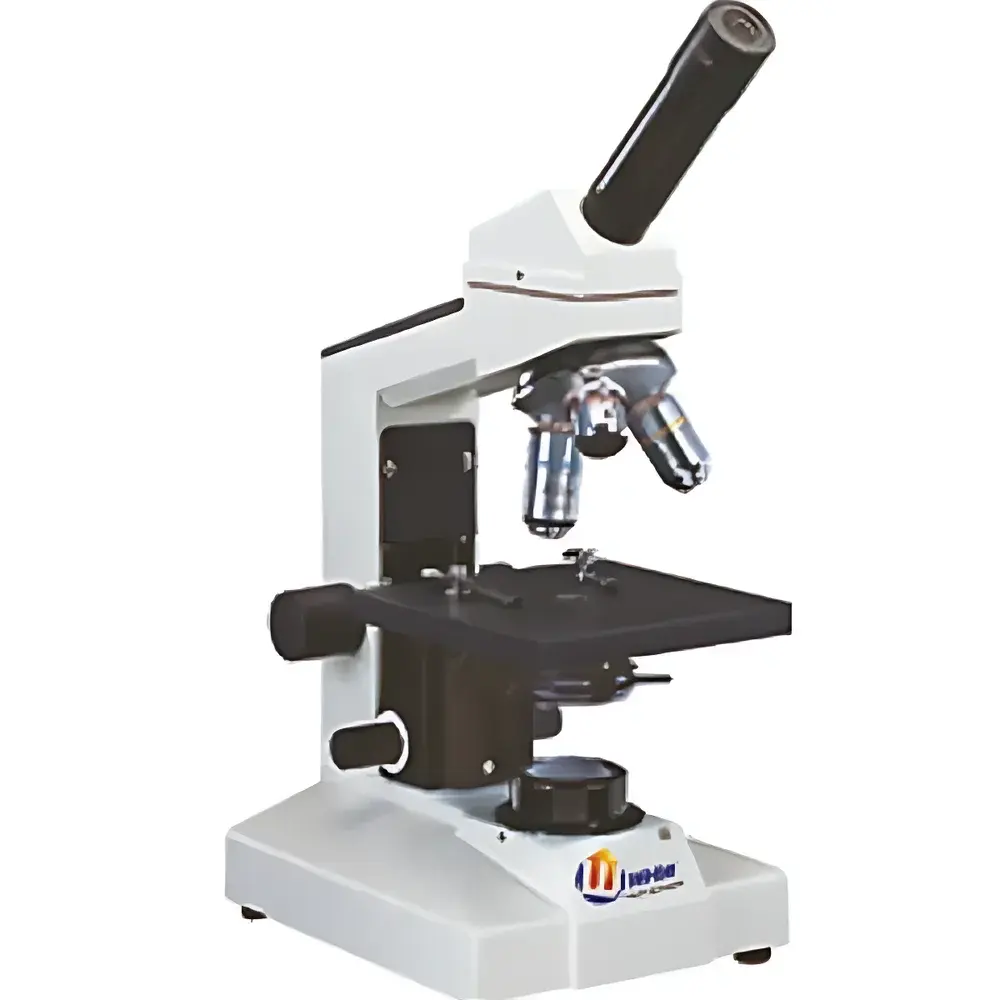
YANRUN BI-10 Biological Microscope
| Brand | YANRUN |
|---|---|
| Origin | Shanghai, China |
| Manufacturer Type | OEM Manufacturer |
| Regional Category | Domestic (China) |
| Model | BI-10 Biological Microscope |
| Instrument Type | Inverted Microscope |
| Magnification Range | 40×–400× (standard) |
| Eyepieces | Wide-field WF10× (Φ18 mm), optional WF16× (Φ11 mm) and pointer eyepiece |
| Objectives | Achromatic 4×/0.10, 10×/0.25, 40×/0.65 (spring-loaded), optional 100×/1.25 (oil immersion, spring-loaded) |
| Nosepiece | Three-position (externally mounted ball-bearing detent) or optional four-position |
| Focusing Mechanism | Dual coarse/fine focusing — either separated or coaxial |
| fine-focus graduation | 4 µm per division |
| Stage | Fixed stage (120 mm × 120 mm), integrated single-lens condenser with adjustable iris diaphragm |
| Illumination | 20 W tungsten-halogen lamp (110 V / 220 V), optional 5 W fluorescent or high-intensity white LED illumination |
| Filters | Blue filter, ground glass diffuser |
| Condenser | Abbe-type, optimized for tungsten illumination |
| Eyepiece Tube | Monocular, 360° rotatable, inclined at 45° |
| Imaging Output | Optional USB/VIDEO photo-eyepiece adapter |
Overview
The YANRUN BI-10 Biological Microscope is a robust, entry-level inverted microscope engineered for routine observation of live and fixed biological specimens in academic teaching laboratories, clinical training environments, and small-scale research settings. Designed around classical Köhler illumination principles and achromatic optical correction, the BI-10 delivers consistent contrast and resolution across its standard 40×–400× magnification range. Its inverted configuration positions the objective lenses beneath the specimen stage—enabling direct observation of cells in culture flasks, Petri dishes, and multi-well plates without specimen inversion or mounting on slides. This architecture supports long-term live-cell monitoring under ambient or controlled incubation conditions, making it suitable for basic cytology, microbiology, and histological screening applications where stability, ergonomic accessibility, and cost-effective maintenance are prioritized.
Key Features
- Optical system based on achromatic objectives (4×/0.10, 10×/0.25, 40×/0.65 spring-loaded) and wide-field WF10× (Φ18 mm) eyepieces—optimized for flatness, color fidelity, and edge-to-edge clarity at low-to-mid magnifications.
- Inverted optical layout with fixed 120 mm × 120 mm mechanical stage, integrated Abbe condenser, and continuously adjustable iris diaphragm—ensuring reproducible illumination uniformity and contrast control per ISO 8578 and ASTM E2899 standards.
- Dual focusing options: user-selectable between separated coarse/fine focus knobs or coaxial focusing mechanism—both calibrated to 4 µm fine-focus graduation for precise Z-axis positioning during serial sectioning or depth profiling.
- Monocular head with 45° inclination and full 360° rotation—designed to accommodate varied user postures and collaborative viewing setups in shared lab spaces.
- Modular illumination platform supporting interchangeable light sources: standard 20 W tungsten-halogen lamp (110 V / 220 V), optional 5 W fluorescent module, or high-efficiency white LED system with regulated 9 V DC power adapters (dual-input 110 V / 230 V).
- Three-position nosepiece with external ball-bearing detent positioning—providing tactile feedback and repeatable objective alignment; upgradeable to four-position configuration for expanded objective capacity.
Sample Compatibility & Compliance
The BI-10 accommodates standard tissue culture vessels—including T-25/T-75 flasks, 35 mm / 60 mm Petri dishes, and 6-/24-/96-well plates—without requiring specimen transfer or coverslip mounting. Its working distance (≥3.5 mm at 40×) permits unobstructed access for micropipette manipulation or stage-top environmental chambers. The microscope conforms to IEC 61000-6-3 (EMC emissions) and IEC 61000-6-2 (immunity) requirements for laboratory equipment. Optical components meet ISO 10934-1 specifications for achromatic correction, while mechanical tolerances align with GB/T 29885–2013 (Chinese national standard for biological microscopes). All electrical modules comply with UL/CSA and CE safety directives for Class I laboratory instruments.
Software & Data Management
The optional USB/VIDEO photo-eyepiece enables direct digital acquisition via industry-standard UVC-compliant drivers—compatible with open-source platforms (e.g., ImageJ/Fiji, Micro-Manager) and commercial imaging suites (Olympus cellSens, Zeiss ZEN Blue). Captured images and time-lapse sequences support TIFF, JPEG, and AVI export formats. Metadata embedding (magnification, objective ID, exposure time) follows DICOM-SR and MIAME-compliant conventions where applicable. For GLP/GMP-aligned workflows, audit trail functionality can be implemented through third-party image management systems compliant with FDA 21 CFR Part 11 requirements—though native firmware does not include electronic signature or role-based access control.
Applications
- Routine morphology assessment of adherent mammalian cell lines (e.g., HeLa, NIH/3T3) during passaging and confluency monitoring.
- Qualitative evaluation of microbial colonies, yeast budding patterns, and protozoan motility in liquid suspension.
- Basic histopathology screening using unstained or hematoxylin-eosin-stained tissue sections on glass slides.
- Teaching laboratories for introductory microscopy techniques—including focus calibration, Köhler alignment, and contrast optimization using blue/green filters.
- Pre-screening prior to higher-resolution analysis on upright fluorescence or confocal systems—reducing instrument time allocation for preliminary viability or morphology checks.
FAQ
Is the BI-10 compatible with oil immersion objectives?
Yes—the optional 100×/1.25 achromatic oil immersion objective is mechanically and optically compatible with the BI-10’s nosepiece and tube lens design.
Can the microscope be used with digital cameras from other manufacturers?
Yes—via the standardized C-mount interface on the photo-eyepiece, supporting most 1/2″ or 1/3″ sensor cameras with appropriate adapters.
Does the BI-10 meet international regulatory requirements for educational use?
It complies with IEC 61010-1 (safety), IEC 61326-1 (EMC), and EN 62366-1 (usability) for classroom and training environments.
What is the maximum working distance at 40× magnification?
Approximately 3.5 mm—sufficient to accommodate standard culture dishes and allow manual intervention with sterile tools.
Is phase contrast or fluorescence capability available as a factory option?
No—phase contrast and fluorescence require dedicated condensers, filter cubes, and excitation sources not supported by the base BI-10 optical train.
Related Products




