
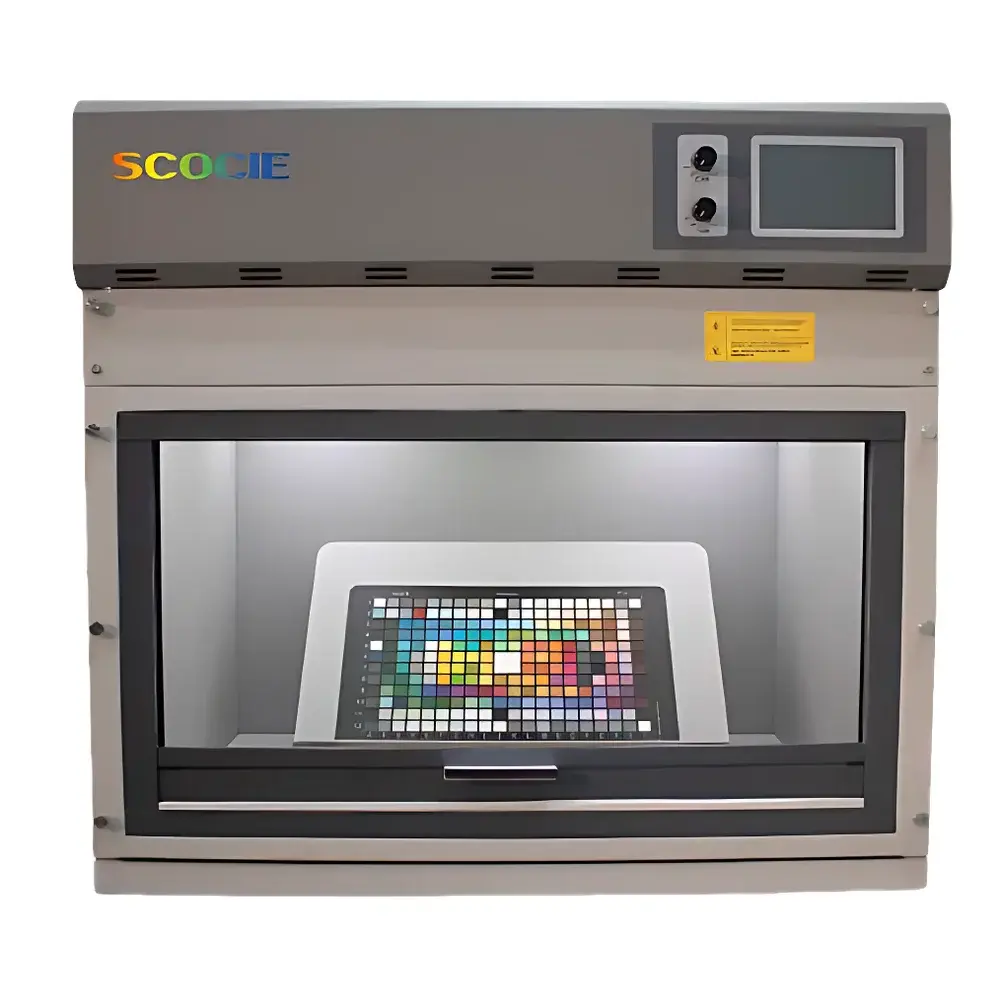
Shike FastnessGrade Digital Colorfastness Analyzer
| Origin | Shanghai, China |
|---|---|
| Manufacturer Type | Distributor |
| Product Origin | Domestic (China) |
| Model | FastnessGrade |
| Price Range | USD 28,000 – 42,500 |
| Instrument Type | Benchtop Spectrophotometer |
| Optical Geometry | 0/45° Integrating Sphere |
| Illuminant | LED Array |
| Spectral Range | 350–700 nm |
| Repeatability | ΔE*ab ≤ 0.03 |
Overview
The Shike FastnessGrade Digital Colorfastness Analyzer is a benchtop spectrophotometric imaging system engineered for objective, repeatable assessment of textile and material colorfastness properties. It operates on the principle of high-fidelity spectral imaging—combining calibrated LED illumination (CIE standard illuminants A, D65, F2, U30, and others simulated via spectral tuning), RGB-based multispectral capture, and CIELAB-based color difference computation—to quantify chromatic shifts induced by standardized physical or environmental stressors. Unlike conventional visual evaluation under viewing booths, FastnessGrade digitizes the entire ASTM D2054, ISO 105-X12, ISO 105-B02, ISO 105-X16, and AATCC TM16 workflows by capturing and analyzing both test specimens and multiblend reference fabrics in a single acquisition cycle. Its optical architecture—featuring a 0/45° integrating sphere geometry with diffuse illumination and directional viewing—ensures minimal influence from surface texture, gloss, or directional reflectance anomalies, thereby supporting compliance with ISO/CIE metrological guidelines for color measurement.
Key Features
- Integrated digital colorfastness grading engine compliant with ISO 105, AATCC TM16, and GB/T 3920 standards for wash, rub, light, and perspiration fastness testing
- Simultaneous dual-sample imaging: captures both original and treated specimens—and adjacent multifiber test cloths—in one frame for direct ΔE*ab and gray scale correlation
- Automated 5-point grayscale and 8-point blue wool scale mapping using embedded reference libraries traceable to NIST-traceable color standards
- Built-in standard light booth emulation (D65, A, F2, U30, TL84) with CCT stability ±15K and Ra ≥ 95, eliminating need for separate viewing cabinets
- On-device spectral analysis (350–700 nm, 10 nm resolution) with CIE 1931 2° and 10° observer functions, enabling metamerism index (MI) and color constancy evaluation
- Modular software architecture supporting GLP-compliant audit trails, user role permissions, and FDA 21 CFR Part 11–ready electronic signatures
Sample Compatibility & Compliance
FastnessGrade accommodates flat, flexible, and moderately textured substrates up to 150 × 150 mm—including woven/knitted textiles, leather, paper, coated films, and printed packaging. Sample holders conform to ISO 105-A02 and AATCC TM16 specimen mounting requirements. The system supports full traceability per ISO/IEC 17025:2017 for calibration verification, with factory-certified spectral irradiance profiles and inter-instrument agreement < ΔE*ab 0.15 across units. All colorfastness algorithms are validated against consensus data from international round-robin studies coordinated by the International Association of Textile Chemists and Colourists (AATCC) and the European Committee for Standardization (CEN). Regulatory alignment includes ASTM D2244 (color difference), ISO 11664-4 (CIELAB), and ISO/TR 11664-8 (metamerism assessment).
Software & Data Management
The FastnessGrade Control Suite runs on Windows OS and provides real-time image preprocessing (defect masking, vignette correction, ROI auto-delineation), batch processing of multi-condition test sets, and export of structured XML/CSV reports containing L*a*b*, ΔL*, Δa*, Δb*, ΔE*ab, grayscale grade, and confidence intervals. Data encryption (AES-256), automated backup to network drives or cloud storage (AWS S3 or Azure Blob), and optional integration with LIMS platforms via HL7 or RESTful API ensure enterprise-grade data integrity. Audit logs record every instrument parameter change, user login/logout, result modification, and calibration event—fully satisfying GLP and GMP documentation requirements for QC laboratories in regulated industries.
Applications
FastnessGrade is deployed across R&D labs and production QA environments in textile dyeing houses, automotive interior suppliers, food packaging converters, and pharmaceutical packaging manufacturers. Specific use cases include: quantitative validation of reactive dye fixation efficiency; comparative assessment of UV stabilizer performance in outdoor awnings; monitoring batch-to-batch consistency of pigment-dispersed coatings; classification of fruit skin browning during cold chain logistics; and forensic-level color matching of historical textile restorations. In food science, it supports objective quantification of Maillard reaction progression in baked goods and enzymatic browning in cut produce—linking spectral shift trends directly to process time/temperature parameters.
FAQ
Does FastnessGrade replace human grading entirely?
Yes—when configured for fully automated mode, it delivers ISO-compliant pass/fail decisions and numeric grades without operator interpretation. However, a manual review mode remains available for borderline cases or method validation.
Can it assess non-textile materials such as plastics or ceramics?
Yes—the optical design and spectral engine support any non-fluorescent, non-translucent solid surface within the defined size and flatness tolerances. Fluorescent additives require optional UV-filtered LED mode.
Is calibration required before each test session?
No—factory-calibrated white tile and black trap references enable daily verification only. Full recalibration is recommended annually or after mechanical impact, per ISO 13655.
How does it handle samples with high surface gloss or metallic finishes?
The 0/45° geometry inherently suppresses specular reflectance artifacts. For extreme cases, users may apply matte spray or select gloss-compensated measurement protocols embedded in the software.
What connectivity options are supported for lab network integration?
Gigabit Ethernet, USB 3.0 host interface, and optional Wi-Fi 6 module—all supporting TLS 1.2 encrypted communication and IEEE 802.1X authentication.





