
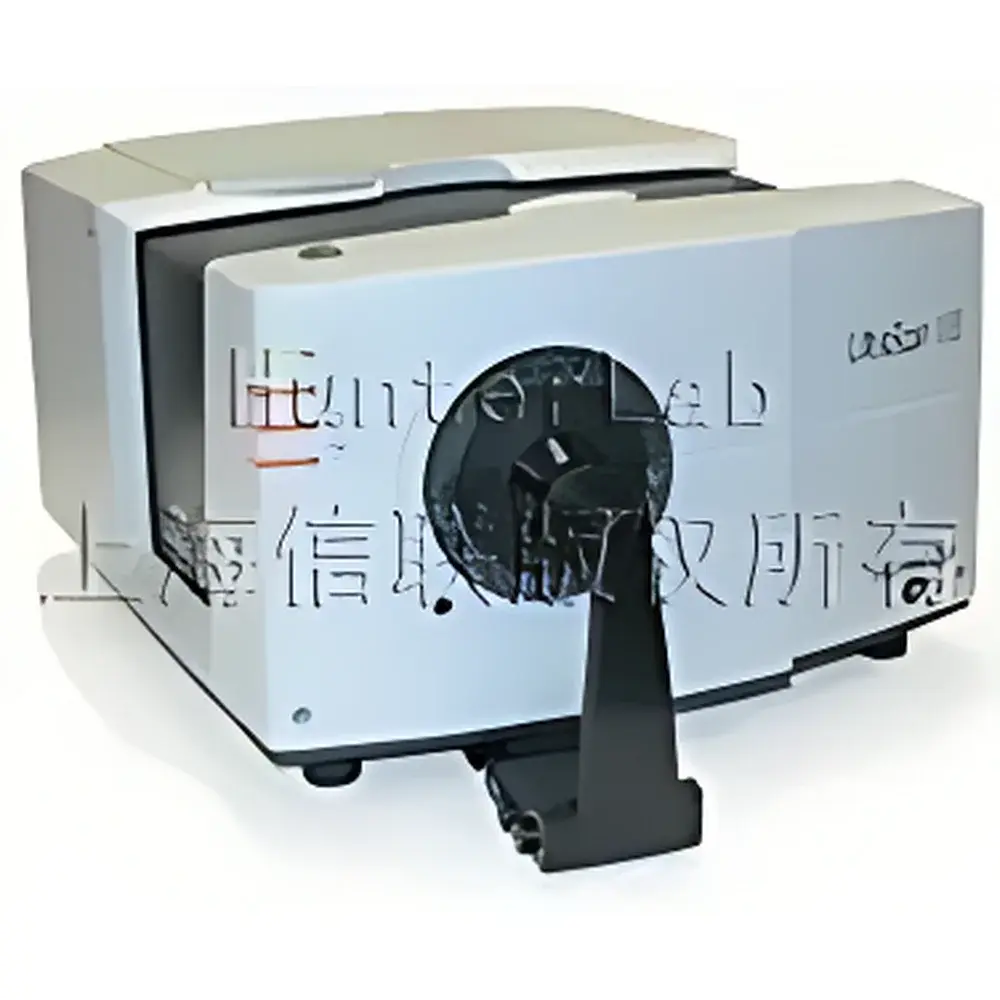
HunterLab UltraScan VIS Benchtop Spectrophotometer
| Brand | HunterLab |
|---|---|
| Origin | USA |
| Model | UltraScan VIS |
| Product Type | Benchtop Spectrophotometer |
| Optical Geometry | d/8° integrating sphere (specular component included/excluded) for reflectance |
| Light Source | Pulsed xenon lamp |
| Spectral Range | 360–780 nm |
| Spectral Resolution | 10 nm |
| Repeatability | ΔE*ab ≤ 0.03 |
| Measurement Apertures | 19 mm (0.75 in) and 6.3 mm (0.25 in) |
| Compliance | ASTM E308, ISO 7724, CIE No. 15, DIN 5033, JIS Z 8722, USP <1061>, EP 2.2.24 |
| Interface | USB and RS-232 |
| Illuminant Simulation | D65, A, C, F2, F7, F11, etc. |
Overview
The HunterLab UltraScan VIS is a high-precision benchtop spectrophotometer engineered for rigorous color measurement and spectral analysis across reflective and transmissive samples. Operating on the principle of diffuse-to-8° geometry (d/8°) with integrated sphere optics, it delivers traceable, reproducible colorimetric data compliant with international standards including CIE, ISO 7724, ASTM E308, and DIN 5033. Its pulsed xenon lamp provides full-spectrum illumination from 360 nm to 780 nm—covering the entire visible range and extending into near-UV—without thermal loading or photodegradation of light-sensitive materials. Unlike continuous tungsten or LED sources, the microsecond-duration flash eliminates triplet-state absorption artifacts and ensures stable spectral output over time, supporting long-term calibration stability and inter-instrument agreement. The system supports both specular component included (SCI) and specular component excluded (SCE) modes via automated port configuration, enabling accurate assessment of surface texture effects on color appearance.
Key Features
- Pulsed xenon light source with >1 million flashes lifetime—field-replaceable without tools or recalibration
- Full spectral acquisition in under 1 second per measurement, enabling high-throughput QC workflows
- Dual-aperture design: 19 mm (standard) and 6.3 mm (small-area) measurement ports for flexible sample coverage
- Large transmittance chamber accommodating thick, irregular, or multi-layered transparent specimens
- Integrated RetroView™ viewing port with magnification for precise alignment of small or patterned samples
- Macro-button interface for one-touch operation, reducing operator variability in production environments
- D65 and multiple CIE standard illuminants simulated digitally with spectral correction algorithms
- USB and RS-232 connectivity for seamless integration into LIMS, MES, and automated lab systems
Sample Compatibility & Compliance
The UltraScan VIS accommodates solid, liquid, powder, paste, and translucent film samples across pharmaceutical, food, paint, plastics, and textile industries. Its d/0° transmittance mode meets USP requirements for solution color assessment, while its d/8° total transmittance geometry complies with EP 2.2.24 for opalescence and haze evaluation. Reflectance measurements adhere to ASTM D2244 (color difference), ISO 11664 (CIE colorimetry), and FDA-recommended practices for cosmetic and packaging validation. All optical path components—including the integrating sphere coating, detector linearity, and wavelength calibration—are certified per NIST-traceable protocols. Instrument qualification documentation supports GLP and GMP audits, including IQ/OQ/PQ templates aligned with 21 CFR Part 11 electronic record requirements.
Software & Data Management
The instrument operates with HunterLab’s EasyMatch QC software, providing real-time spectral visualization, pass/fail tolerancing, batch reporting, and statistical process control (SPC) charts. Data export formats include CSV, XML, and PDF for integration with enterprise quality systems. Audit trail functionality logs all user actions, parameter changes, and calibration events with timestamps and operator IDs—fully compliant with FDA 21 CFR Part 11 and EU Annex 11. Customizable report templates support regulatory submissions, including EP monograph referencing and USP chapter compliance statements. Optional ConnectIQ™ cloud module enables remote monitoring, fleet-wide firmware updates, and centralized method management across global manufacturing sites.
Applications
- Pharmaceutical: Quantitative color assessment of tablets, capsules, excipients, and liquid formulations per USP/EP monographs
- Food & Beverage: Batch consistency verification of sauces, dairy products, beverages, and confectionery coatings
- Paints & Coatings: Metallic flake orientation analysis, weathering studies, and batch-to-batch color matching
- Plastics & Polymers: Melt index correlation, thermal degradation tracking, and pigment dispersion uniformity
- Textiles & Apparel: Dye lot approval, fading resistance evaluation, and multi-material assembly color harmony
- Consumer Electronics: Display filter calibration, anodized aluminum finish verification, and lens tint consistency
FAQ
What is the difference between SCI and SCE measurement modes?
SCI includes specular reflectance and measures total color—ideal for evaluating intrinsic material color independent of surface gloss. SCE excludes specular reflectance and correlates more closely with human visual perception under typical viewing conditions.
Can the UltraScan VIS measure fluorescent or phosphorescent samples?
Yes—its pulsed xenon source minimizes photobleaching and allows gated detection timing, making it suitable for fluorescent whitening agent (FWA) quantification in detergents and paper applications.
Is the instrument compatible with Good Manufacturing Practice (GMP) environments?
Yes—full 21 CFR Part 11 compliance is supported through electronic signatures, audit trails, and role-based access control when configured with EasyMatch QC Enterprise Edition.
How often does the instrument require calibration verification?
Daily verification using supplied ceramic tile standards is recommended; full recalibration is typically required every 12–24 months depending on usage frequency and environmental conditions.
Does the system support custom color spaces or user-defined tolerances?
Yes—EasyMatch QC allows creation of proprietary color spaces (e.g., ∆E(Hunter), ∆E94, ∆E2000, ∆Ecmc) and multi-dimensional tolerance ellipsoids for complex acceptance criteria.





