
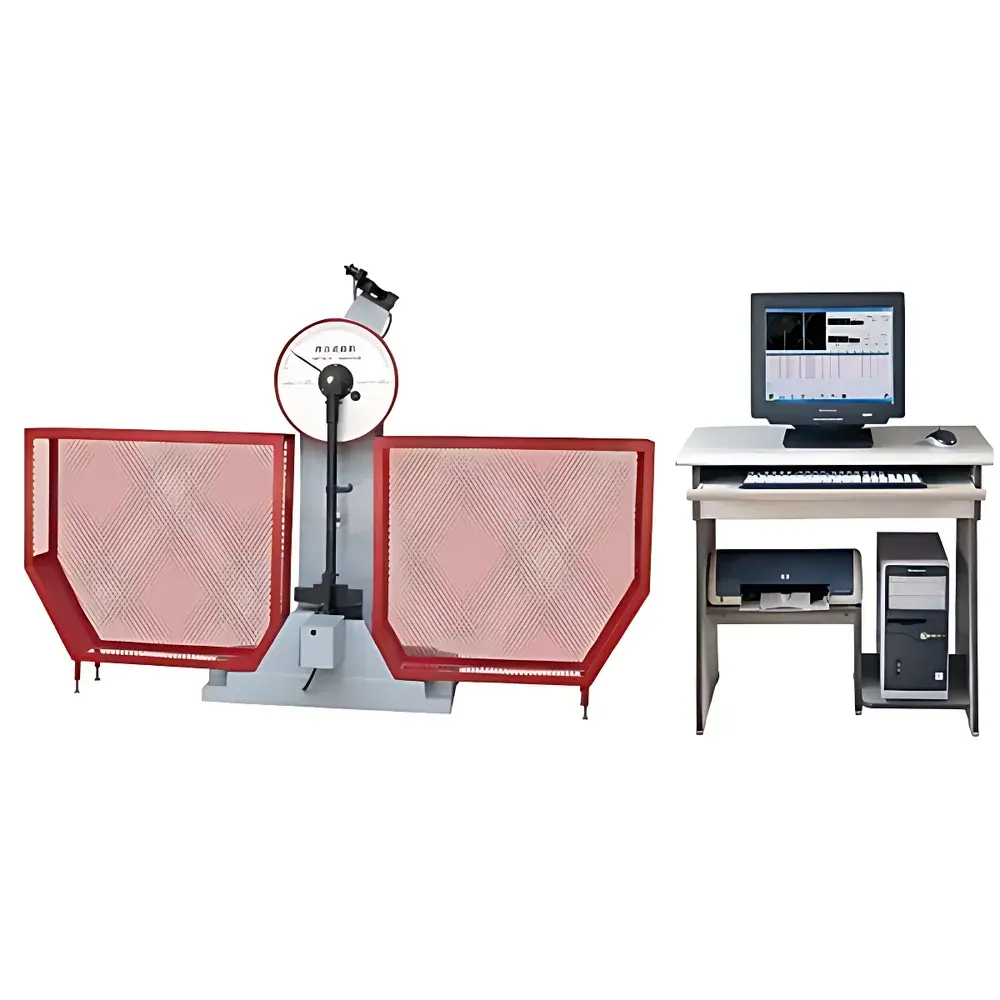
YANRUN JBW-300Z Computer-Controlled Automatic Charpy Impact Testing Machine
| Brand | YANRUN |
|---|---|
| Origin | Shanghai, China |
| Manufacturer Type | Direct Manufacturer |
| Country of Origin | China |
| Model | JBW-300Z |
| Impact Energy | 150 J, 300 J |
| Impact Velocity | 5.2 m/s |
| Pendulum Pre-lift Angle | 150° |
| Distance from Pendulum Axis to Impact Point | 750 mm |
| Specimen Support Span | 40 mm |
| Specimen Dimensions | 10 × 10 × 55 mm |
| Notch Knife Radius Options | R2–R2.5 mm, R8 mm |
| Specimen Holder Capacity | 10 positions |
| Alignment Method | Automatic Specimen Centering |
| Power Supply | 380 V / 50 Hz / 5 A |
| Compliance | GB/T 229–2007, GB/T 3803–2002 |
Overview
The YANRUN JBW-300Z is a fully automated, computer-controlled Charpy impact testing machine engineered for high-throughput, repeatable mechanical characterization of metallic materials under standardized notched-bar impact conditions. It operates on the principle of pendulum impact mechanics, where gravitational potential energy—converted from a precisely elevated hammer—is released to fracture a standardized specimen supported in a three-point bending configuration. The system measures absorbed energy (in joules) by analyzing the residual swing height of the pendulum post-impact, in strict accordance with ISO 148-1 and ASTM E23 methodologies. Designed for metallurgical laboratories, quality control departments in heavy manufacturing, and accredited testing facilities, the JBW-300Z integrates electromechanical automation with real-time microprocessor-based data acquisition to eliminate manual intervention across the full test cycle: pendulum lifting, specimen auto-feeding, precise positioning, impact execution, post-fracture energy calculation, and automatic re-lift using residual kinetic energy.
Key Features
- Integrated PC-based control architecture with dedicated impact testing software for real-time monitoring, parameter configuration, and result traceability.
- Motor-driven pendulum lifting mechanism ensures consistent pre-lift angle (150° ± 0.1°) and eliminates operator-dependent variability in energy input.
- Automated specimen handling system accommodates up to 10 standard Charpy specimens (10 × 10 × 55 mm) in a rotating specimen magazine, enabling unattended sequential testing.
- U-shaped pendulum hammer with interchangeable anvils and dual-radius impact blades (R2–R2.5 mm for standard V-notch, R8 mm for U-notch per GB/T 229–2007) ensures compliance with multiple international notch geometry requirements.
- Robust single-column frame with cantilevered pendulum suspension and rigid specimen supports (40 mm span, ±0.05 mm tolerance) minimizes structural deflection and enhances measurement reproducibility.
- Redundant safety architecture including mechanical safety pins, interlocked protective enclosure, and emergency stop circuitry compliant with IEC 60204-1 requirements.
- Automatic post-impact re-lift function recovers residual pendulum energy to reset the hammer—reducing cycle time and improving throughput in high-volume environments.
Sample Compatibility & Compliance
The JBW-300Z is validated for use with standard Charpy V-notch (CVN) and Charpy U-notch specimens conforming to dimensions specified in GB/T 229–2007 (equivalent to ISO 148-1:2016 and ASTM E23–23). Specimen cross-sections are strictly limited to 10 × 10 mm; non-standard geometries require recalibration and validation per ISO/IEC 17025 clause 5.4.3. The machine satisfies metrological verification criteria outlined in GB/T 3803–2002 (identical to ISO 148-2), including angular accuracy (±0.1°), impact velocity tolerance (5.2 m/s ± 0.2 m/s), and energy indication error (≤ ±0.5% of full scale). All test reports generated include audit-ready metadata: timestamp, operator ID, calibration certificate reference, environmental temperature, and raw analog-to-digital conversion values—supporting GLP/GMP documentation and FDA 21 CFR Part 11 electronic record integrity requirements.
Software & Data Management
The embedded Windows-based application provides a validated, password-protected interface for test method definition, calibration management, and statistical analysis. Each test session logs raw encoder data, pendulum trajectory profiles, and calculated metrics—including absorbed energy (J), lateral expansion (if equipped with optional dial gauge), and normalized toughness indices (kJ/m²). Export formats include CSV, PDF (with digital signature), and XML for LIMS integration. Audit trails record all user actions (e.g., parameter edits, calibration events, report generation) with immutable timestamps. Software validation documentation (IQ/OQ/PQ protocols) is available upon request to support regulatory submissions under ISO 17025 or CAP accreditation.
Applications
This instrument is routinely deployed in steel mills, aerospace component suppliers, pressure vessel fabricators, and third-party certification labs for evaluating ductile-to-brittle transition behavior, batch homogeneity assessment, weldment qualification (per AWS D1.1), and material acceptance testing against procurement specifications (e.g., ASTM A370, EN 10045-1). Its automation capability makes it particularly suitable for longitudinal testing programs requiring >50 specimens/day, such as heat treatment validation studies or incoming raw material screening in automotive casting operations.
FAQ
What standards does the JBW-300Z comply with?
It meets GB/T 229–2007 (Charpy test method), GB/T 3803–2002 (machine verification), and is technically aligned with ISO 148-1, ASTM E23, and EN 10045-1.
Can the system be integrated into an existing LIMS?
Yes—via configurable CSV/XML export and optional OPC UA server module for real-time data streaming to enterprise QA systems.
Is operator training included with purchase?
Standard commissioning includes on-site installation verification and two-day operator training covering calibration, routine maintenance, and report generation per ISO/IEC 17025 Annex A.
What maintenance intervals are recommended?
Lubrication of pendulum bearings every 6 months; annual verification of encoder linearity and impact velocity using NIST-traceable calibration fixtures.
Does the software support multi-language interfaces?
English and Simplified Chinese UIs are pre-installed; additional language packs (German, Spanish, Japanese) are available as licensed add-ons.



