
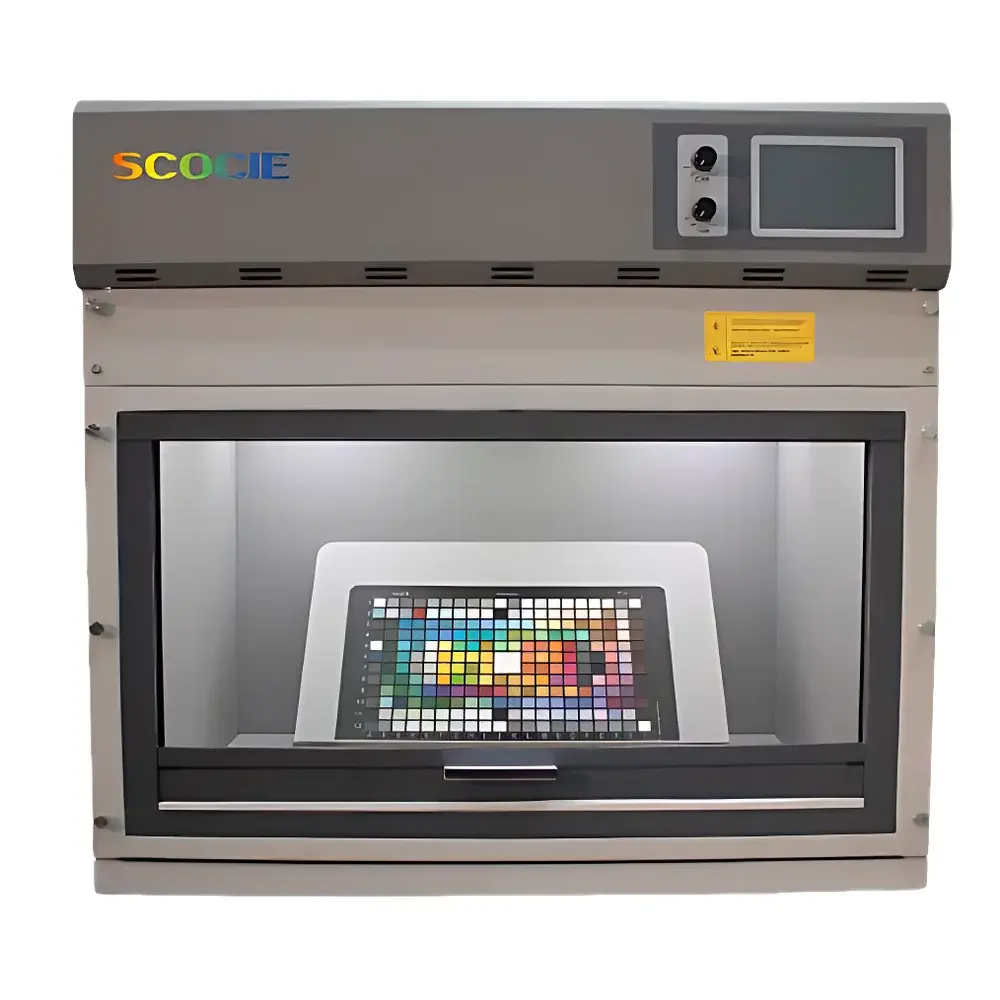
Shike FastnessGrade Color Fastness Analyzer
| Origin | Shanghai, China |
|---|---|
| Manufacturer Type | Distributor |
| Origin Category | Domestic |
| Model | FastnessGrade |
| Price Range | USD 28,000–42,000 |
| Instrument Type | Benchtop Spectrophotometer |
| Optical Geometry | 0/45° Integrating Sphere |
| Light Source | LED Array |
| Spectral Range | 350–700 nm |
| Repeatability (ΔE*ab) | ≤0.03 |
Overview
The Shike FastnessGrade Color Fastness Analyzer is a benchtop spectral imaging instrument engineered for objective, quantitative assessment of textile and material color fastness properties. Unlike conventional visual evaluation methods reliant on human observers under standardized illumination, the FastnessGrade integrates high-fidelity RGB imaging with spectrophotometric measurement in a single optical platform. Its core measurement principle combines spatially resolved digital image capture—using calibrated LED illumination at 0/45° geometry—with full-spectrum reflectance analysis (350–700 nm) to extract CIE L*a*b*, ΔE*ab, and CMC(2:1) color difference metrics. This dual-mode architecture enables traceable, repeatable grading of color change (colorfastness to washing, light, perspiration, etc.) and color transfer (staining), while simultaneously supporting standard-compliant color difference evaluation per ISO 105-A02, ISO 105-B02, AATCC TM16, AATCC TM15, and ISO 105-X12. The system eliminates inter-observer variability and supports remote collaborative grading across geographically distributed laboratories.
Key Features
- Benchtop 0/45° integrating sphere design ensures uniform illumination and minimizes directional reflectance artifacts during sample imaging.
- Stable, narrow-band LED array provides consistent spectral output across the visible range (350–700 nm), eliminating lamp aging drift and enabling long-term calibration stability.
- Dual-function operation: simultaneous acquisition of high-resolution RGB images and spectrophotometric reflectance data from the same measurement zone.
- Automated fastness grading engine compliant with ISO 105-A02 (gray scale), ISO 105-B02 (blue wool scale), and AATCC Evaluation Procedures for staining and color change.
- Integrated standard illuminant simulation (D65, A, F2, F7, F11) with CRI >95, meeting ISO/CIE requirements for visual color assessment environments.
- Multi-sample batch imaging capability—up to six specimens captured and graded in a single acquisition cycle—reducing throughput time by >60% versus sequential manual evaluation.
Sample Compatibility & Compliance
The FastnessGrade accommodates flat, flexible, and moderately textured specimens up to 150 mm × 150 mm, including woven/knitted textiles, leather, coated papers, plastic films, and printed substrates. It supports standard test specimens per ISO 105-C06 (washing), ISO 105-B02 (lightfastness), ISO 105-X12 (rubbing), and ISO 12945-2 (pilling). All grading algorithms are traceable to NIST-traceable reference standards and validated against inter-laboratory round-robin data per ISO/IEC 17043. The instrument’s software architecture complies with GLP and GMP documentation requirements—including full audit trail, electronic signature support, and 21 CFR Part 11–ready user access control—making it suitable for regulated quality assurance workflows in textile manufacturing, automotive interiors, and medical device packaging.
Software & Data Management
FastnessGrade Control Suite is a Windows-based application offering real-time image acquisition, spectral data export (CSV, XML), and automated report generation in PDF or Excel format. It includes embedded calibration verification routines, spectral deviation alerts, and configurable pass/fail thresholds aligned with internal QC specifications or customer-facing standards (e.g., OEKO-TEX®, ZDHC MRSL). Raw spectral data and annotated images are stored with metadata (operator ID, timestamp, environmental conditions, instrument serial number), ensuring full data lineage. Network deployment allows centralized database synchronization across multiple instruments; results can be pushed directly to LIMS or ERP systems via secure HTTPS API. All software updates undergo ISO 13485-aligned validation protocols.
Applications
- Textile & Apparel: Objective grading of wash, light, perspiration, and rubbing fastness per ISO/AATCC standards; pilling assessment using ISO 12945-2 reference images.
- Printing & Packaging: Quantitative evaluation of ink migration, substrate metamerism, and batch-to-batch color consistency in flexo, gravure, and digital print.
- Food & Agriculture: Non-destructive maturity assessment of fruits/vegetables via surface chromaticity trends; baked goods browning index quantification (L* decay modeling).
- Coatings & Plastics: UV-induced fading analysis of automotive clearcoats; fluorescent additive concentration estimation via excitation-emission correlation.
- R&D Laboratories: Correlation studies between instrumental ΔE*ab and sensory panel scores; development of custom fastness scales for novel fiber blends.
FAQ
Does FastnessGrade replace human grading entirely?
Yes—when configured for ISO-compliant automated grading, it delivers statistically equivalent or superior reproducibility (CV <1.2%) compared to trained visual assessors, as verified in ISO/IEC 17043 proficiency testing.
Can it evaluate non-textile materials such as leather or synthetic polymers?
Yes—the 0/45° geometry and broad spectral response support accurate reflectance measurement on low-gloss, semi-diffuse surfaces common in automotive trim, footwear, and medical device housings.
Is spectral data export supported for third-party analysis?
Yes—full 10-nm interval reflectance spectra (350–700 nm) are exportable in CSV and XML formats, compatible with MATLAB, Python (NumPy/Pandas), and commercial color science toolkits.
How is calibration maintained over time?
The system performs daily self-checks using integrated ceramic tile references; annual recalibration is performed using NIST-traceable standards by Shike-certified service engineers.
What network security protocols does the software support?
TLS 1.2+ encryption, LDAP/Active Directory integration, role-based permissions, and immutable audit logs compliant with ISO 27001 information security management requirements.




