
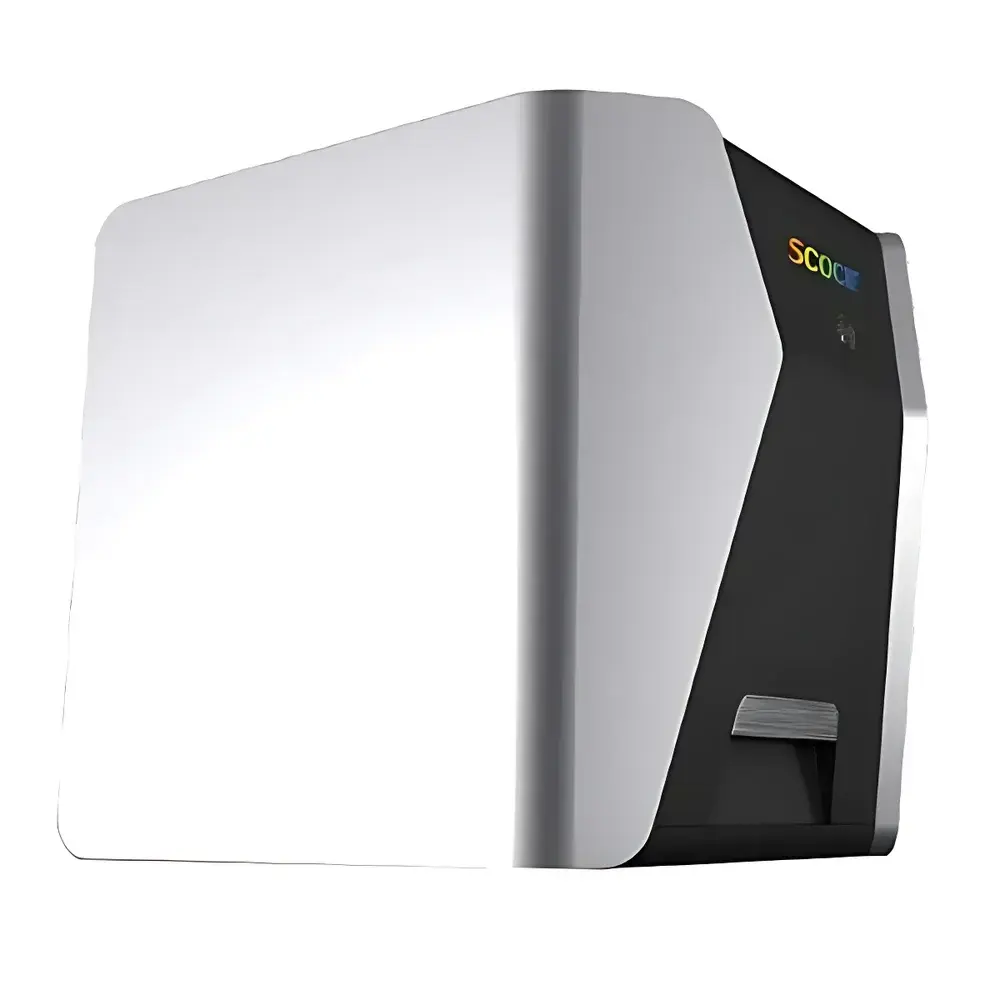
SCOSIE Digieye Digicolor Desktop Spectrophotometric Color Imaging System
| Brand | SCOSIE |
|---|---|
| Origin | Shanghai, China |
| Product Type | Spectrophotometric Color Measurement System |
| Instrument Type | Benchtop |
| Optical Geometry | 0°/45° Integrating Sphere |
| Illuminant | Standard D65 |
| Spectral Range | 400–700 nm |
| Repeatability | ΔE*ab ≤ 0.03 |
| Color Spaces | CIELAB, CIELCH, CIELUV, Hunter Lab, Munsell |
| Observer Angles | 2° and 10° |
| Color Difference Formulas | CIE L*a*b*, CMC (l:c), CIE94, CIEDE2000 |
| Data Output Formats | CSV, QTX, TXT, DAT |
| Compliance | ASTM E308, ISO/CIE 11664, ISO 7724, GB/T 3978–2008, GB/T 3979–2008 |
Overview
The SCOSIE Digieye Digicolor is a benchtop spectrophotometric color imaging system engineered for high-fidelity, non-contact color and appearance evaluation across heterogeneous, textured, and geometrically complex surfaces. Unlike conventional tristimulus colorimeters or handheld spectrophotometers constrained by spot-size limitations and specular interference, the Digicolor employs a calibrated digital imaging platform coupled with a 0°/45° integrating sphere optical architecture to capture spatially resolved spectral reflectance data across the full visible spectrum (400–700 nm). Its measurement principle integrates multi-angle illumination, uniform D65-standardized illumination, and pixel-level spectral reconstruction—enabling quantitative assessment of color uniformity, metamerism, texture-induced chromatic variation, and surface gloss effects. Designed for industrial metrology-grade consistency, it delivers ΔE*ab repeatability ≤ 0.03 under controlled environmental conditions (23 °C ± 2 °C, 50% RH ± 5%), meeting the stability requirements for GLP-compliant color validation workflows.
Key Features
- Non-contact, full-field imaging acquisition eliminates physical contact artifacts and enables measurement of fragile, hot, or irregularly shaped samples—including fabrics, ceramics, printed packaging, and injection-molded plastics.
- 0°/45° integrating sphere geometry ensures diffuse illumination and directional viewing—minimizing specular reflection influence and conforming to ISO 7724-1 and ASTM E308 spectral measurement protocols.
- Multi-illuminant simulation (D65, A, F11, D50, F02, F07) supports metamerism analysis and lighting-condition-specific pass/fail evaluation per ISO 12647 or ISO 13655 standards.
- Integrated support for multiple color spaces (CIELAB, CIELCH, CIELUV, Hunter Lab, Munsell) and industry-standard difference formulas (CMC, CIE94, CIEDE2000) facilitates cross-supplier color agreement and tolerance mapping.
- Comprehensive metric reporting includes K/S (color strength), whiteness (CIE Ganz, ASTM E313), yellowness index (ASTM E313), opacity (ISO 2814), ISO 105-A11 staining/colour change ratings, and spectral reflectance curves.
- Modular data ingestion accepts camera-based RGB input, spectrophotometer-derived XYZ/LAB values, and raw spectral reflectance files—enabling traceable integration into existing QC databases and ERP systems.
Sample Compatibility & Compliance
The Digicolor accommodates samples up to 300 × 300 mm with variable height clearance (up to 120 mm), supporting textiles, leather, coated metals, laminated films, pharmaceutical tablets, cosmetic compacts, and architectural tile specimens. Its optical design complies with ISO/CIE 11664 (Colorimetry), ISO 7724 (Paints and varnishes — Color measurement), and GB/T 3978–2008 (Standard illuminants and geometries for colorimetry). For regulated environments, audit-trail-enabled software modules support 21 CFR Part 11-compliant electronic signatures, user access controls, and immutable measurement history logging—suitable for GMP-aligned quality control in pharma, food, and cosmetics manufacturing.
Software & Data Management
The Digicolor Control Suite provides real-time image-based color mapping, statistical process control (SPC) charting, and batch-level deviation trending. All measurements are timestamped, geotagged (via optional calibration reference grid), and stored in a relational database with configurable retention policies. Export options include CSV (for Excel/SPSS), QTX (QuarkXPress-compatible), TXT (ASCII), and DAT (binary spectral archives). API endpoints support RESTful integration with MES platforms (e.g., Siemens Opcenter, Rockwell FactoryTalk) and cloud-based analytics engines. Software validation documentation (IQ/OQ/PQ templates) is provided for laboratory accreditation (ISO/IEC 17025) and internal SOP alignment.
Applications
The system serves as a primary color verification tool in textile dyeing QA (ISO 105-C06 wash fastness correlation), automotive interior trim matching (SAE J1545), food product batch release (USDA/FDA color consistency thresholds), packaging print certification (ISO 12647-2), pharmaceutical tablet coating uniformity (ICH Q5C), and heritage conservation pigment analysis (CEN/TS 16417). Its ability to quantify spatial color gradients—such as seam mismatches in apparel or gloss-band anomalies in coated steel—extends utility beyond traditional spot-measurement paradigms.
FAQ
What distinguishes Digicolor from conventional colorimeters?
It combines full-field spectral imaging with 0°/45° geometry—enabling spatially resolved color analysis across non-uniform surfaces where spot instruments fail.
Does the system support regulatory compliance for pharmaceutical use?
Yes—software modules include 21 CFR Part 11 audit trails, role-based access, and electronic signature capability for GMP documentation.
Can Digicolor integrate with existing LIMS or SAP QM modules?
Yes—via standardized ODBC drivers and REST API interfaces; prebuilt connectors available for major LIMS vendors.
Is calibration traceable to NIST or PTB standards?
Instrument calibration uses SCOSIE-certified ceramic tiles traceable to NIST SRM 2021 and PTB BCR-177a; annual recalibration services include uncertainty reporting per ISO/IEC 17025.
What maintenance is required beyond routine calibration?
No consumables or lamps require replacement; the solid-state LED illuminant has >50,000-hour service life and stable spectral output per IEC 62471.





