
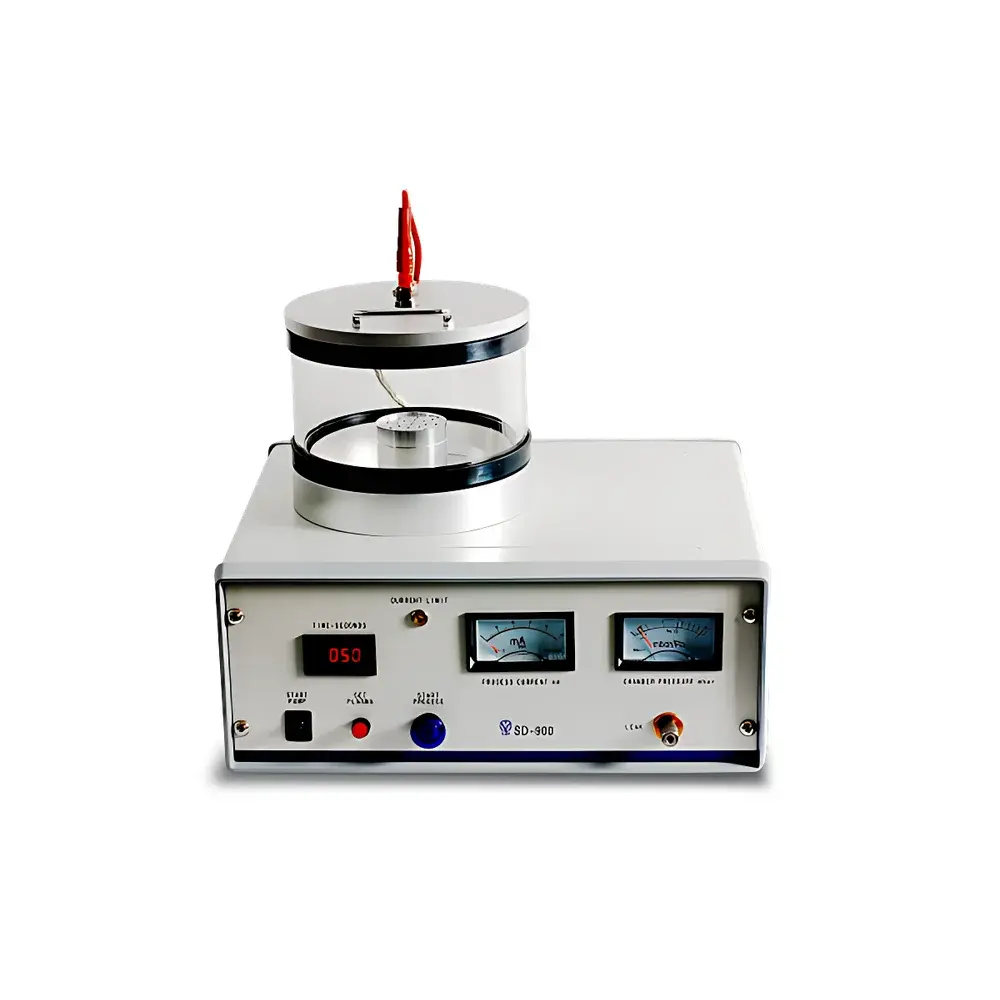
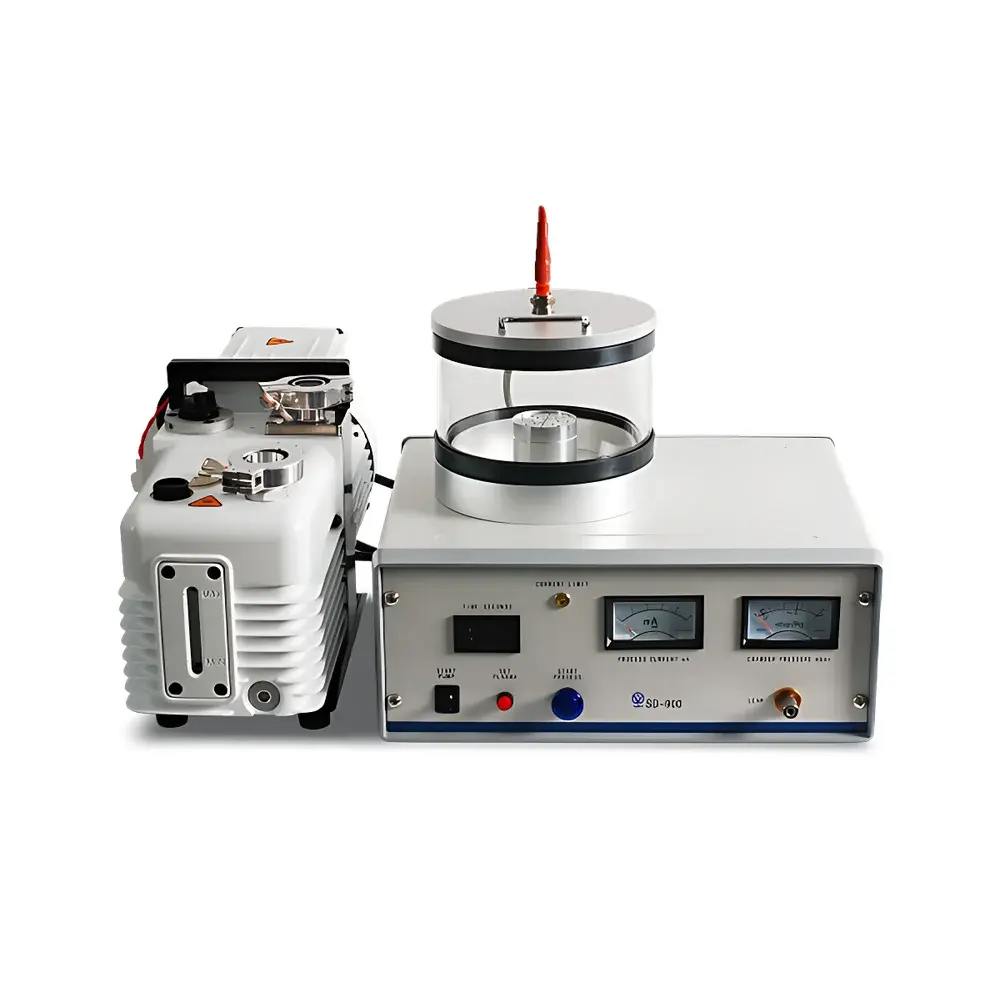
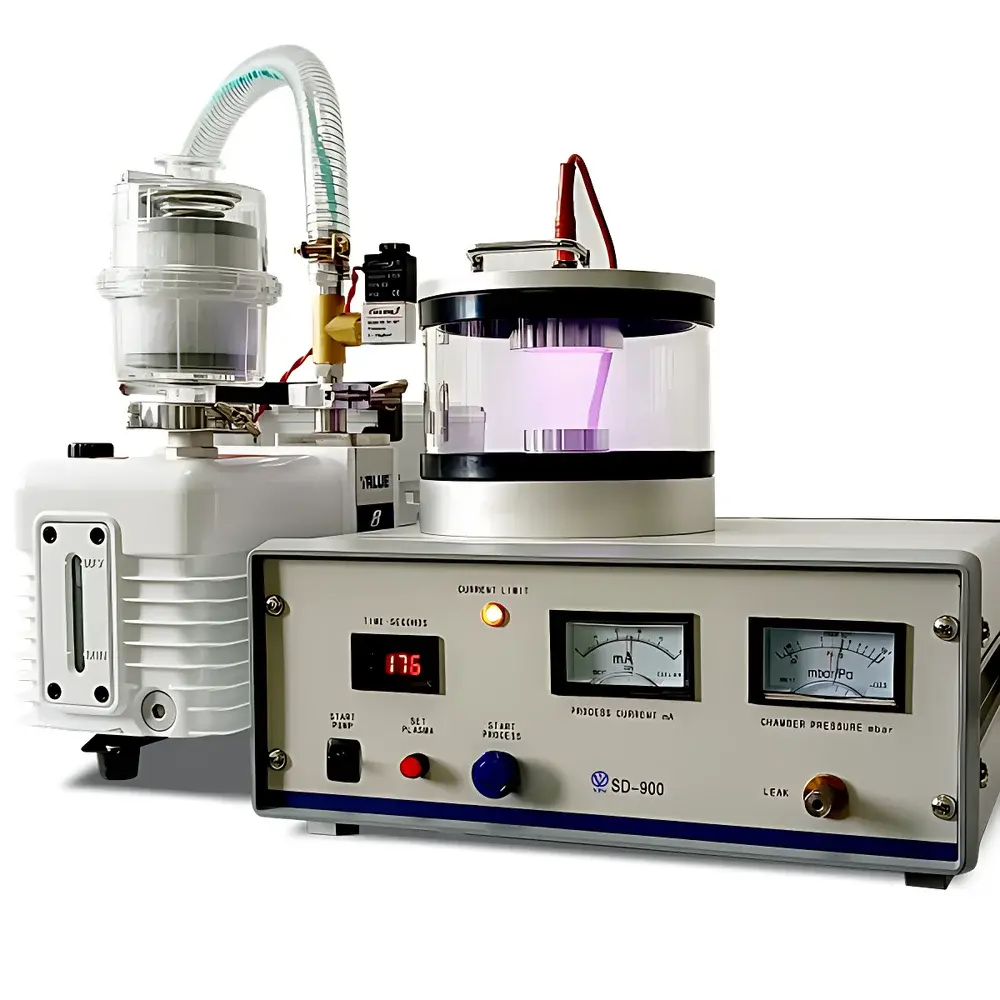
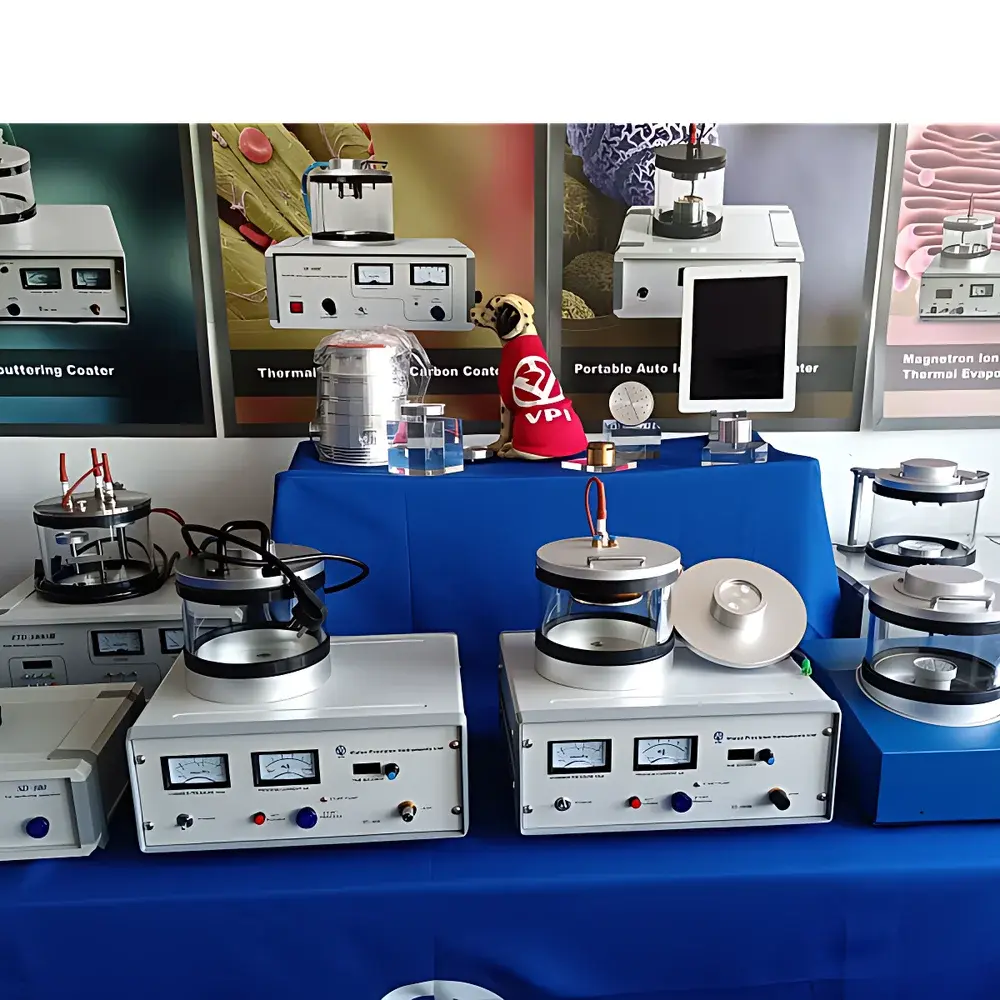
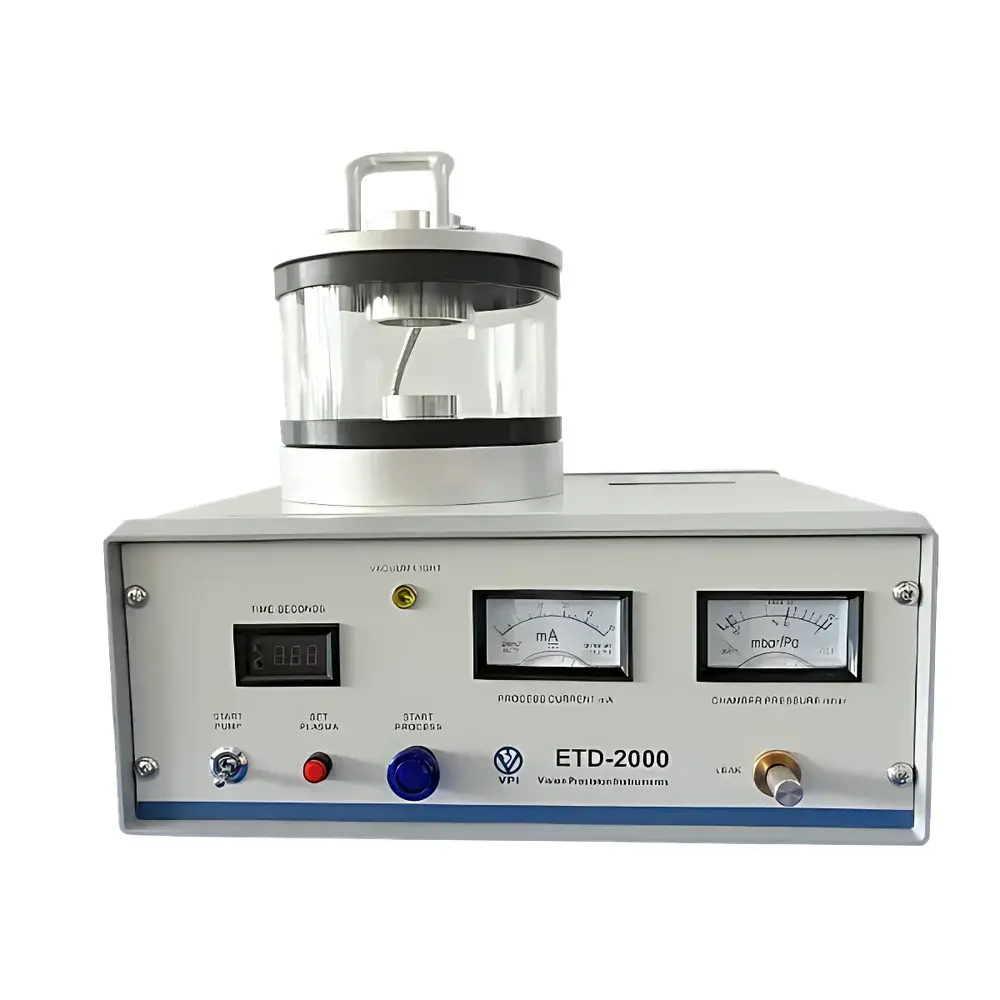
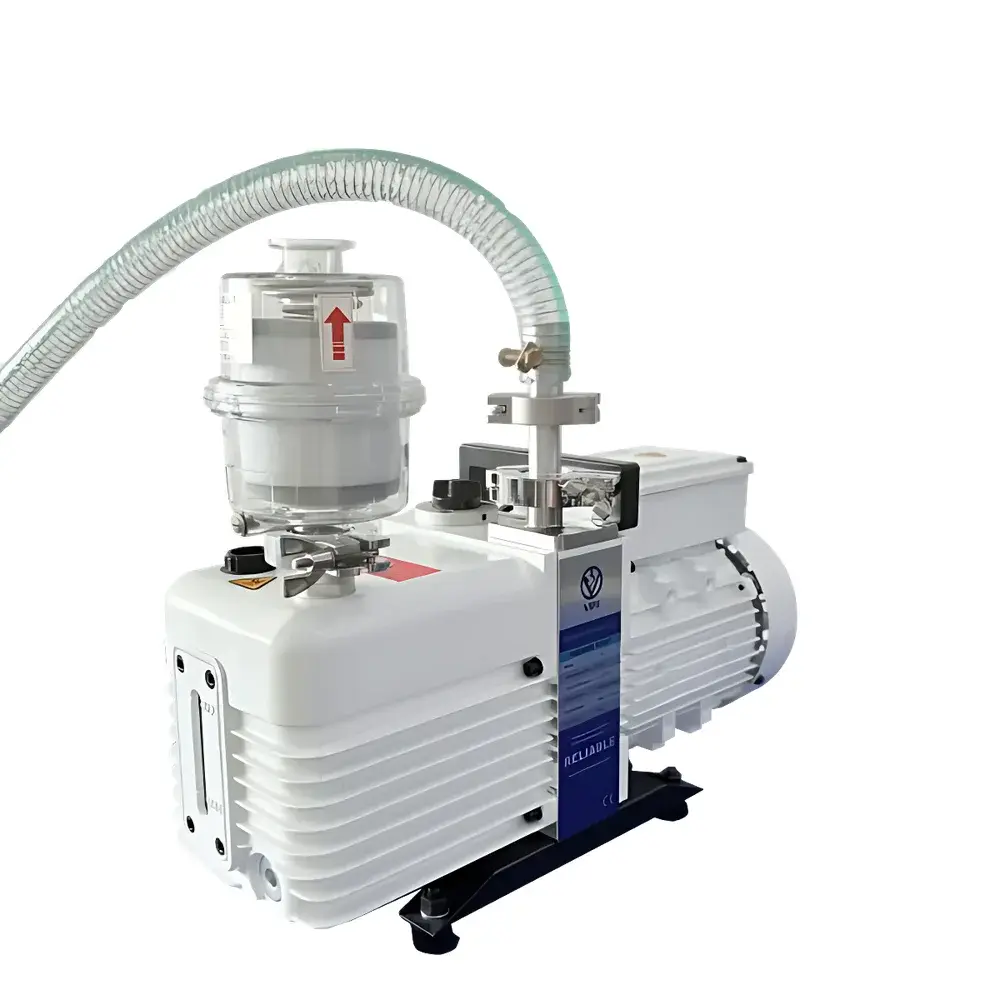
VPI SD-900 Desktop Ion Sputter Coater for SEM Sample Preparation
| Brand | VPI (BoYuan Micro-Nano) |
|---|---|
| Origin | Beijing, China |
| Model | SD-900 |
| Target Materials | Au, Pt, Ag |
| Target Diameter | 50 mm |
| Control Method | Microprocessor-Based Electronic Control |
| Chamber Dimensions | Ø160 mm × 120 mm (H) |
| Sample Stage Diameter | 50–70 mm (customizable) |
| Sputtering Gases | Ar, N₂, Air |
| Vacuum Gauge Range | 1 × 10⁻³ to 1 × 10³ mbar |
| Max DC Voltage | −1600 V |
| Max Sputtering Current | 50 mA |
| Current Stability | ±0.1 mA |
| Timer Range | 0–999 s |
| Base Pump | 2 L/s VRD-8 Rotary Vane Pump |
| Chamber Material | Borosilicate Glass |
| Power Supply | 220 V AC, 50 Hz (110 V optional) |
| Weight | ~35 kg |
| Dimensions (W×D×H) | 300 × 360 × 380 mm |
Overview
The VPI SD-900 is a compact, benchtop ion sputter coater engineered for high-reproducibility conductive coating of non-conductive or beam-sensitive specimens prior to scanning electron microscopy (SEM) analysis. It operates on the principle of diode-type direct-current (DC) sputtering—a physical vapor deposition (PVD) technique—where a high-voltage electric field ionizes inert process gas (typically argon) within a low-vacuum chamber (≤4 × 10⁻² mbar), generating a plasma. Positive ions from the plasma are accelerated toward a negatively biased metallic target (cathode), dislodging atoms via momentum transfer. These sputtered atoms travel ballistically across the chamber and condense uniformly onto grounded, non-conductive samples mounted on the anode stage, forming a continuous, nanoscale conductive film (e.g., Pt, Au, or Ag). Unlike magnetron systems, the SD-900’s simplified two-electrode architecture eliminates magnetic field complexity, enabling stable operation at modest vacuum levels while maintaining excellent film adhesion, grain fineness, and thickness uniformity—critical for high-magnification (>100,000×) SEM imaging and quantitative EDS analysis.
Key Features
- Benchtop form factor (300 × 360 × 380 mm; ~35 kg) with <0.2 m² footprint—designed for space-constrained labs, fume hoods, or shared instrumentation suites.
- Borosilicate glass chamber (Ø160 mm × 120 mm H) with anti-sputter coating for real-time visual monitoring and long-term optical clarity.
- Precision-engineered 50 mm diameter Pt target (≥99.99% purity), integrated with upper electrode—ensuring ≤±3% thickness uniformity over Ø50 mm deposition area.
- Dual-range Pirani vacuum gauge (1 × 10⁻³–1 × 10³ mbar), factory-calibrated for low-vacuum sputtering; resolution ±0.01 mbar.
- Microprocessor-controlled sputtering parameters: adjustable DC voltage (up to −1600 V), current (0–50 mA, stability ±0.1 mA), and timer (0–999 s, 1 s resolution).
- Dedicated micro-leak gas valve (φ3 mm port) for precise introduction of Ar, N₂, or air—enabling optimization of plasma density and film morphology.
- Integrated safety interlocks: vacuum protection circuit prevents arcing below operational pressure; overload/overvoltage protection on power module.
- Standard 2 L/s VRD-8 rotary vane pump (noise ≤50 dB); achieves working vacuum in 3–5 minutes from atmosphere.
Sample Compatibility & Compliance
The SD-900 accommodates diverse sample geometries—including biological tissues, polymers, ceramics, semiconductors, and fragile MEMS devices—via its adjustable 50–70 mm diameter sample stage (custom stages available). Its low-energy sputtering regime minimizes thermal and electron-beam damage to radiation-sensitive specimens (e.g., hydrated biofilms, organic thin films). The system supports ASTM E1558 (Standard Guide for Preparation of Specimens for SEM) and ISO 27687 (Electron microscopy — Vocabulary), and its controlled, repeatable coating process aligns with GLP-compliant workflows. While not CE-marked per EU Machinery Directive 2006/42/EC out-of-box, the unit meets essential safety requirements for laboratory use when operated with certified vacuum components and grounding per IEC 61010-1.
Software & Data Management
The SD-900 employs embedded firmware—not PC-dependent software—for core operation. All process parameters (voltage, current, time, gas flow status) are logged locally with timestamping to non-volatile memory. Optional RS-232 or USB-to-serial interface enables external logging via third-party LabVIEW or Python scripts for audit trails. Though lacking FDA 21 CFR Part 11–compliant electronic signatures, the device supports manual record-keeping aligned with ISO/IEC 17025 documentation standards: operators log batch ID, target material, vacuum level, sputtering duration, and post-coating inspection notes in bound lab notebooks.
Applications
- SEM Sample Preparation: Deposits sub-10 nm Pt or Au films on insulating materials (e.g., alumina, PMMA, bone sections) to eliminate charging artifacts and improve secondary electron yield—enabling high-resolution topographic and compositional imaging.
- Electron Beam Lithography Substrates: Provides atomically clean, conductive underlayers for resist spin-coating on Si/SiO₂ wafers, reducing pattern distortion from static buildup.
- Biosensor Fabrication: Forms microelectrode arrays on glucose test strips or DNA chips; Pt’s electrochemical stability and biocompatibility ensure reproducible amperometric response.
- Materials Science Research: Prepares cross-sectional TEM lamellae (via FIB) by pre-coating with Cr or Al to suppress ion milling curtaining and redeposition.
- Academic Teaching: Demonstrates fundamental PVD physics—plasma generation, ion acceleration, sputter yield dependence on atomic mass—and introduces students to vacuum technology and surface characterization protocols.
FAQ
What target materials are compatible with the SD-900?
The system accepts standard 50 mm diameter targets of Au, Pt, Ag, Cr, Al, and Cu. Pt (≥99.99% purity) is supplied as standard due to its superior corrosion resistance, fine grain structure, and compatibility with high-resolution SEM.
Can the chamber be upgraded for reactive sputtering?
No—the SD-900 is configured exclusively for inert-gas DC sputtering. Reactive processes (e.g., TiN deposition using N₂ + Ti target) require RF power supplies and impedance-matched matching networks not present in this platform.
Is remote operation or network connectivity supported?
The SD-900 does not include Ethernet, Wi-Fi, or cloud connectivity. Remote control is limited to serial-command interfacing via optional hardware adapters for integration into automated lab workflows.
How often must the vacuum pump oil be changed?
Under typical usage (≤5 cycles/day), VRD-8 pump oil should be replaced every 500 operating hours or annually—whichever occurs first—to maintain base pressure integrity and prevent backstreaming contamination.
Does the unit comply with electromagnetic compatibility (EMC) standards?
The SD-900 meets Class B emission limits per CISPR 11 and IEC 61326-1 when installed with proper grounding and shielded power cabling; full EMC test reports are available upon request for institutional procurement review.



