
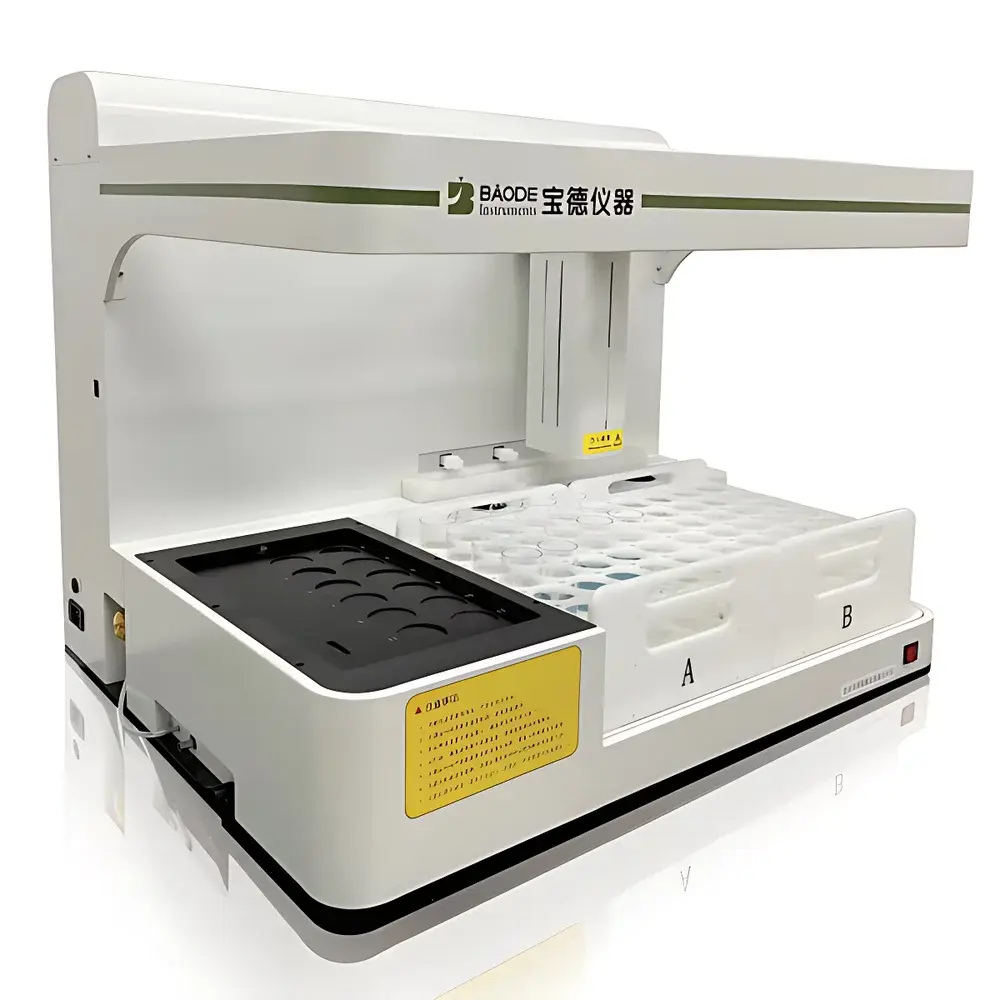
Brookfield BCOD-60 Dual-Channel Automated Permanganate Index Analyzer
| Brand | Brookfield |
|---|---|
| Origin | Beijing, China |
| Manufacturer Type | Original Equipment Manufacturer (OEM) |
| Product Origin | Domestic (China) |
| Model | BCOD-60 |
| Pricing | Available Upon Request |
Overview
The Brookfield BCOD-60 Dual-Channel Automated Permanganate Index Analyzer is a fully automated, benchtop analytical system engineered for precise and reproducible determination of the permanganate index (also known as potassium permanganate consumption or CODMn) in natural and treated water matrices. It operates on the standardized redox titration principle defined in GB 11892–1989 and GB/T 5750.7–2006—equivalent to ISO 8467:1993 and aligned with methodological frameworks referenced in APHA Standard Methods 5210 B. The instrument quantifies the oxygen demand of oxidizable organic and inorganic substances through controlled oxidation by potassium permanganate under acidic or alkaline conditions at elevated temperature, followed by back-titration with sodium oxalate. Its dual-channel architecture enables concurrent analysis of two independent samples, significantly improving throughput without compromising measurement integrity.
Key Features
- Dual-channel parallel processing with independent reagent delivery, heating, and endpoint detection systems
- Three-axis robotic arm with high-precision positioning for reliable sample vial handling, reagent dispensing, and tray navigation
- Micro-boiling water bath digestion module featuring closed-loop temperature control and auto-refill functionality from external deionized water supply
- Optical endpoint detection system simulating human visual assessment: real-time RGB colorimetric monitoring of the characteristic pink-to-colorless transition during titration
- Integrated acid/alkaline mode selection—supports both GB 11892 acidic method (for low-ionic-strength surface waters) and GB/T 5750.7 alkaline method (for high-chloride or low-pH samples)
- Fully unattended operation: automatic sample aspiration, reagent addition, digestion, cooling, titration, waste disposal, and post-analysis vial return
- Thermal stabilization architecture ensures rapid ramp-up to 97 ± 1 °C digestion temperature within ≤4 minutes, minimizing thermal lag and inter-sample variability
Sample Compatibility & Compliance
The BCOD-60 is validated for use with drinking water, raw source water, river and lake surface water, and treated effluent—samples with turbidity ≤10 NTU and chloride concentration <300 mg/L (acidic mode) or <1000 mg/L (alkaline mode). It complies with national regulatory requirements for routine environmental monitoring in China and supports data traceability under GLP-aligned laboratory practices. All critical process parameters—including digestion time, temperature profile, titrant delivery volume, and endpoint threshold—are logged with timestamped audit trails. Data export formats include CSV and PDF reports compatible with LIMS integration. While not pre-certified for FDA 21 CFR Part 11, the software architecture supports configurable user authentication, electronic signatures, and immutable data archiving—enabling laboratories to implement compliant validation protocols per internal SOPs.
Software & Data Management
The BCOD-60 is operated via an embedded Windows-based HMI with intuitive graphical workflow navigation. Method setup includes customizable digestion duration (10–120 min), titration step resolution (0.01 mL increments), and colorimetric sensitivity thresholds. Real-time progress visualization displays active channel status, temperature curves, titrant consumption, and dynamic endpoint recognition confidence metrics. All raw absorbance data, intermediate calculations, and final results are stored locally with automatic backup to network drives. Batch reporting supports statistical summaries (mean, SD, CV%), outlier flagging per Grubbs’ test, and calibration verification logs. Exported datasets retain full metadata: operator ID, sample ID, method version, instrument serial number, and environmental ambient conditions recorded at run initiation.
Applications
- Routine surveillance of potable water quality in municipal utilities and third-party testing labs
- Source water characterization for watershed management and early-warning systems
- Compliance monitoring for discharge permits under China’s “Water Pollution Prevention and Control Action Plan”
- Method validation studies comparing CODMn against dichromate-based CODCr in low-organic-load matrices
- Educational use in environmental engineering curricula for teaching standardized redox titration principles and automation design
- Research applications requiring high-reproducibility longitudinal tracking of organic load trends in oligotrophic ecosystems
FAQ
What is the measurable range of the BCOD-60 for permanganate index?
The instrument delivers linear response across 0.5–5.0 mg/L O₂, optimized for low-to-moderate organic loading typical of unpolluted surface waters and finished drinking water.
Does the BCOD-60 require external ventilation or fume hood installation?
No. Its sealed micro-boiling water bath and condensate recirculation design eliminate vapor release, enabling safe operation in standard laboratory environments without dedicated exhaust infrastructure.
How does the system ensure titration endpoint accuracy compared to manual methods?
The optical sensor continuously monitors spectral reflectance at 525 nm with 12-bit ADC resolution; algorithmic smoothing and derivative-based inflection point detection reduce subjectivity and improve repeatability (RSD <1.8% at 2.0 mg/L, n=6).
Can the BCOD-60 be integrated into an existing LIMS environment?
Yes—via configurable ODBC-compliant database export or RESTful API endpoints (available with optional software upgrade package), supporting bidirectional sample queueing and result ingestion.
Is method validation documentation provided with the instrument?
A comprehensive IQ/OQ protocol package—including performance verification checklists, reference material traceability records, and uncertainty budget templates—is supplied with each unit and updated annually per ISO/IEC 17025 guidance.







