
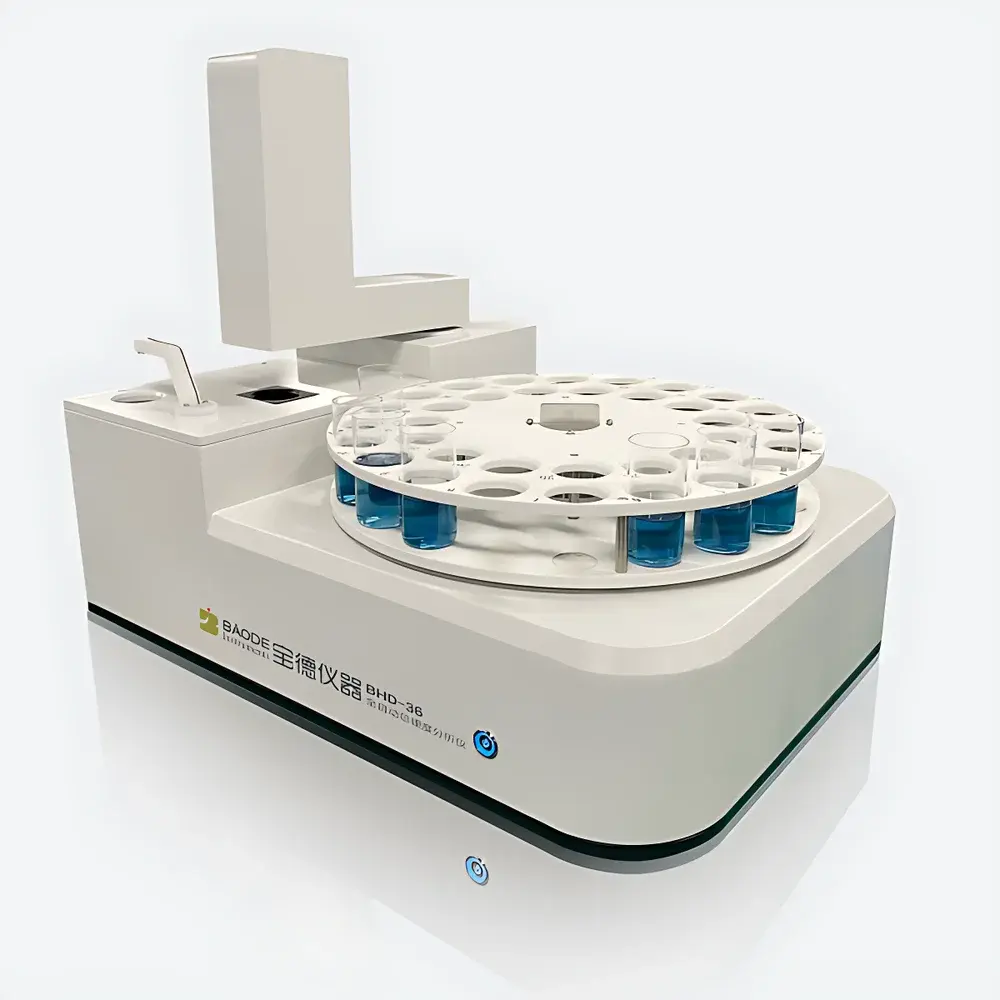
Brookfield BDA-36 Automatic Potentiometric Titrator
| Brand | Brookfield |
|---|---|
| Origin | Beijing, China |
| Manufacturer Type | Direct Manufacturer |
| Country of Origin | China |
| Model | BDA-36 |
| Pricing | Upon Request |
Overview
The Brookfield BDA-36 Automatic Potentiometric Titrator is a fully automated, microprocessor-controlled titration system engineered for precision and reproducibility in routine and regulatory-compliant chemical analysis. It operates on the principle of potentiometric endpoint detection—measuring the potential difference between a reference electrode and an indicator electrode as titrant is incrementally added—to determine stoichiometric equivalence points with high resolution. Unlike classical manual or semi-automated titrators, the BDA-36 integrates real-time potential monitoring, adaptive titration kinetics, and colorimetric endpoint recognition into a single platform, enabling dual-mode operation (potentiometric and visual-colorimetric) without hardware reconfiguration. Designed primarily for quality control laboratories in food safety, public health, and environmental monitoring sectors, it meets methodological requirements for iodine quantification in iodized salt (as per GB/T 13025.7–2012), total hardness determination in drinking water (using Na₂EDTA titration per ISO 6059:2022), and standardized colorimetric assays including chloride, cyanide, CODCr, and permanganate index (O2 demand).
Key Features
- Adaptive three-phase titration algorithm: slow–fast–slow dispensing profile emulates expert manual technique, optimizing response time while minimizing overshoot and ensuring endpoint reproducibility within ±0.02 mL across ≥50 consecutive runs.
- High-stability peristaltic titration pump with minimum dispensing volume of 0.025 mL and long-term volumetric drift <0.2% over 8-hour continuous operation—calibration-free due to factory-traceable flow characterization.
- RGB full-spectrum color recognition module (380–780 nm) coupled with white LED illumination enables robust endpoint detection for visually assessed titrations, including starch-iodine (blue), Eriochrome Black T (wine-red to blue), and ferroin (red-to-phenanthroline-blue transitions).
- Polar-coordinate robotic arm with ±0.1° angular resolution and 0.2 mm positional repeatability ensures precise handling of up to 36 sample vials arranged on a rotating circular carousel—compatible with standard 50 mL glass or polypropylene titration cups.
- Modular reagent delivery system comprising four independent 5 mL capacity dosing pumps (accuracy ±0.01 mL per stroke) and one dedicated titration pump; all fluidic pathways constructed from FEP tubing (perfluoroalkoxy alkane) for chemical inertness against strong acids, bases, oxidants, and chelating agents.
- One-touch assay switching: preloaded methods for iodine in salt, total hardness, chloride, cyanide, CODCr, and permanganate index require no mechanical modification or accessory swapping—method selection triggers automatic recalibration of pump parameters, electrode conditioning, and endpoint criteria.
Sample Compatibility & Compliance
The BDA-36 accommodates aqueous liquid samples with suspended solids ≤50 mg/L and turbidity <10 NTU, including drinking water, groundwater, surface water, bottled mineral water, boiler feedwater, and lightly contaminated wastewater. It complies with ISO/IEC 17025:2017 general requirements for testing laboratories, supports audit-ready data integrity per FDA 21 CFR Part 11 (electronic records and signatures), and generates GLP/GMP-compliant reports with full audit trail—including user login history, method version, raw potential vs. volume curves, and manual override logs. All iodine analysis workflows align with national standard GB/T 13025.7–2012 and AOAC Official Method 992.11; hardness determinations conform to ISO 6059:2022 and APHA Standard Methods 2340 C.
Software & Data Management
Controlled via Windows-based BDA-Link™ software (v3.2+), the instrument provides intuitive method editor, real-time titration curve visualization, and automated report generation in PDF/XLSX formats. Software architecture includes role-based access control (administrator/operator/auditor), electronic signature capability, and encrypted local database storage with optional network backup. Raw data files retain native timestamped electrode potential (mV), volume dispensed (mL), RGB intensity values, and derivative dE/dV calculations—exportable for third-party statistical analysis or LIMS integration via ASTM E1384-compliant XML schema.
Applications
- Quantitative iodine determination in iodized table salt (KIO₃-fortified), with detection limit ≤0.5 mg/kg and linearity R² ≥0.999 over 1–50 mg/kg range.
- Total hardness assessment in potable water using standardized EDTA titration under buffered conditions (pH 10.0 ± 0.1), reporting results as CaCO₃ equivalents (mg/L).
- Chloride analysis by Mohr or Volhard methods; cyanide quantification via pyridine-barbituric acid colorimetry; CODCr by dichromate reflux followed by ferrous ammonium sulfate back-titration.
- Permanganate index (O₂ demand) measurement in low-organic-content waters according to ISO 8467:1993, with automatic endpoint confirmation via redox potential inflection.
- Method validation support for laboratory accreditation (CNAS, UKAS, A2LA) through built-in precision/recovery studies, spike recovery tests, and intermediate precision evaluation across operators and days.
FAQ
Does the BDA-36 require daily calibration of the titration pump?
No—the titration pump is factory-characterized using gravimetric flow profiling and does not require user calibration; periodic verification (e.g., monthly) using certified volumetric standards is recommended.
Can the instrument perform both potentiometric and colorimetric titrations in the same sequence?
Yes—dual-mode analysis is supported within a single method protocol; the system automatically switches detection mode based on selected assay step.
Is FEP tubing compatible with concentrated HNO₃ or KMnO₄ solutions?
Yes—FEP exhibits excellent resistance to oxidizing agents including hot 6 mol/L HNO₃ and 0.1 mol/L KMnO₄ at ambient temperature; continuous exposure above 60°C is not advised.
What electrode types are supported for potentiometric applications?
Standard single-junction Ag/AgCl reference electrodes and combination pH/redox electrodes with double-junction capability; optional ion-selective electrodes (e.g., I⁻, CN⁻) may be integrated with appropriate interface modules.
How is data integrity ensured during regulatory audits?
All analytical sessions generate immutable digital records with embedded hash codes, electronic signatures, and time-stamped metadata—fully compliant with ALCOA+ principles (Attributable, Legible, Contemporaneous, Original, Accurate, Complete, Consistent, Enduring, Available).
Related Products




