
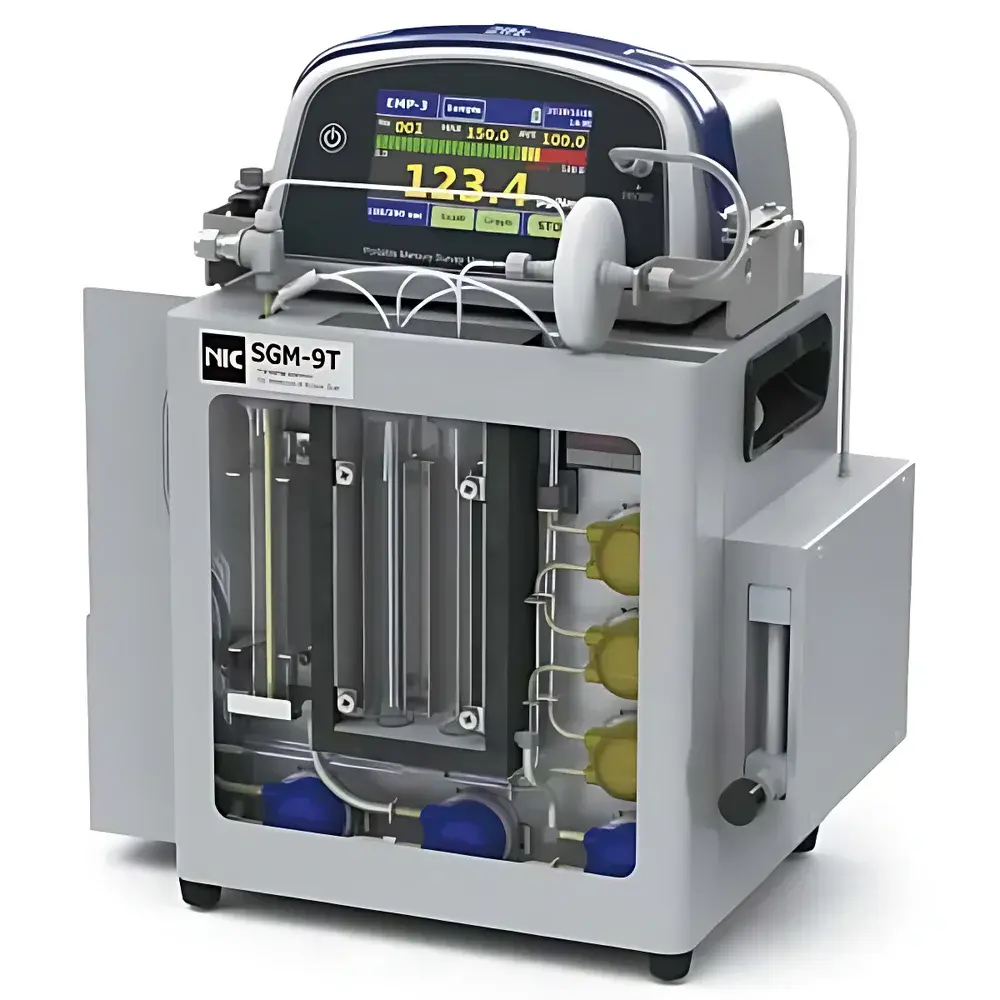
Baode Instruments SGM-9 Portable Flue Gas Mercury Monitor
| Brand | Baode Instruments |
|---|---|
| Origin | Beijing, China |
| Manufacturer Type | Direct Manufacturer |
| Product Category | Domestic |
| Model | SGM-9 |
| Instrument Type | Portable |
| Measurement Principle | Cold Vapor Atomic Absorption Spectrometry (CVAAS) |
| Compliance Standard | JIS B 7994 |
Overview
The Baode Instruments SGM-9 Portable Flue Gas Mercury Monitor is an engineered field-deployable system designed for real-time, on-site quantification of gaseous mercury species in industrial flue gas streams. It operates on the principle of Cold Vapor Atomic Absorption Spectrometry (CVAAS), utilizing the characteristic absorption of elemental mercury vapor at 253.7 nm. The instrument is purpose-built for regulatory monitoring, process optimization, and compliance verification under stringent environmental emission standards—including those aligned with the U.S. EPA Method 29, EU IED (Industrial Emissions Directive), and China’s GB 13223–2011. Its modular architecture separates gas conditioning from optical detection: the WLE-9 pre-treatment unit conditions raw flue gas, while the EMP-3 detector performs high-sensitivity CVAAS analysis. Unlike traditional wet-chemical grab sampling followed by lab-based AAS or CVAFS, the SGM-9 delivers quantitative results within minutes of probe insertion—eliminating transport delays, sample degradation risks, and laboratory turnaround bottlenecks.
Key Features
- Non-dispersive dual-beam CVAAS detection with 253.7 nm mercury resonance line isolation, ensuring high specificity and baseline stability under variable thermal and flow conditions.
- Modular two-unit configuration: WLE-9 gas conditioning module (with heated sampling probe, three-stage chemical scrubbing, and electronic condenser-based dehydration) and EMP-3 CVAAS detector (third-generation NIC-engineered optical cell).
- Dual operational modes: SGM-9T for total gaseous mercury (Hg0 + Hg2+ after SnCl2 reduction) and SGM-9E for elemental mercury only (Hg0 after KCl-based oxidative removal of Hg2+).
- Integrated GPS module embedded in EMP-3, geotagging every measurement with latitude, longitude, altitude, and timestamp—enabling spatial mapping of mercury concentration gradients across multi-point stack surveys.
- Extended dynamic range up to 2000 µg/Nm³, validated per JIS B 7994 calibration protocols, suitable for both routine monitoring and emergency response scenarios (e.g., post-SCR catalyst failure or activated carbon injection upsets).
- Intelligent reagent management algorithm that calculates reagent depletion rates based on real-time input of flue gas temperature, humidity, and flow velocity—optimizing consumable usage and minimizing hazardous waste generation.
Sample Compatibility & Compliance
The SGM-9 is validated for use with flue gases from coal-fired power plants, municipal solid waste incinerators, cement kilns, and non-ferrous metal smelters. Its heated sampling probe (up to 200 °C) prevents mercury adsorption and condensation during extraction. The WLE-9’s three-stage scrubbing sequence ensures selective removal of interfering species: Stage 1 chemically isolates target mercury species; Stage 2 eliminates acidic gases (SOx, NOx) via KOH impregnated media; Stage 3 achieves dew point control ≤5 °C using thermoelectric cooling—meeting ISO 19735:2020 requirements for dry, particle-free sample delivery to the detector. The system complies with JIS B 7994 for performance verification and supports audit-ready documentation for GLP/GMP-aligned quality systems. While not inherently 21 CFR Part 11 compliant, raw data export formats (CSV, XML) are structured to support integration with validated LIMS platforms requiring electronic signature and audit trail capabilities.
Software & Data Management
The SGM-9 runs on a ruggedized embedded OS with a touchscreen interface supporting multilingual operation (English, Chinese, Japanese). All measurements are stored locally with full metadata: GPS coordinates, ambient pressure/temperature, flow rate, reagent status, calibration history, and spectral absorbance traces. Data export is supported via USB 2.0 and Bluetooth 5.0 to external PCs or cloud gateways. Firmware includes configurable alarm thresholds, automatic zero/sensitivity checks every 2 hours, and drift compensation routines referencing internal Hg0 lamp stability. Raw spectral files (.spc) retain wavelength-resolved absorbance data for retrospective validation—a requirement under ISO/IEC 17025 accredited laboratories.
Applications
- Real-time compliance monitoring against national and regional mercury emission limits (e.g., MATS in the U.S., BAT conclusions under EU IED).
- Performance evaluation of mercury control technologies—including activated carbon injection (ACI), brominated sorbents, and catalytic oxidation units.
- Morphological speciation studies when deployed in parallel (two SGM-9 units fed from a common heated manifold), enabling simultaneous quantification of Hg0 and Hg2+ without offline derivatization.
- Stack testing and source apportionment campaigns requiring high spatial resolution across multiple ducts or boiler units.
- Emergency response and incident investigation—rapid deployment for leak detection, catalyst deactivation diagnostics, or post-maintenance verification.
FAQ
What mercury species does the SGM-9 measure?
The SGM-9 measures gaseous elemental mercury (Hg0) directly. With optional SnCl2 reduction in the WLE-9, it measures total gaseous mercury (HgT = Hg0 + Hg2+). Morphological differentiation requires dual-unit deployment.
Is the SGM-9 certified to international standards?
It conforms to JIS B 7994 for performance verification. While not CE-marked or EPA-listed, its measurement principle and uncertainty profile align with ISO 19735 and ASTM D6784-22 Annex A3 for portable mercury monitors.
How often must reagents be replaced?
Reagent replacement intervals are dynamically calculated by the intelligent management system; typical service life ranges from 8–48 hours depending on flue gas SO2 concentration, moisture content, and flow rate.
Can the SGM-9 operate unattended?
Yes—it supports autonomous 8-hour continuous operation with auto-zeroing, battery-backed clock, and local data logging. External power (24 V DC) enables extended field deployment.
What is the minimum detectable concentration (MDC)?
Based on JIS B 7994 validation, the MDC is ≤0.05 µg/Nm³ for Hg0 at 1-meter optical path length and 1-L/min sample flow, assuming 3σ signal-to-noise criteria over 60-second integration time.
Related Products





