
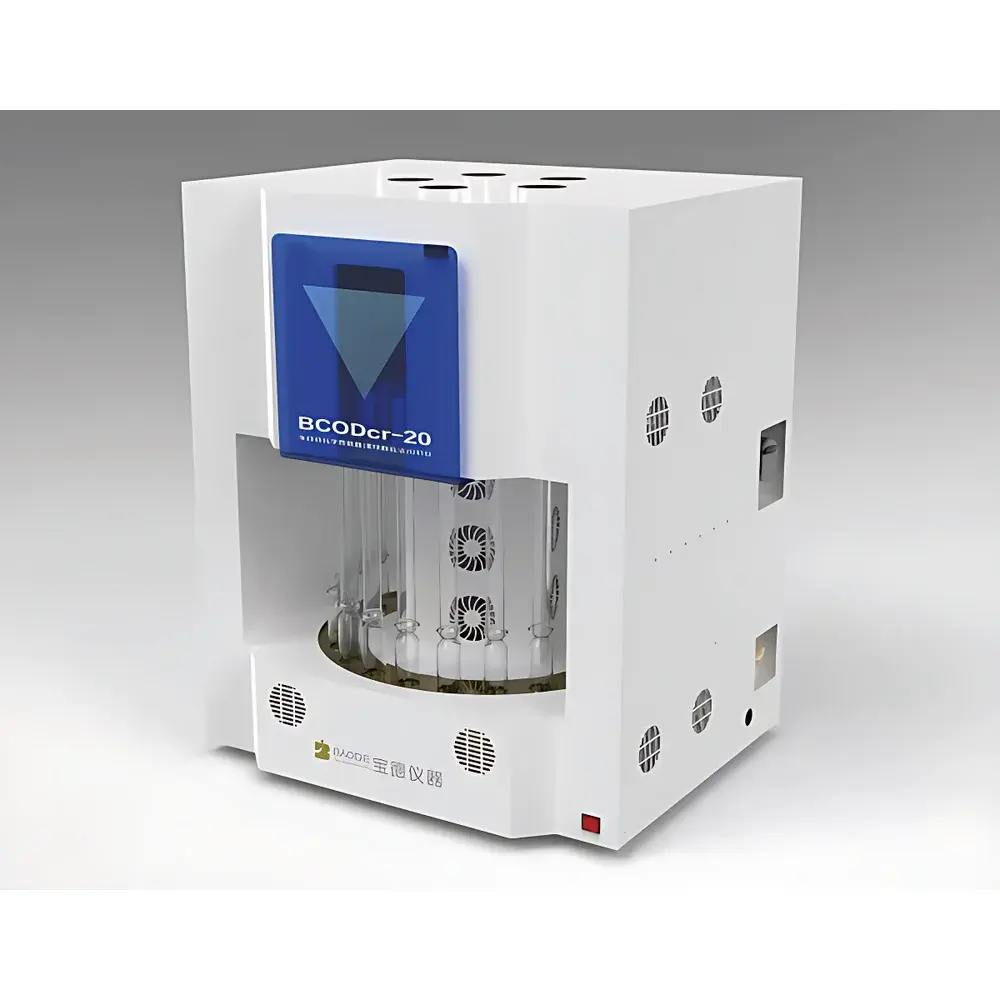
Brookdale BCODcr-20 Automated Chemical Oxygen Demand Analyzer (Dichromate Method)
| Brand | Brookdale |
|---|---|
| Origin | Beijing, China |
| Manufacturer Type | Direct Manufacturer |
| Country of Origin | China |
| Model | BCODcr-20 |
| Pricing | Available Upon Request |
Overview
The Brookdale BCODcr-20 is a fully automated, laboratory-grade Chemical Oxygen Demand (COD) analyzer engineered for precise, standardized determination of COD in aqueous samples using the dichromate oxidation method per Chinese national standard HJ 828–2017. It implements the classical closed-reflux titrimetric principle: under strongly acidic conditions (H₂SO₄), with Ag₂SO₄ as catalyst and HgSO₄ to complex chloride interference, organic matter in the sample reduces a fixed amount of K₂Cr₂O₇. After 2-hour reflux at boiling temperature, residual dichromate is quantified via automated potentiometric or colorimetric endpoint detection during titration with standardized ammonium iron(II) sulfate [(NH₄)₂Fe(SO₄)₂]. The instrument replicates manual wet chemistry protocols with metrological fidelity—eliminating operator variability while maintaining full traceability to reference methods. Its architecture integrates thermal control, liquid handling, endpoint recognition, and calculation logic into a single platform compliant with ISO/IEC 17025 preconditions for routine environmental testing laboratories.
Key Features
- 22-position integrated heating and digestion block with independent temperature control per position, enabling parallel processing of up to 22 samples per batch
- Dedicated, non-digestion-based calibration station for ammonium iron(II) sulfate standardization—ensuring reagent concentration accuracy without compromising throughput
- Modular heating system featuring high-efficiency thermal conduction plates composed of corrosion-resistant, oxidation-stable alloy; delivers uniform heat distribution (±0.5 °C across all positions) and rapid thermal ramping (0–150 °C in <90 s)
- Automated sequential reagent dispensing: HgSO₄ solution → K₂Cr₂O₇ standard solution → Ag₂SO₄–H₂SO₄ mixture → deionized water for dilution → ferroin indicator → (NH₄)₂Fe(SO₄)₂ titrant
- Endpoint detection via dual-mode algorithm combining photometric absorbance tracking at 510 nm and first-derivative inflection analysis—minimizing false positives from turbidity or colored matrices
- Self-diagnostic routines for pump calibration, valve actuation, sensor drift monitoring, and digestion temperature validation—generating audit-ready diagnostic logs
Sample Compatibility & Compliance
The BCODcr-20 accommodates liquid samples with COD concentrations ranging from 10 to 7000 mg/L O₂ (extendable via optional dilution module). It accepts standard 16-mm borosilicate glass digestion tubes (20 mL volume) and supports matrix types including surface water, domestic wastewater, municipal effluent, and industrial discharges with high organic load—e.g., pharmaceutical, textile, pulp & paper, agrochemical, and metallurgical wastewaters. All operational sequences strictly follow HJ 828–2017 procedural requirements, including reflux duration (120 ±2 min), acid concentration (≥9 mol/L H₂SO₄), catalyst dosage (0.4 g Ag₂SO₄ per tube), and chloride masking (HgSO₄ at 10:1 Hg:Cl mass ratio). Data integrity meets GLP and ISO/IEC 17025 documentation requirements; electronic records include timestamped reagent lot numbers, operator ID, digestion temperature profiles, titration curves, and raw absorbance values.
Software & Data Management
The embedded Windows-based control software provides role-based access (Operator, Supervisor, Administrator), configurable method templates, and automatic generation of LIMS-compatible CSV and PDF reports. All analytical data—including intermediate values (initial/final absorbance, titrant volume, blank correction, recovery spikes)—are stored with immutable timestamps and user authentication. Audit trails comply with principles outlined in FDA 21 CFR Part 11 for electronic records and signatures, supporting retrospective review and regulatory inspection. Optional integration with laboratory information management systems (LIMS) is available via ASTM E1384-compliant HL7 or OPC UA interfaces.
Applications
The BCODcr-20 serves as a primary tool for environmental compliance monitoring, wastewater treatment process control, and research-scale biodegradability assessment. It is routinely deployed in municipal wastewater treatment plants for influent/effluent load balancing, in industrial pretreatment verification programs subject to discharge permits (e.g., EPA NPDES or local ecological authority mandates), and in R&D laboratories evaluating oxidation efficiency of advanced treatment technologies (e.g., Fenton, ozonation, electrochemical oxidation). Its dual-range capability allows simultaneous low-COD (10–150 mg/L) and high-COD (150–7000 mg/L) determinations without cross-contamination—critical for facilities managing heterogeneous influent streams.
FAQ
Does the BCODcr-20 support method validation per ISO 8467?
Yes—the instrument enables full validation protocols including precision (repeatability and intermediate precision), trueness (spike recovery across 3 concentration levels), limit of quantification (LOQ), and robustness testing (e.g., ±5 °C digestion temperature variation).
Can it handle high-chloride samples without manual pretreatment?
It automatically adds HgSO₄ in stoichiometric excess relative to measured or estimated chloride content; however, samples exceeding 2000 mg/L Cl⁻ require prior dilution or alternative chloride removal (e.g., AgNO₃ precipitation) per HJ 828–2017 Annex B.
Is remote monitoring and troubleshooting supported?
Yes—via secure HTTPS web interface with real-time status dashboard, live digestion temperature plots, and remote firmware update capability through authenticated SSH tunnel.
What maintenance intervals are recommended?
Daily: rinse fluidic paths with deionized water; weekly: inspect digestion tube seals and clean optical sensor window; quarterly: recalibrate photometer with NIST-traceable neutral density filters and verify titrant delivery accuracy using gravimetric dispensing test.







