
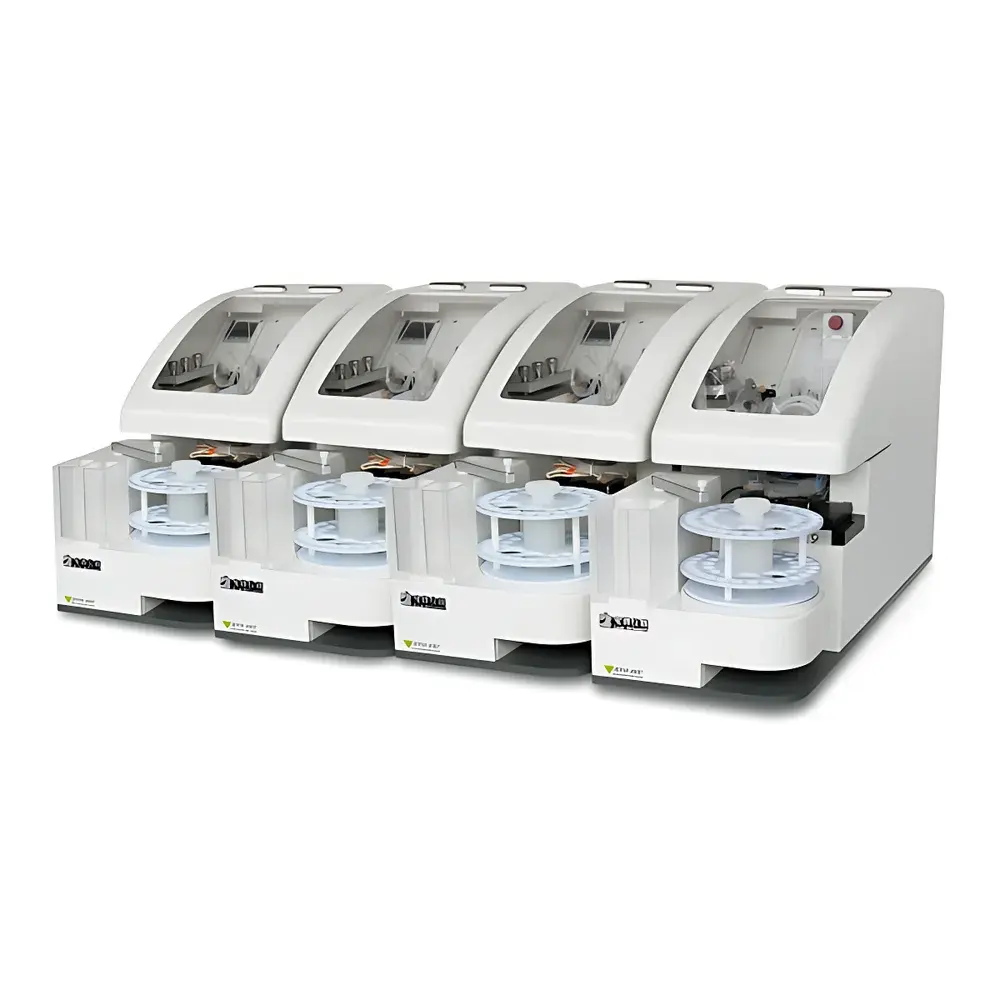
Brookfield BDFIA-8000 Fully Automated Flow Injection Analyzer
| Brand | Brookfield |
|---|---|
| Origin | Beijing, China |
| Manufacturer Type | Original Equipment Manufacturer (OEM) |
| Product Category | Domestic |
| Model | BDFIA-8000 |
| Price | Upon Request |
| Instrument Type | Flow Injection Analyzer |
| Wavelength Range | 200–900 nm |
| Sample Rack Capacity | 10-position or 40-position options |
| Reagent Positions | 11 |
| Flow Cell Path Length | 10 mm |
| Light Source | 5 V Halogen Lamp |
Overview
The Brookfield BDFIA-8000 Fully Automated Flow Injection Analyzer is an integrated, benchtop analytical platform engineered for high-throughput, multi-parameter determination of inorganic and low-molecular-weight organic analytes in environmental, agricultural, food, and industrial matrices. It operates on the principle of flow injection analysis (FIA), wherein discrete sample zones are introduced into a continuous, carrier-stream-driven flow system, followed by precise timing-controlled mixing with reagents, online chemical derivatization (e.g., diazotization, reduction, distillation, UV digestion), and spectrophotometric detection in a fixed-pathlength flow cell. Coupled with ultraviolet–visible (UV–Vis) absorption spectroscopy (200–900 nm), the system enables quantitative measurement of species based on Beer–Lambert law compliance under optimized hydrodynamic and reaction conditions. The BDFIA-8000 implements a fully automated, software-synchronized workflow—from syringe-driven sampling and programmable peristaltic pumping to thermal/phase-transfer-based pretreatment modules (including on-line heating, steam distillation, liquid–liquid extraction, cadmium column reduction, and condensation)—eliminating manual intervention and ensuring inter-run reproducibility across batched analyses.
Key Features
- Integrated channel-based architecture: All core FIA functions—sample aspiration, reagent delivery, reaction manifold control, optical detection, and waste management—are housed within a single compact chassis.
- Modular online pretreatment suite: Supports temperature-regulated digestion (up to 100 °C), steam distillation for volatile phenols and cyanides, solid-phase extraction, cadmium-column reduction for nitrate-to-nitrite conversion, and phase-separation membranes for surfactant or sulfide analysis.
- Programmable dual-sample rack configuration: Accepts either 10 standard 50-mL vials or 40 microtubes (12–15 mL), enabling flexible throughput scaling without hardware modification.
- Dual safety monitoring system: Real-time leak detection via capacitive sensors at critical fluid junctions; overflow alarm triggered by ultrasonic level sensing in the waste reservoir; automatic pump shutdown upon anomaly confirmation.
- Optimized optical detection module: Stable 5 V halogen light source with thermally stabilized output; 10 mm pathlength quartz flow cell; wavelength selection via internal grating monochromator (200–900 nm range); photodiode array detector with 0.5 nm spectral resolution and <±0.3 nm wavelength accuracy.
Sample Compatibility & Compliance
The BDFIA-8000 is validated for aqueous extracts, acid-digested soil leachates, food homogenates, fertilizer solutions, and clarified beverage samples. Its modular chemistry design supports method adaptation compliant with multiple international standard protocols, including ISO 6776 (cyanide), ISO 6878 (phosphate), ISO 11905-1 (total nitrogen), ASTM D1209/D5810 (color, surfactants), EPA Method 354.1 (nitrate/nitrite), and APHA Standard Methods 4500-NH₃ F (ammonia). System operation adheres to GLP principles: audit trails record all method parameters, calibration events, operator logins, and instrument status changes; data files are timestamped and digitally signed to support 21 CFR Part 11 readiness when deployed with validated LIMS integration.
Software & Data Management
Control and data acquisition are managed through proprietary FIA-Studio™ software (v3.2+), running on Windows 10/11 platforms. The interface provides graphical method builder with drag-and-drop valve sequencing, real-time chromatogram visualization, peak integration using tangent skim or Gaussian deconvolution algorithms, and automated calibration curve generation (linear, quadratic, or cubic fit with R² ≥ 0.999). Raw absorbance-time datasets are stored in vendor-neutral .csv and .xlsx formats; processed reports include QC metrics (RSD%, spike recovery %, LOD/LOQ), regulatory metadata headers, and optional PDF export with digital signature fields. Software supports remote diagnostics via encrypted TLS 1.3 connection and scheduled firmware updates over secure HTTPS.
Applications
- Water quality monitoring: Quantification of NH₄⁺, NO₂⁻, NO₃⁻, PO₄³⁻, Cr(VI), CN⁻, phenol, SO₄²⁻, SiO₂, F⁻, BO₃³⁻, and COD surrogate (permanganate index) in drinking water, wastewater effluents, surface/groundwater, and boiler feedwater.
- Soil and plant tissue analysis: Extraction-based determination of available phosphorus, exchangeable cations (Ca²⁺, Mg²⁺), total Kjeldahl nitrogen, and trace anions following EPA 3050B or ISO 11466 protocols.
- Food and beverage testing: Nitrite in cured meats, sulfite in wines, phosphate additives in dairy products, and formaldehyde in seafood preservation screening.
- Agricultural inputs: Total N/P/K profiling in liquid fertilizers; boron and fluoride content verification in micronutrient blends.
FAQ
What regulatory standards does the BDFIA-8000 support for environmental testing?
The system accommodates method configurations aligned with ISO, ASTM, EPA, and APHA standards for over 25 target analytes—including but not limited to cyanide (ISO 6776), orthophosphate (ISO 6878), and total nitrogen (ISO 11905-1). Full validation documentation is provided per ICH Q2(R2) guidelines.
Can the instrument perform simultaneous multi-analyte analysis?
Yes—via sequential channel switching or parallel manifolds (optional upgrade), the BDFIA-8000 achieves concurrent measurement of up to six independent parameters per sample injection cycle, with independent calibration and detection wavelengths assigned per channel.
Is method development supported for non-standard analytes?
Absolutely. The open-access FIA-Studio™ scripting environment allows users to define custom valve actuation sequences, temperature ramp profiles, reagent addition timing, and kinetic measurement windows—enabling adaptation to novel chemistries beyond preloaded methods.
How is data integrity ensured during long unattended runs?
All operational logs, raw detector outputs, and processed results are written to redundant local storage with SHA-256 checksum verification. Power-loss recovery resumes from last stable state without data truncation or method corruption.
What maintenance intervals are recommended for routine operation?
Peristaltic pump tubing requires replacement every 300–500 hours of cumulative runtime; flow cell quartz windows should be inspected quarterly and cleaned with ethanol/isopropanol; halogen lamp lifetime is rated at ≥2,000 hours under thermal regulation.
Related Products







