API Nebula Horizontal Arm Coordinate Measuring Machine
| Brand | API |
|---|---|
| Origin | Sichuan, China |
| Manufacturer Type | Authorized Distributor |
| Origin Category | Domestic (China) |
| Model | Nebula |
| Configuration | Horizontal Arm CMM |
| Operation Mode | Motorized Automatic |
| Application Class | Shop-Floor CMM |
| Measurement Range (X×Y×Z) | 0–10,000 mm |
| Volumetric Accuracy | ±(0.02 + 0.02L) mm, where L is measured length in meters |
Overview
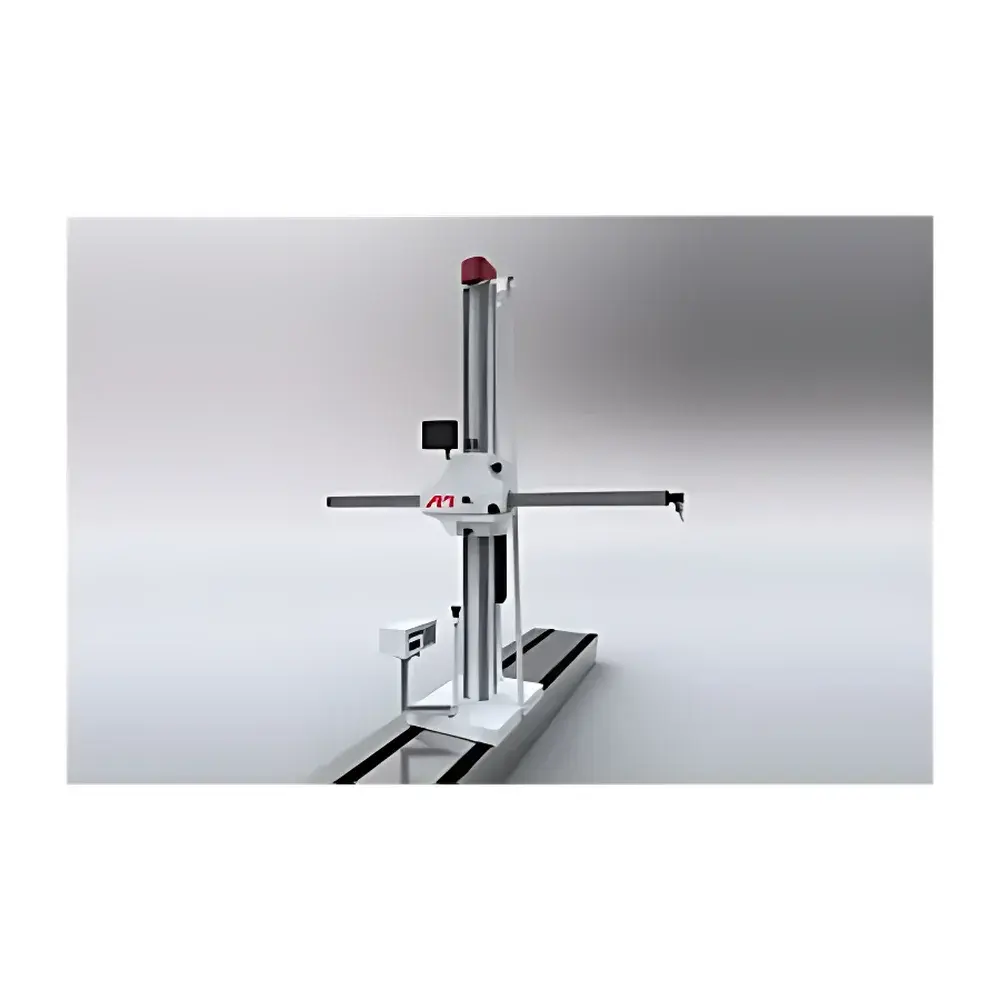
The API Nebula Horizontal Arm Coordinate Measuring Machine (CMM) is an industrial-grade metrology platform engineered for high-repeatability dimensional inspection in production environments. Unlike traditional bridge or gantry CMMs, the Nebula employs a horizontal arm architecture—featuring a cantilevered probe carriage mounted on a rigid, ground-level rail system—optimized for accessibility, large-part measurement, and integration into shop-floor workflows. Its core measurement principle relies on high-resolution linear encoders mounted directly on each axis (X, Y, Z), coupled with real-time spatial error mapping and thermal drift compensation algorithms. The machine operates under ISO 10360-2 (CMM performance verification) and complies with GD&T standards per ASME Y14.5 and ISO 1101, supporting first-article inspection, statistical process control (SPC), and tolerance stack-up analysis across automotive, aerospace, and heavy machinery manufacturing.
Key Features
- Structural stability ensured by primary frame construction using aerospace-grade aluminum alloy or structural steel—subjected to both natural aging (≥12 months) and controlled artificial aging cycles to minimize residual stress and long-term geometric drift.
- High-fidelity linear position feedback via precision optical encoders with sub-micron resolution, enabling traceable length measurement performance aligned with ISO 10012 requirements.
- Base rail system fabricated from either precision-ground granite or stress-relieved cast iron, providing low thermal expansion coefficient (<8 µm/m·°C for granite; <10.5 µm/m·°C for cast iron) and vibration-damping mass essential for shop-floor operation.
- Volumetric error compensation implemented through a 21-parameter kinematic model, correcting for squareness, straightness, pitch/yaw/roll errors, and scale nonlinearity across the full 10 m measurement envelope.
- Integrated thermal management: onboard temperature sensors (at encoder mounts, column, and workpiece level) feed real-time data to a multi-point compensation algorithm compliant with ISO 230-3 Annex B, reducing thermal-induced deviation by up to 65% compared to uncompensated operation.
- Unified controller architecture—motion control, probe interface, and metrology engine co-located within the base enclosure—minimizing signal latency and electromagnetic interference (EMI) susceptibility in electrically noisy factory settings.
Sample Compatibility & Compliance
The Nebula accommodates parts ranging from small machined brackets to fully assembled chassis frames, with unrestricted access along the Y-axis due to its open-side design. It supports tactile probing (via TP20, PH10M, or SP25 modules), optical scanning (with optional laser line or structured light sensors), and non-contact video measurement (with telecentric optics). All measurement routines adhere to ISO/IEC 17025:2017 calibration traceability requirements when operated with certified artifacts and validated software procedures. The system meets CE marking directives (2014/30/EU EMC, 2014/35/EU LVD), and its environmental rating (IP52 per IEC 60529) ensures reliable function in typical industrial ambient conditions (10–40 °C, 30–80% RH, non-condensing).
Software & Data Management
The Nebula is delivered with API’s Metrology Software Suite (v5.2+), a Windows-based application supporting DMIS 4.0 and Q-DAS QDB file export. It includes full GD&T evaluation (position, profile, concentricity, runout), statistical reporting (CPK, PPK, X-bar R charts), and automated report generation compliant with AS9102 and PPAP Level 3 requirements. Audit trail functionality satisfies FDA 21 CFR Part 11 criteria—including electronic signatures, user role-based permissions, and immutable log records—with optional integration into enterprise MES/QMS platforms via OPC UA or RESTful API endpoints.
Applications
- Dimensional verification of welded assemblies, sheet metal stampings, and composite airframe components prior to final machining or bonding.
- In-process validation of CNC-machined molds and dies, including cavity depth, draft angle, and surface curvature against CAD nominal geometry.
- Tooling certification for robotic welding cells—measuring fixture repeatability, locator pin positions, and clamping force alignment.
- Reverse engineering support: dense point-cloud acquisition (up to 10,000 points/sec) for legacy part digitization and tolerance-critical re-design.
- Long-term stability monitoring of production tooling via scheduled automated measurement sequences with trend analysis against baseline reference datasets.
FAQ
What environmental conditions are required for optimal accuracy?
The Nebula is rated for operation between 10–40 °C and 30–80% relative humidity. For volumetric accuracy within specification, ambient temperature must remain stable within ±1 °C/hour, and thermal gradients across the machine structure should not exceed 0.5 °C/m.
Is the system compatible with existing metrology software platforms?
Yes—standard DMIS 4.0 output enables interoperability with PC-DMIS, Calypso, and OpenDMIS. Native drivers are provided for API’s Metrology Suite; third-party integrations require vendor-certified interface modules.
How is traceability maintained during routine calibration?
Calibration follows ISO 10360-2 protocols using certified step gauges, ball bars, and laser interferometers. All calibration events generate timestamped, digitally signed reports stored in the system audit log with full revision history.
Can the Nebula be relocated within a facility without full recalibration?
Relocation requires mechanical re-leveling and verification of rail straightness, followed by a full 21-parameter volumetric compensation update using API’s proprietary calibration sphere array and software wizard—typically completed in under 8 labor hours.
Does the system support automated inspection programming?
Yes—Metrology Suite includes offline programming mode with CAD import (STEP AP214, IGES), feature-based auto-teach, and simulation-driven path optimization to prevent probe collision and ensure measurement sequence robustness.