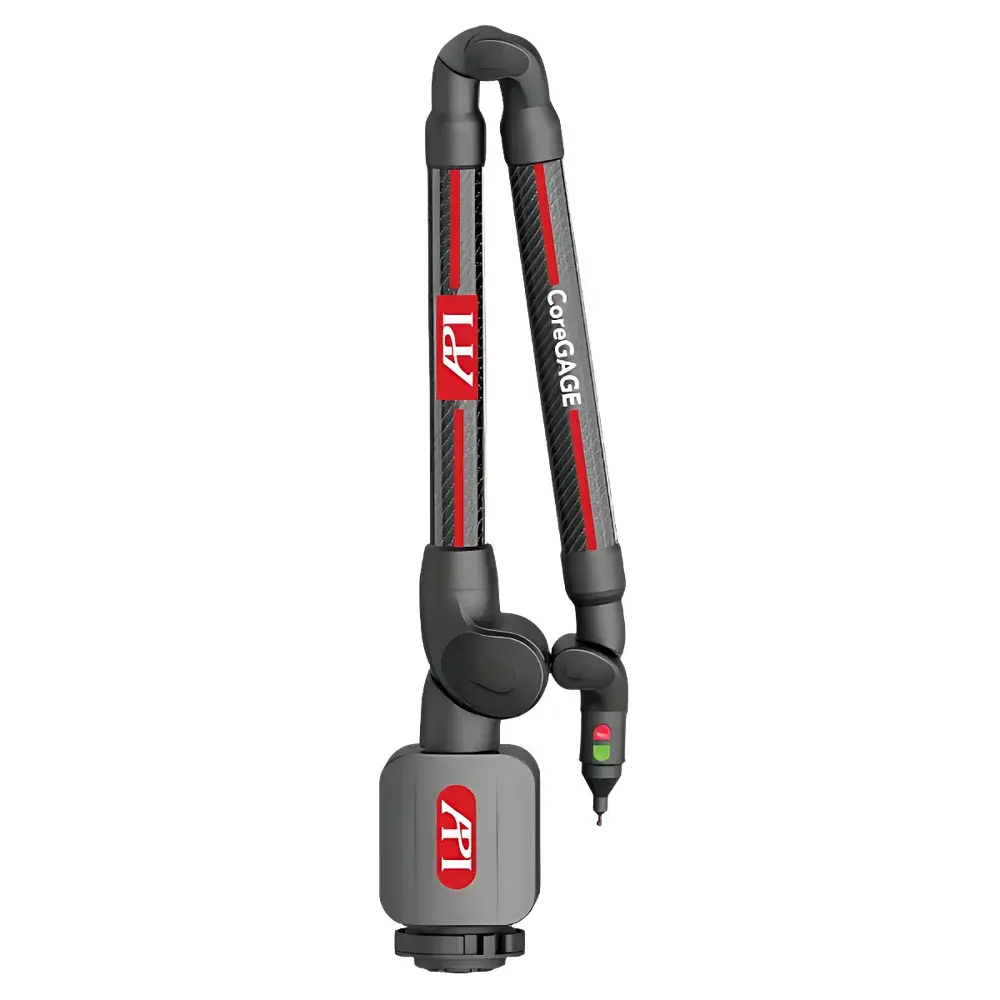
API CoreGAGE Portable Articulated Arm Coordinate Measuring Machine
| Brand | API |
|---|---|
| Origin | USA |
| Manufacturer Type | Authorized Distributor |
| Origin Category | Imported |
| Model | CoreGAGE |
| Configuration | Articulated Arm CMM |
| Operation Mode | Manual |
| Form Factor | Portable |
| Measurement Method | Hybrid Contact & Non-Contact (Tactile Probe + Laser Line Scanner) |
| Measurement Volume Range | 2.0 m to 5.5 m (configurable by arm length) |
| Volumetric Accuracy | ±0.027 mm (ISO 10360-2 compliant) |
| Maximum Data Acquisition Rate | 1,200,000 points/sec |
| Standard Operating Temperature | 5 °C to 45 °C |
| Laser Line Probe (HDSD) | Accuracy ±15 µm (2σ, near-field), ±28 µm (2σ, far-field) |
| Laser Line Probe Baseline Distance | 115 mm |
| Effective Scan Width | 80 mm (near-field) / 150 mm (far-field) |
| Points per Scan Line | Up to 4,000 |
| Laser Class | Class 2 |
| HDSD Probe Weight | 536 g |
| Arm Material | Aerospace-Grade Carbon Fiber |
| Integrated Balancing System | Yes |
| Battery Life | >10 hours (dual high-capacity Li-ion) |
| Wireless Data Transmission | IEEE 802.11ac Wi-Fi |
Overview
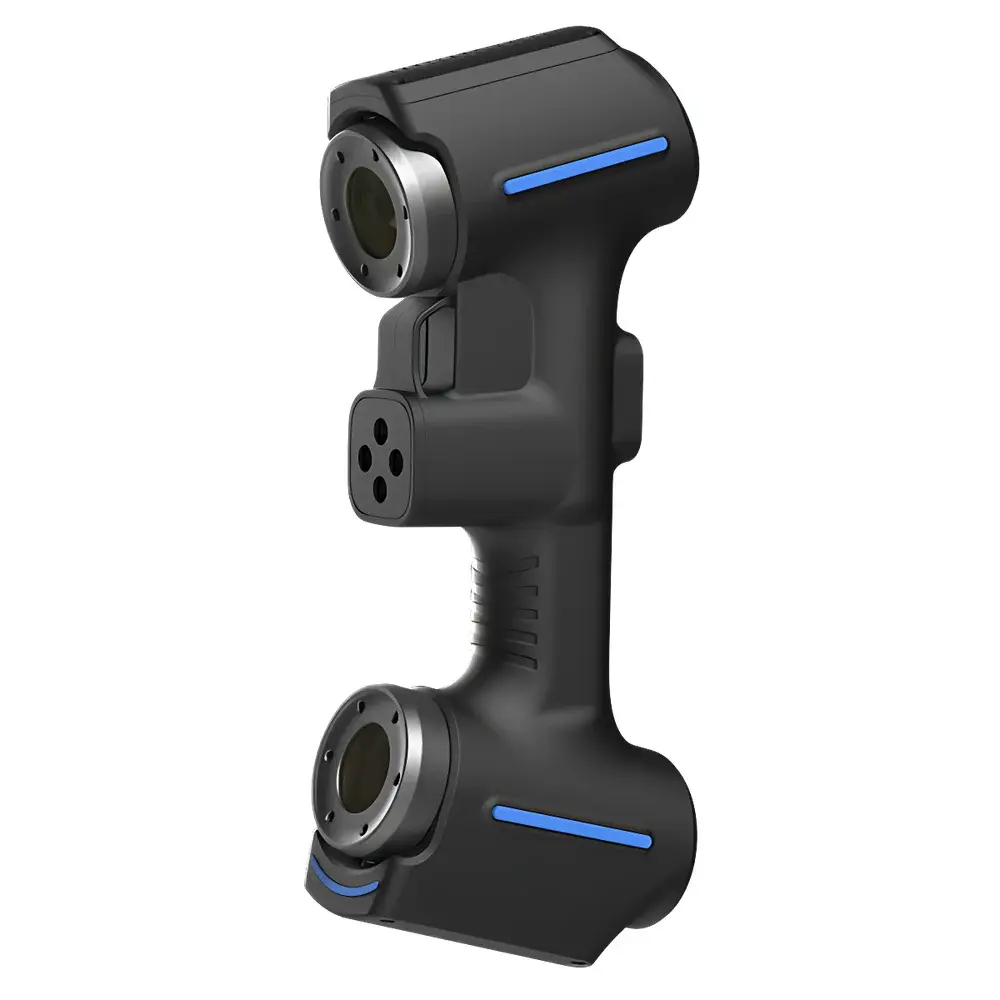
The API CoreGAGE is a high-performance, portable articulated arm coordinate measuring machine (CMM) engineered for precision geometric metrology in dynamic industrial environments. Unlike traditional fixed-base CMMs, the CoreGAGE leverages a kinematically optimized 6- or 7-axis serial linkage architecture with real-time joint-angle encoding and temperature-compensated encoders to deliver traceable volumetric accuracy of ±0.027 mm across its full measurement envelope (2.0–5.5 m). Its hybrid measurement capability integrates tactile probing—using interchangeable touch-trigger or scanning probes—with non-contact laser line scanning via the optional HDSD (High Definition Scanning Device) module. This dual-mode architecture enables seamless transition between feature-based GD&T verification (e.g., position, concentricity, profile per ASME Y14.5) and dense surface digitization for reverse engineering, tooling validation, and first-article inspection. Designed for ISO 10360-2 compliance and compatible with GLP/GMP documentation workflows, the CoreGAGE meets the metrological rigor required in aerospace, automotive Tier-1 manufacturing, energy equipment fabrication, and medical device production.
Key Features
- Integrated Kinematic Balancing System: Patented internal counterbalance mechanism ensures consistent torque response and measurement stability across all arm configurations—including overhead, inverted, or extended poses—eliminating operator-induced drift and enhancing repeatability.
- Aerospace-Grade Carbon Fiber Construction: The arm structure utilizes unidirectional carbon fiber composites with thermally matched resin systems, achieving a stiffness-to-weight ratio exceeding 120 GPa·cm³/kg while maintaining dimensional stability within ±1.5 µm/m/°C across the 5–45 °C operating range.
- Dual High-Capacity Battery System: Redundant lithium-ion battery packs support continuous operation for over 10 hours without tethering, enabling uninterrupted shop-floor inspections, field metrology audits, and mobile quality control deployments.
- IEEE 802.11ac Wi-Fi Real-Time Data Streaming: Synchronized point-cloud and probe-event data are transmitted at sub-50 ms latency to host metrology software, supporting live deviation mapping, statistical process monitoring (SPC), and on-the-fly report generation.
- Modular Hybrid Sensor Interface: Standardized mechanical and electrical interfaces allow rapid swapping between tactile probes (including SP25M scanning modules) and the HDSD laser line scanner—enabling single-setup execution of both discrete feature inspection and full-surface capture.
Sample Compatibility & Compliance
The CoreGAGE accommodates a broad spectrum of part geometries—from small machined components (≥5 mm features) to large-scale assemblies such as turbine casings, composite fuselage sections, and wind turbine blades. Its open architecture supports ASTM E1392-compliant calibration protocols and is validated against ISO 10360-2 Annex B for volumetric performance assessment. When configured with NIST-traceable artifacts and operated under controlled environmental conditions (per ISO 14253-1), measurement uncertainty budgets comply with ISO/IEC 17025 requirements for accredited calibration laboratories. All firmware and embedded motion controllers adhere to IEC 61508 SIL2 functional safety standards, and audit trails meet FDA 21 CFR Part 11 electronic record integrity criteria when used with compliant metrology software platforms.
Software & Data Management
The CoreGAGE operates natively with API’s Metrology Software Suite (v7.2+), which provides full GD&T evaluation per ASME Y14.5–2018 and ISO 1101, automated alignment routines (RPS, best-fit, iterative), and multi-sensor fusion algorithms that co-register tactile and laser scan data into unified CAD-based deviation models. Raw point clouds are exported in industry-standard formats (ASCII XYZ, STL, IGES, STEP AP214) and support direct integration with PolyWorks, Geomagic Control X, and Verisurf via certified API SDKs. All measurement sessions generate immutable digital logs—including encoder raw values, thermal sensor readings, probe ID, operator credentials, timestamp, and environmental metadata—enabling full traceability for internal audits and regulatory submissions.
Applications
- Aerospace structural assembly verification (wing spar alignment, winglet fit-up, engine mount positioning)
- Automotive body-in-white (BIW) dimensional analysis and fixture validation
- Large-part first-article inspection (castings, forgings, additive-manufactured components)
- Tooling and mold verification—including die face matching and shrinkage analysis
- Reverse engineering of legacy parts lacking CAD documentation
- On-site calibration of CNC machine tools and robotic workcells
FAQ
Is the CoreGAGE certified for ISO 10360-2 volumetric accuracy verification?
Yes—the CoreGAGE is supplied with factory certification per ISO 10360-2 Annex B, including MPE (Maximum Permissible Error) test reports generated using certified ball bars and step gauges traceable to NIST.
Can the HDSD laser scanner be used simultaneously with a tactile probe?
No—sensor modes are mutually exclusive at runtime; however, measurement programs can interleave tactile and laser operations within a single inspection routine, with automatic coordinate system registration between modalities.
What environmental monitoring is required during operation?
Ambient temperature must remain within 5–45 °C; optional integrated air temperature and humidity sensors (API ENV-2) provide real-time compensation inputs to the metrology engine for enhanced thermal error correction.
Does the CoreGAGE support automated reporting for quality documentation?
Yes—Metrology Software Suite includes configurable report templates compliant with PPAP Level 3, AIAG CQI-9, and internal quality management system (QMS) requirements, with digital signatures and PDF/A-2 archival export.