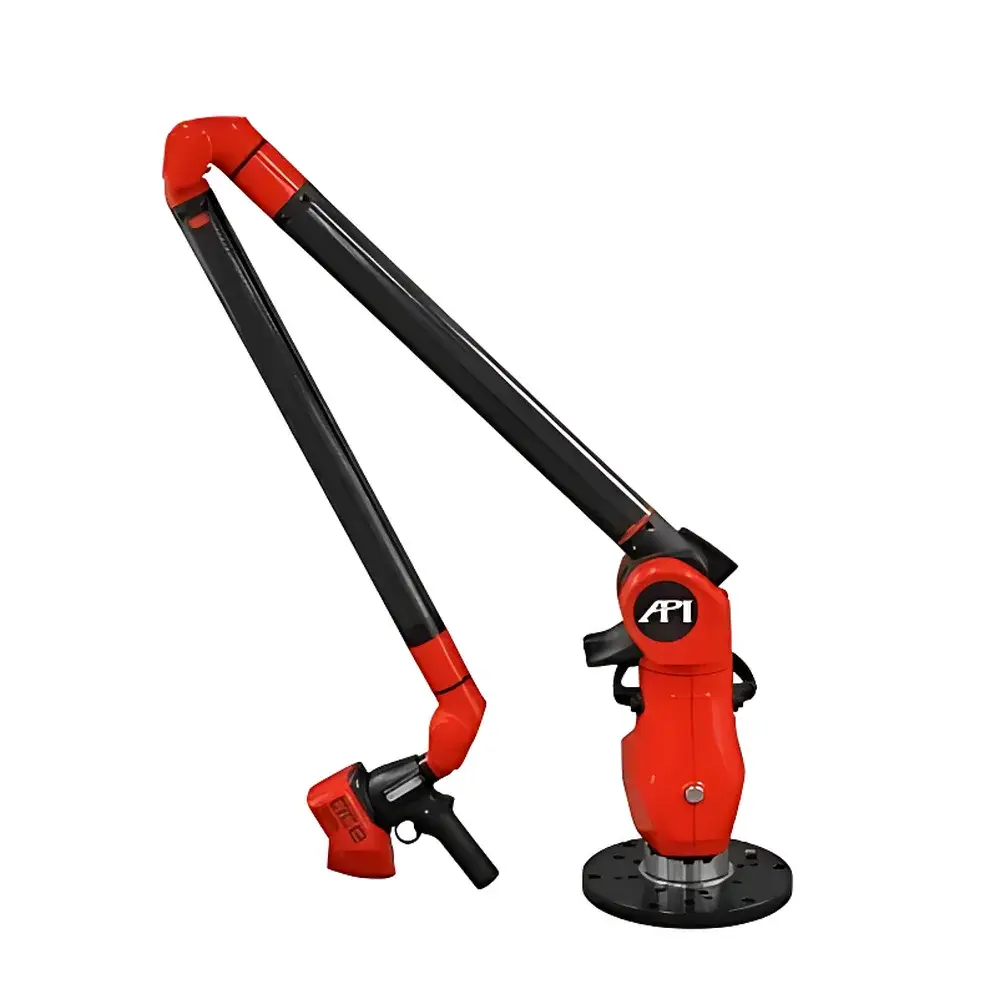
API ARM Portable Articulated Arm Coordinate Measuring Machine
| Origin | USA |
|---|---|
| Manufacturer Type | Authorized Distributor |
| Origin Category | Imported |
| Model | API ARM |
| Price Range | USD 42,000 – 70,000 (FOB) |
| Configuration | Articulated Arm CMM |
| Operation Mode | Manual |
| Form Factor | Portable |
| Measurement Volume | 2.0 m – 4.5 m (configurable arm length) |
| Volumetric Accuracy | ±0.032 mm |
| Operating Temperature Range | 10 °C – 45 °C |
Overview
The API ARM Portable Articulated Arm Coordinate Measuring Machine is an ISO/IEC 17025-aligned precision metrology system engineered for high-accuracy geometric measurement in production floors, aerospace assembly bays, automotive body shops, and field service environments. Based on the principle of kinematic chain metrology—where each joint’s angular position is resolved via high-resolution absolute encoders and fused using forward kinematics—the ARM delivers traceable 3D coordinate data with volumetric uncertainty certified to ±0.032 mm across its full working volume. Unlike traditional bridge-type or gantry CMMs, the ARM eliminates the need for fixed foundations or climate-controlled labs; its self-contained architecture enables rapid deployment and real-time dimensional verification directly at the point of manufacture or maintenance.
Key Features
- Lightweight carbon-fiber articulated structure—optimized stiffness-to-weight ratio ensures thermal stability and mechanical repeatability under dynamic handling
- Ergonomic, self-balancing handle with tactile feedback controls and integrated trigger—designed for extended operator use without fatigue or positional drift
- Onboard rechargeable lithium-ion battery (up to 8 hours continuous operation) and dual-mode wireless connectivity (Wi-Fi 5 + Bluetooth 5.0) for seamless integration with shop-floor networks
- Real-time environmental compensation: built-in temperature sensor (±0.1 °C resolution) and optional barometric/humidity modules enable automatic thermal drift correction per ISO 10360-2 and VDI/VDE 2617 Part 9
- Modular arm configurations: selectable lengths of 2.0 m, 2.5 m, 3.0 m, 3.5 m, and 4.5 m—each calibrated to NIST-traceable standards and supplied with individual certificate of calibration (ISO 17025 accredited)
- Multi-sensor compatibility: supports contact probing (standard ruby-tipped styli), non-contact laser line scanners (e.g., API RPS series), and photogrammetric targets for hybrid measurement workflows
Sample Compatibility & Compliance
The API ARM accommodates a broad spectrum of industrial parts—from large sheet-metal assemblies and composite airframe components to precision-machined turbine housings and injection-molded medical device housings. Its open-volume workspace permits measurement of objects exceeding arm length via repositioning and datum registration, supported by robust best-fit alignment algorithms (RANSAC + iterative closest point). The system complies with ISO 10360-2 (CMM performance verification), ASME B89.4.10M (articulated arm CMM specifications), and meets essential requirements of EU Machinery Directive 2006/42/EC. For regulated industries, audit-ready data export formats (XML, CSV, STEP AP214) and optional 21 CFR Part 11-compliant software modules support GLP/GMP validation protocols.
Software & Data Management
The ARM operates natively with API’s Metrology Software Suite (v8.x), a Windows-based platform supporting GD&T evaluation per ASME Y14.5–2018 and ISO 1101. Key capabilities include real-time probe path visualization, automated feature recognition (planes, cylinders, cones, spheres), statistical process control (SPC) charting with Cp/Cpk calculation, and customizable reporting templates compliant with internal QA documentation standards. All measurement sessions are timestamped, user-authenticated, and stored with full metadata (environmental logs, calibration status, probe configuration)—enabling full traceability for internal audits or FDA/EMA inspections. Data exports support direct import into common PLM systems (Teamcenter, Windchill) and statistical analysis tools (Minitab, JMP).
Applications
- Aerospace: Tooling verification, wing spar contour inspection, fastener hole pattern validation on composite fuselage sections
- Automotive: Body-in-white gap-and-flush analysis, die tryout validation, powertrain component dimensional release testing
- Energy: Offshore wind turbine blade root geometry verification, nuclear valve seat concentricity checks
- Medical Device Manufacturing: Dimensional release of Class II orthopedic implant fixtures and surgical robot end-effector housings
- Education & Research Labs: Teaching kinematic modeling, reverse engineering of legacy parts, and metrology method validation studies
FAQ
What standards does the API ARM comply with for accuracy verification?
The system adheres to ISO 10360-2 for volumetric performance testing and ASME B89.4.10M for articulated arm CMM specification—certification reports include length measurement error (LME), probing error (PFORM), and scanning error (SFORM) as defined in these standards.
Can the ARM be used in uncontrolled factory environments?
Yes—its integrated thermal compensation, wide operating temperature range (10–45 °C), and vibration-damped base mount enable reliable operation on concrete floors, near CNC machines, and within vehicle assembly lines without dedicated metrology rooms.
Is probe calibration required before each measurement session?
No—API’s QuickCal™ routine validates probe tip geometry and orientation in under 90 seconds using a certified reference sphere; full recalibration is recommended every 6 months or after impact events, per ISO 17025 guidelines.
Does the ARM support automated reporting for quality audits?
Yes—Metrology Software Suite generates PDF/HTML reports with embedded traceability data, digital signatures, revision history, and compliance statements aligned with IATF 16949 clause 8.5.1 and ISO 9001:2015 section 8.2.4.
How is measurement uncertainty communicated to end users?
Each unit ships with a manufacturer-issued ISO 17025-accredited calibration certificate listing expanded uncertainty (k=2) for volumetric error, angular encoder resolution, and thermal coefficient of expansion—values are referenced to NIST SRM 2036 and validated per EURAMET cg-19 guidelines.