
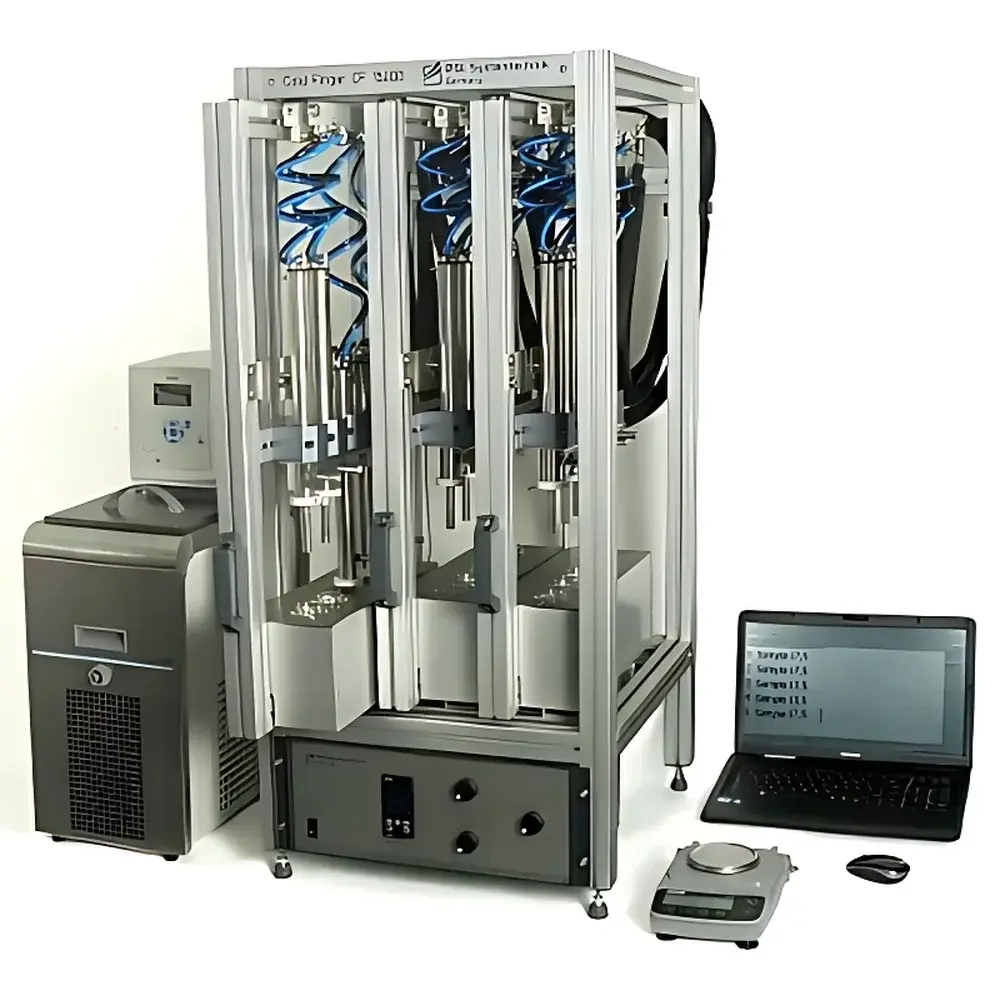
PSL CF 15200 Wax Content Analyzer for Crude Oil
| Origin | Germany |
|---|---|
| Manufacturer Type | Authorized Distributor |
| Origin Category | Imported |
| Model | CF 15200 |
| Quotation | Upon Request |
| Cold Finger Temperature Range | –10 °C to 80 °C |
| Heating Bath Temperature Range | 30 °C to 200 °C |
| Number of Test Units | 15 (arranged in 3 independently controlled aluminum frames) |
| Sample Volume per Unit | up to 75 mL |
| Stirring Speed | 0 or 100–200 RPM |
| Mass Measurement Resolution | 0.01 g |
Overview
The PSL CF 15200 Wax Content Analyzer is a precision-engineered instrument designed specifically for quantitative determination of wax content and wax appearance temperature (WAT) in crude oil and waxy petroleum fractions. It operates on the principle of cold finger crystallization—where a thermally controlled metal probe (the “cold finger”) is immersed into a heated, agitated crude oil sample under precisely defined thermal and hydrodynamic conditions. As the cold finger surface cools below the wax appearance temperature, paraffinic hydrocarbons nucleate and deposit as solid wax crystals. The mass gain on the cold finger is measured gravimetrically at predefined time intervals, enabling calculation of dynamic wax deposition rate, total wax content, and WAT. This method aligns with established laboratory practices referenced in ASTM D7153 (Standard Test Method for Determination of Wax Appearance Temperature by Cold Finger Technique) and supports routine QC, flow assurance studies, and inhibitor evaluation in upstream and refining laboratories.
Key Features
- Fifteen parallel test units organized into three independently programmable aluminum frames—each frame supports individual setpoints for cold finger temperature and stirring speed.
- Dual-range heating bath options: standard configuration (30 °C to 120 °C) or high-temperature variant (30 °C to 200 °C), accommodating heavy crudes and high-viscosity fractions requiring elevated operating temperatures.
- Cold finger temperature control from –10 °C to +80 °C with high stability (< ±0.2 °C), ensuring reproducible nucleation onset across repeated runs.
- Gravimetric measurement system with 0.01 g resolution, integrated into each test station to capture real-time wax mass accumulation without manual intervention.
- Programmable stirring: zero-speed (static deposition) or adjustable rotational speed from 100 to 200 RPM—enabling simulation of varying shear conditions relevant to pipeline transport and downhole flow.
- Modular mechanical design with quick-release frame lowering mechanism for safe, repeatable immersion and retrieval of cold fingers into the thermal bath.
Sample Compatibility & Compliance
The CF 15200 accommodates crude oils, blended crudes, and stabilized condensates with API gravity ranging from 10° to 45°, including samples containing asphaltenes and resins that influence wax crystallization kinetics. Each test unit accepts up to 75 mL of sample, minimizing reagent consumption while maintaining representative phase behavior. The system complies with key industry standards governing wax analysis, including ASTM D7153 and ISO 16987 (Petroleum products — Determination of wax appearance temperature — Cold finger method). Its architecture supports GLP-compliant operation through configurable audit trails, user access levels, and electronic signature support when paired with validated PSL control software. All wetted surfaces are constructed from corrosion-resistant stainless steel and anodized aluminum, ensuring long-term compatibility with sulfur-containing and acidic crude streams.
Software & Data Management
The instrument is operated via PSL’s proprietary Windows-based control suite, which provides full automation of temperature ramping, stirring profiles, data logging, and report generation. Each test sequence is defined using a structured protocol template—including cold finger setpoint, bath temperature, agitation profile, weighing interval, and duration. Raw mass vs. time datasets are stored in secure, timestamped binary files (.pslbin), exportable to CSV or Excel for further statistical analysis. The software enforces 21 CFR Part 11 compliance features including role-based login, electronic signatures for method validation, and immutable audit logs tracking all parameter changes and measurement events. Data integrity is preserved through automatic backup and checksum verification upon file closure.
Applications
- Quantitative wax content determination per ASTM D7153 for custody transfer and refinery feedstock specification.
- Dynamic wax deposition rate profiling under simulated pipeline shear conditions (e.g., 150 RPM at 45 °C bath temperature).
- Screening and dose-response evaluation of wax inhibitors—including polymeric pour point depressants and dispersants—via parallel testing of multiple formulations or concentration gradients.
- Wax appearance temperature (WAT) mapping across temperature ramps to support thermal management strategies in subsea production systems.
- Investigation of wax crystal morphology evolution using post-test cold finger imaging (compatible with SEM or optical microscopy after solvent rinsing).
- Method development and inter-laboratory comparison studies requiring high inter-unit reproducibility (CV < 2.1% for replicate WAT measurements).
FAQ
What standards does the CF 15200 comply with?
The system is designed to meet ASTM D7153 and ISO 16987 requirements for cold finger–based wax analysis. Optional IQ/OQ documentation packages are available for GxP environments.
Can the CF 15200 be used for inhibited crude screening?
Yes—the 15-unit architecture enables simultaneous evaluation of up to 15 different inhibitor candidates or concentration levels, with independent temperature and shear control per group of five units.
Is calibration traceable to national standards?
Temperature sensors are factory-calibrated against NIST-traceable references; optional annual recalibration services include certificate of calibration with uncertainty budget.
How is sample cross-contamination prevented between runs?
Each cold finger is cleaned in situ using automated solvent flush cycles (e.g., toluene or xylene), followed by nitrogen purge. The aluminum frames are removable for manual inspection and ultrasonic cleaning.
Does the system support unattended overnight operation?
Yes—fully automated sequences with programmable start/stop times, alarm-triggered shutdown (e.g., bath overtemperature), and email notifications ensure robust 24/7 operation in core labs.





