
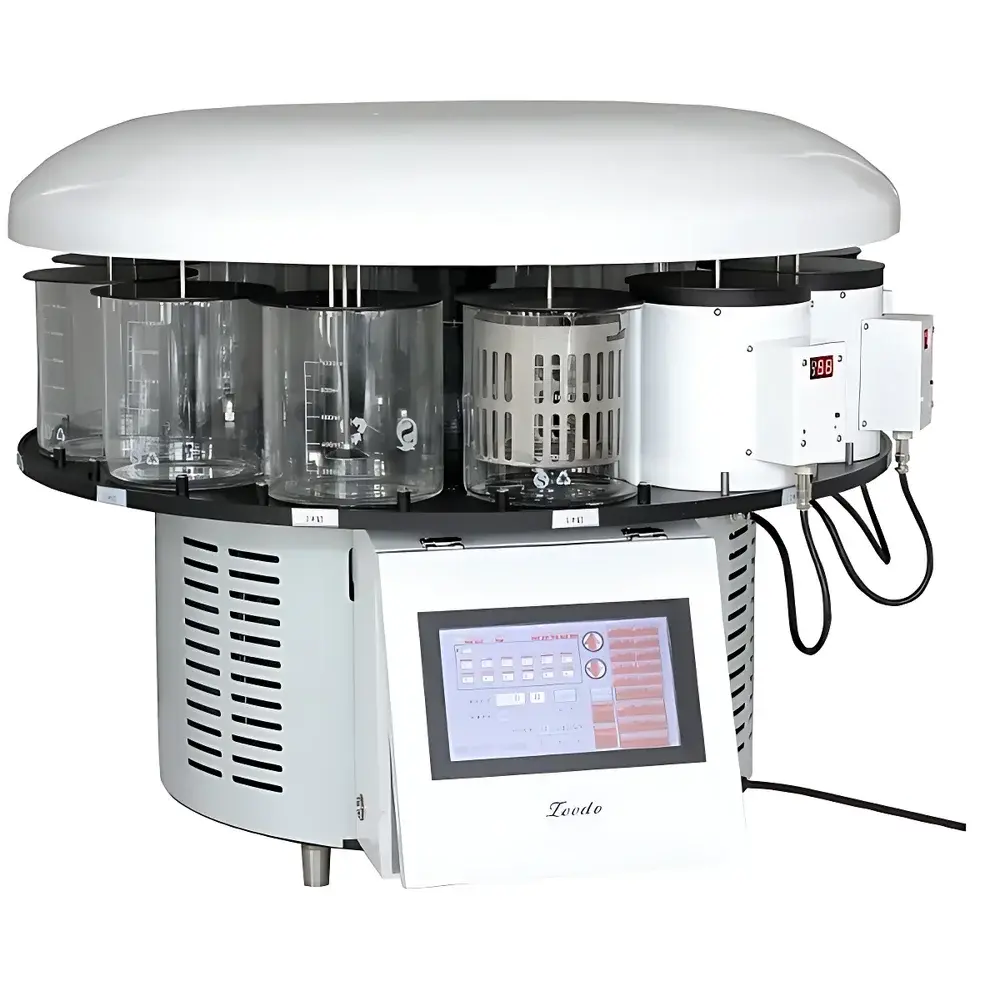
ZEEDO HS-566 Circular Vacuum Tissue Dehydrator
| Origin | Zhejiang, China |
|---|---|
| Manufacturer Type | Authorized Distributor |
| Product Origin | Domestic (PRC) |
| Model | HS-566 |
| Price Range | USD 7,000 – 14,000 |
| Tissue Processing Stages | 12 |
| Solvent Stations | 9 × 1.2 L |
| Paraffin Stations | 3 × 1.0 L |
| Temperature Control Range | 45–85 °C (±3 °C) |
| Per-Station Timer | 0–999 min |
| Delay Start | 0–999 min |
| Vacuum Level | ≤0.053 MPa |
| Agitation Frequency | 3 cycles/min |
| Basket Dimensions | Φ95 × 80 mm (cylindrical & tiered) |
| Net Weight | ~60 kg |
| External Dimensions | 670 × 550 × 680 mm |
| Power Supply | AC 220 V, 50 Hz |
| Rated Power | 500 W |
| Operating Environment | +5–40 °C, RH <85% (at 20±5 °C) |
Overview
The ZEEDO HS-566 Circular Vacuum Tissue Dehydrator is an automated, microprocessor-controlled instrument engineered for standardized histological tissue processing in pathology laboratories. It implements a sequential solvent exchange protocol—typically ethanol, xylene, and molten paraffin—under controlled thermal and vacuum conditions to replace water with infiltration-compatible media. The device operates on the principle of vacuum-assisted diffusion enhancement: by reducing ambient pressure within individual processing chambers, vapor pressure differentials accelerate solvent penetration and water removal from fixed biological specimens (e.g., formalin-fixed, paraffin-embedded tissues). This significantly shortens total processing time while maintaining morphological integrity and minimizing artifacts such as shrinkage or nuclear distortion. Designed for routine clinical diagnostics, academic research, and preclinical study workflows, the HS-566 complies with foundational principles outlined in CAP (College of American Pathologists) Laboratory Accreditation Checklists and aligns with ISO 15189 requirements for preanalytical process control in medical laboratories.
Key Features
- Twelve-stage programmable workflow with independent timer settings per station (0–999 minutes), enabling full customization of dehydration, clearing, and infiltration protocols.
- Nine transparent 1.2 L borosilicate glass solvent reservoirs allow real-time visual monitoring of tissue immersion status and reagent clarity—critical for quality assurance and troubleshooting.
- Three independently temperature-regulated paraffin stations (45–85 °C, ±3 °C accuracy) feature oxidized interior surfaces to prevent wax residue buildup and cross-contamination between batches.
- Vacuum functionality is configurable per station: users may activate vacuum only during critical phases (e.g., xylene clearing or final paraffin infiltration) to optimize tissue integrity without unnecessary mechanical stress.
- Mechanical agitation at 3 cycles per minute ensures uniform reagent contact across heterogeneous tissue types—including dense fibrous samples and delicate neural tissues—without requiring manual intervention.
- Integrated safety architecture includes power-failure memory retention, emergency tissue preservation mode (automatically relocates baskets to protective ethanol), and obstruction detection that halts motion if basket movement is impeded.
- Intuitive LCD interface displays all operational parameters in English; supports up to 10 user-defined protocols with delay-start capability up to 999 minutes (16.6 hours), facilitating overnight or staggered batch processing.
Sample Compatibility & Compliance
The HS-566 accommodates standard histology cassettes (e.g., Leica, Sakura) placed in either cylindrical or tiered Φ95 × 80 mm baskets, supporting simultaneous processing of up to 36 specimens per cycle depending on cassette density. It is validated for human and veterinary soft-tissue biopsies, surgical resections, and experimental animal tissues (murine, porcine, bovine). All fluid-contact components meet USP Class VI biocompatibility standards for diagnostic use. While not FDA-cleared as a Class II medical device, the system adheres to GLP-aligned documentation practices: audit trails for program edits, timestamped run logs, and parameter lockout options support laboratory compliance with CAP, CLIA, and ISO/IEC 17025 requirements. Vacuum performance (≤0.053 MPa absolute) satisfies ASTM E1228-17 guidelines for vacuum-assisted tissue processing equipment validation.
Software & Data Management
The HS-566 operates via embedded firmware with no external PC dependency. All program configurations—including stage sequence, temperature setpoints, agitation timing, and vacuum activation flags—are stored in non-volatile memory with checksum verification. Each completed run generates a timestamped log file (exportable via USB port) containing start/stop times, actual temperatures per station, vacuum status history, and error codes (e.g., “T1_Temp_OutOfRange”, “VAC_Pump_Failure”). These logs are structured in CSV format for integration into LIMS environments or internal QA databases. Optional firmware updates—distributed through authorized ZEEDO service partners—include enhanced alarm categorization (warning vs. critical), expanded protocol versioning, and improved thermal ramp profiling for sensitive embryonic or lipid-rich tissues.
Applications
- Routine diagnostic histopathology: high-throughput processing of biopsy specimens in hospital labs with >50 daily cases.
- Academic research: reproducible preparation of tissue blocks for immunohistochemistry (IHC), in situ hybridization (ISH), and digital pathology scanning.
- Toxicology and drug development: standardized processing of rodent organ tissues across multi-site preclinical studies to ensure inter-laboratory comparability.
- Botanical and veterinary pathology: adaptation of protocols for lignified plant sections or avian/fish tissues with modified dehydration kinetics.
- Education: hands-on training in histotechnique fundamentals, emphasizing vacuum effects on diffusion rates and artifact mitigation strategies.
FAQ
What vacuum level does the HS-566 achieve, and how is it measured?
The system maintains ≤0.053 MPa (absolute) vacuum using an oil-free diaphragm pump; measurement is performed via integrated piezoresistive pressure transducer calibrated traceably to NIST standards.
Can I run different protocols simultaneously on separate baskets?
No—the HS-566 executes one global program per cycle; however, basket positioning allows selective exposure (e.g., placing fragile samples only in ethanol/xylene stations while omitting harsher solvents).
Is remote monitoring or network connectivity supported?
Not natively; the device lacks Ethernet/Wi-Fi interfaces. Remote status checks require physical access or integration via third-party environmental monitoring systems using dry-contact relay outputs.
How often must the vacuum pump oil be changed?
The oil-free design eliminates routine oil maintenance; periodic inspection of intake filters and replacement every 12 months under continuous operation is recommended.
Does the HS-566 comply with FDA 21 CFR Part 11 for electronic records?
It does not provide Part 11-compliant audit trails (e.g., electronic signatures, immutable logs); however, exported CSV logs may be archived within a validated LIMS that meets those requirements.
Related Products




